Ruomeng Chen, Kun Zhang, Hui Liu, Lijuan Liu, Hui Li, Yan Yan, Zhou Zhou, Chaoyue Meng, Xuelin Wang, Haoran Wu, Ruihan Miao, Rui Wang, Xiaoyun Liu
{"title":"Association of Butyryl Cholinesterase and Recurrent Ischemic Stroke: A Cross-Sectional Study.","authors":"Ruomeng Chen, Kun Zhang, Hui Liu, Lijuan Liu, Hui Li, Yan Yan, Zhou Zhou, Chaoyue Meng, Xuelin Wang, Haoran Wu, Ruihan Miao, Rui Wang, Xiaoyun Liu","doi":"10.2147/IJGM.S509543","DOIUrl":null,"url":null,"abstract":"<p><strong>Objective: </strong>Exploring novel relevant factors associated with recurrent ischemic stroke.</p><p><strong>Methods: </strong>This is a retrospective study, patients were divided into first-ever ischemic stroke group and recurrent ischemic stroke groups. We conducted a comparative analysis of baseline data between the two groups. Multifactorial logistic regression analysis was performed to identify factors associated with recurrent ischemic stroke. Grouped according to butyryl cholinesterase levels, to elucidate the relationship between butyryl cholinesterase levels and stroke recurrence.</p><p><strong>Results: </strong>A total of 2029 patients were included, with 1174 in the first-ever ischemic stroke group and 855 in the recurrent ischemic stroke group. Age, hypertension, diabetes, alanine aminotransferase, and lipoprotein(a) were identified as risk factors for recurrent ischemic stroke (ALL <i>p</i><0.05). Erythrocyte count, butyryl cholinesterase, low-density lipoprotein, and non-atherosclerotic type of large arteries were found to be negative associated with recurrent ischemic stroke (ALL <i>p</i><0.05). Subgroup analyses indicated that butyryl cholinesterase levels were significantly negatively associated with recurrent ischemic stroke in males (OR=0.814, <i>p</i><0.001, 95% CI: 0.761 ~ 0.871), especially under 60 years (OR=0.781, <i>p</i><0.001, 95% CI: 0.708 ~ 0.862). After adjusting for multifactorial regression analyses, the recurrent rate in the lowest quartile of butyryl cholinesterase levels was 2.281 times that of the highest quartile (OR=2.281, <i>p</i><0.05, 95% CI: 1.318 ~ 3.948).</p><p><strong>Conclusion: </strong>Age, hypertension, diabetes, alanine aminotransferase, and lipoprotein(a) are independent risk factors for the recurrence of ischemic stroke. The inverse association between butyryl cholinesterase levels and stroke recurrence suggests butyryl cholinesterase may serve as a potential target for therapeutic intervention to improve the prognosis of ischemic stroke.</p>","PeriodicalId":14131,"journal":{"name":"International Journal of General Medicine","volume":"18 ","pages":"1709-1720"},"PeriodicalIF":2.0000,"publicationDate":"2025-03-26","publicationTypes":"Journal Article","fieldsOfStudy":null,"isOpenAccess":false,"openAccessPdf":"https://www.ncbi.nlm.nih.gov/pmc/articles/PMC11955186/pdf/","citationCount":"0","resultStr":null,"platform":"Semanticscholar","paperid":null,"PeriodicalName":"International Journal of General Medicine","FirstCategoryId":"3","ListUrlMain":"https://doi.org/10.2147/IJGM.S509543","RegionNum":4,"RegionCategory":"医学","ArticlePicture":[],"TitleCN":null,"AbstractTextCN":null,"PMCID":null,"EPubDate":"2025/1/1 0:00:00","PubModel":"eCollection","JCR":"Q2","JCRName":"MEDICINE, GENERAL & INTERNAL","Score":null,"Total":0}
引用次数: 0
Abstract
Objective: Exploring novel relevant factors associated with recurrent ischemic stroke.
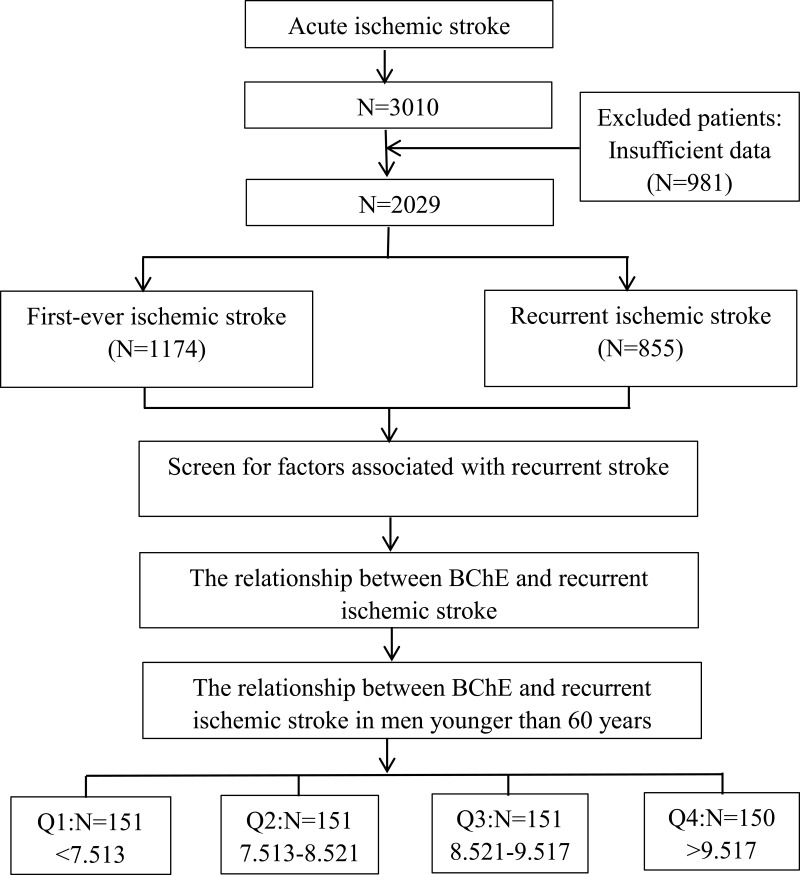
Methods: This is a retrospective study, patients were divided into first-ever ischemic stroke group and recurrent ischemic stroke groups. We conducted a comparative analysis of baseline data between the two groups. Multifactorial logistic regression analysis was performed to identify factors associated with recurrent ischemic stroke. Grouped according to butyryl cholinesterase levels, to elucidate the relationship between butyryl cholinesterase levels and stroke recurrence.
Results: A total of 2029 patients were included, with 1174 in the first-ever ischemic stroke group and 855 in the recurrent ischemic stroke group. Age, hypertension, diabetes, alanine aminotransferase, and lipoprotein(a) were identified as risk factors for recurrent ischemic stroke (ALL p<0.05). Erythrocyte count, butyryl cholinesterase, low-density lipoprotein, and non-atherosclerotic type of large arteries were found to be negative associated with recurrent ischemic stroke (ALL p<0.05). Subgroup analyses indicated that butyryl cholinesterase levels were significantly negatively associated with recurrent ischemic stroke in males (OR=0.814, p<0.001, 95% CI: 0.761 ~ 0.871), especially under 60 years (OR=0.781, p<0.001, 95% CI: 0.708 ~ 0.862). After adjusting for multifactorial regression analyses, the recurrent rate in the lowest quartile of butyryl cholinesterase levels was 2.281 times that of the highest quartile (OR=2.281, p<0.05, 95% CI: 1.318 ~ 3.948).
Conclusion: Age, hypertension, diabetes, alanine aminotransferase, and lipoprotein(a) are independent risk factors for the recurrence of ischemic stroke. The inverse association between butyryl cholinesterase levels and stroke recurrence suggests butyryl cholinesterase may serve as a potential target for therapeutic intervention to improve the prognosis of ischemic stroke.
期刊介绍:
The International Journal of General Medicine is an international, peer-reviewed, open access journal that focuses on general and internal medicine, pathogenesis, epidemiology, diagnosis, monitoring and treatment protocols. The journal is characterized by the rapid reporting of reviews, original research and clinical studies across all disease areas.
A key focus of the journal is the elucidation of disease processes and management protocols resulting in improved outcomes for the patient. Patient perspectives such as satisfaction, quality of life, health literacy and communication and their role in developing new healthcare programs and optimizing clinical outcomes are major areas of interest for the journal.
As of 1st April 2019, the International Journal of General Medicine will no longer consider meta-analyses for publication.





 京公网安备 11010802042870号
京ICP备2023020795号-1
京公网安备 11010802042870号
京ICP备2023020795号-1

 分享
分享
 求助内容:
求助内容: 应助结果提醒方式:
 扫码关注我们
