Jenna Matsukubo, Sarah Dickson, Jennifer Xiao, Erik Loewen Friesen, Marco Solmi, Jess G Fiedorowicz, Benedikt Fischer, Daniel T Myran
{"title":"Psilocybin Dispensaries and Online Health Claims in Canada.","authors":"Jenna Matsukubo, Sarah Dickson, Jennifer Xiao, Erik Loewen Friesen, Marco Solmi, Jess G Fiedorowicz, Benedikt Fischer, Daniel T Myran","doi":"10.1001/jamanetworkopen.2025.2853","DOIUrl":null,"url":null,"abstract":"<p><strong>Importance: </strong>There is growing societal interest in and use of psilocybin. While psilocybin in Canada is illegal outside of clinical trials, there have been anecdotal reports of increasing access via unregulated online purchases and retail dispensaries.</p><p><strong>Objective: </strong>To describe access to and the characteristics of psilocybin dispensaries across Canada and the health claims and warnings made on dispensary websites.</p><p><strong>Design, setting, and participants: </strong>This cross-sectional study used systematic web searches and media reports to identify psilocybin dispensaries operating in Canada in May 2024. Data analysis was performed from June 17 to August 29, 2024.</p><p><strong>Main outcomes and measures: </strong>Descriptive and geospatial analyses were used to identify the psilocybin dispensary characteristics, product types, and store distribution. Content analysis assessed the nature and frequency of health claims and warnings on websites.</p><p><strong>Results: </strong>As of May 2024, 57 psilocybin dispensaries were identified in Canada (0.18 dispensaries per 100 000 individuals aged ≥15 years) in 15 of Canada's 42 major urban cities (35.7%). Approximately 815 628 (2.6%) of Canadians lived within 1 km of a dispensary. Only 4 of 13 provinces and territories had a dispensary, with most in Ontario and British Columbia. Of the 57 stores, 35 (61.4%) were part of a chain (≥2 stores owned by a single company) and 52 (91.2%) had an online presence. Stores sold a wide variety of products, including dried mushrooms (100.0%), microdosing capsules (97.8%), psilocybin-infused chocolate (91.3%) and gummies (93.4%), and most stores (65.2%) sold products mimicking popular food brands. Among stores with websites, 86.4% claimed mental health benefits of psilocybin (eg, alleviating anxiety). While 86.4% of websites provided health warnings, relevant warnings, such as those about use while driving (9.1%), during pregnancy (13.6%), or in individuals with a history of psychosis, schizophrenia, or bipolar disorder (31.8%) were rare.</p><p><strong>Conclusions and relevance: </strong>In this study, psilocybin retailers, who were present in over a third of major Canadian cities, made a variety of unverified health claims and lacked warnings of potential harms, suggesting the need for greater regulatory measures to protect the public.</p>","PeriodicalId":14694,"journal":{"name":"JAMA Network Open","volume":"8 4","pages":"e252853"},"PeriodicalIF":9.7000,"publicationDate":"2025-04-01","publicationTypes":"Journal Article","fieldsOfStudy":null,"isOpenAccess":false,"openAccessPdf":"https://www.ncbi.nlm.nih.gov/pmc/articles/PMC11962669/pdf/","citationCount":"0","resultStr":null,"platform":"Semanticscholar","paperid":null,"PeriodicalName":"JAMA Network Open","FirstCategoryId":"3","ListUrlMain":"https://doi.org/10.1001/jamanetworkopen.2025.2853","RegionNum":1,"RegionCategory":"医学","ArticlePicture":[],"TitleCN":null,"AbstractTextCN":null,"PMCID":null,"EPubDate":"","PubModel":"","JCR":"Q1","JCRName":"MEDICINE, GENERAL & INTERNAL","Score":null,"Total":0}
引用次数: 0
Abstract
Importance: There is growing societal interest in and use of psilocybin. While psilocybin in Canada is illegal outside of clinical trials, there have been anecdotal reports of increasing access via unregulated online purchases and retail dispensaries.
Objective: To describe access to and the characteristics of psilocybin dispensaries across Canada and the health claims and warnings made on dispensary websites.
Design, setting, and participants: This cross-sectional study used systematic web searches and media reports to identify psilocybin dispensaries operating in Canada in May 2024. Data analysis was performed from June 17 to August 29, 2024.
Main outcomes and measures: Descriptive and geospatial analyses were used to identify the psilocybin dispensary characteristics, product types, and store distribution. Content analysis assessed the nature and frequency of health claims and warnings on websites.
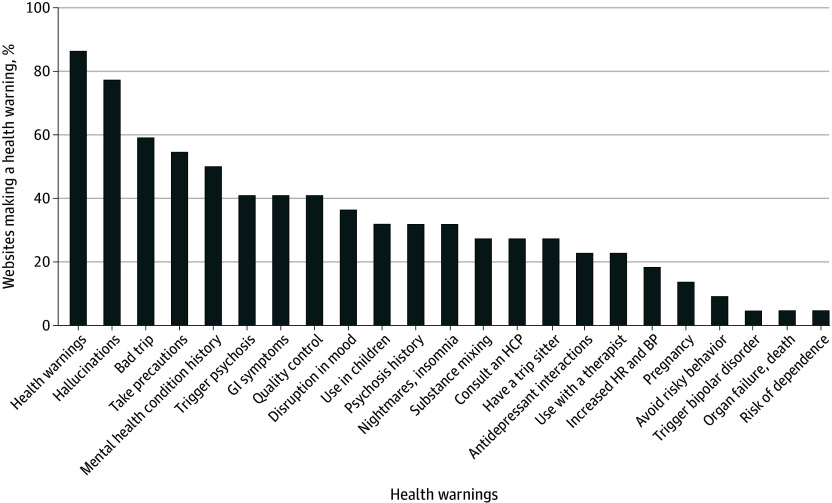
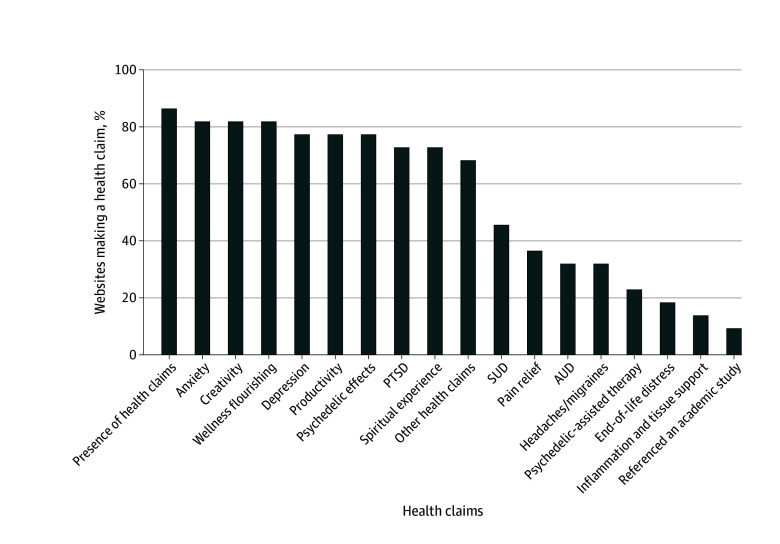
Results: As of May 2024, 57 psilocybin dispensaries were identified in Canada (0.18 dispensaries per 100 000 individuals aged ≥15 years) in 15 of Canada's 42 major urban cities (35.7%). Approximately 815 628 (2.6%) of Canadians lived within 1 km of a dispensary. Only 4 of 13 provinces and territories had a dispensary, with most in Ontario and British Columbia. Of the 57 stores, 35 (61.4%) were part of a chain (≥2 stores owned by a single company) and 52 (91.2%) had an online presence. Stores sold a wide variety of products, including dried mushrooms (100.0%), microdosing capsules (97.8%), psilocybin-infused chocolate (91.3%) and gummies (93.4%), and most stores (65.2%) sold products mimicking popular food brands. Among stores with websites, 86.4% claimed mental health benefits of psilocybin (eg, alleviating anxiety). While 86.4% of websites provided health warnings, relevant warnings, such as those about use while driving (9.1%), during pregnancy (13.6%), or in individuals with a history of psychosis, schizophrenia, or bipolar disorder (31.8%) were rare.
Conclusions and relevance: In this study, psilocybin retailers, who were present in over a third of major Canadian cities, made a variety of unverified health claims and lacked warnings of potential harms, suggesting the need for greater regulatory measures to protect the public.
期刊介绍:
JAMA Network Open, a member of the esteemed JAMA Network, stands as an international, peer-reviewed, open-access general medical journal.The publication is dedicated to disseminating research across various health disciplines and countries, encompassing clinical care, innovation in health care, health policy, and global health.
JAMA Network Open caters to clinicians, investigators, and policymakers, providing a platform for valuable insights and advancements in the medical field. As part of the JAMA Network, a consortium of peer-reviewed general medical and specialty publications, JAMA Network Open contributes to the collective knowledge and understanding within the medical community.



 京公网安备 11010802042870号
京ICP备2023020795号-1
京公网安备 11010802042870号
京ICP备2023020795号-1

 分享
分享
 求助内容:
求助内容: 应助结果提醒方式:
 扫码关注我们
