Ahmed Arafa, Yuka Kato, Yoshihiro Kokubo, Paramita Khairan, Chisa Matsumoto, Yoko M Nakao, Yu Kataoka, Mariko Harada-Shiba
{"title":"Lipoprotein(a) Levels and the Risk of Coronary Heart Disease and Stroke: The Suita Study.","authors":"Ahmed Arafa, Yuka Kato, Yoshihiro Kokubo, Paramita Khairan, Chisa Matsumoto, Yoko M Nakao, Yu Kataoka, Mariko Harada-Shiba","doi":"10.5551/jat.65437","DOIUrl":null,"url":null,"abstract":"<p><strong>Aims: </strong>Lipoprotein(a) (Lp[a]) exhibits atherogenic and thrombogenic properties. We investigated the association between Lp(a) levels and the risk of coronary heart disease (CHD) and stroke.</p><p><strong>Methods: </strong>We used data from 5138 people ≥ 30 years old registered in the Suita Study, a Japanese population-based prospective cohort study. All participants were initially free from CHD or stroke. Cox proportional hazard models were applied to calculate hazard ratios (HRs) and 95% confidence intervals (CIs) for CHD and stroke among participants with elevated Lp(a) levels.</p><p><strong>Results: </strong>At baseline, only 17.0% of participants had Lp(a) levels ≥ 30 mg/dL. Within the median follow-up period of 11.7 years, 164 CHD and 234 stroke events were detected. In the multivariable-adjusted regression model, Lp(a) ≥ 30 mg/dL was associated with an increased risk of CHD (HR, 1.52 [95% CI, 1.05-2.21]). Every 10-ml/dL increment in Lp(a) level was associated with a 7.9% increase in CHD risk. The association with CHD did not change significantly after adjusting for total cholesterol level or lipid-lowering drugs. In contrast, increased Lp(a) levels were not associated with stroke risk or any subtype.</p><p><strong>Conclusions: </strong>Lp(a) ≥ 30 mg/dL was associated with an increased risk of CHD in the Japanese population.</p>","PeriodicalId":15128,"journal":{"name":"Journal of atherosclerosis and thrombosis","volume":" ","pages":"1139-1149"},"PeriodicalIF":2.8000,"publicationDate":"2025-09-01","publicationTypes":"Journal Article","fieldsOfStudy":null,"isOpenAccess":false,"openAccessPdf":"https://www.ncbi.nlm.nih.gov/pmc/articles/PMC12416928/pdf/","citationCount":"0","resultStr":null,"platform":"Semanticscholar","paperid":null,"PeriodicalName":"Journal of atherosclerosis and thrombosis","FirstCategoryId":"3","ListUrlMain":"https://doi.org/10.5551/jat.65437","RegionNum":2,"RegionCategory":"医学","ArticlePicture":[],"TitleCN":null,"AbstractTextCN":null,"PMCID":null,"EPubDate":"2025/3/30 0:00:00","PubModel":"Epub","JCR":"Q2","JCRName":"PERIPHERAL VASCULAR DISEASE","Score":null,"Total":0}
引用次数: 0
Abstract
Aims: Lipoprotein(a) (Lp[a]) exhibits atherogenic and thrombogenic properties. We investigated the association between Lp(a) levels and the risk of coronary heart disease (CHD) and stroke.
Methods: We used data from 5138 people ≥ 30 years old registered in the Suita Study, a Japanese population-based prospective cohort study. All participants were initially free from CHD or stroke. Cox proportional hazard models were applied to calculate hazard ratios (HRs) and 95% confidence intervals (CIs) for CHD and stroke among participants with elevated Lp(a) levels.
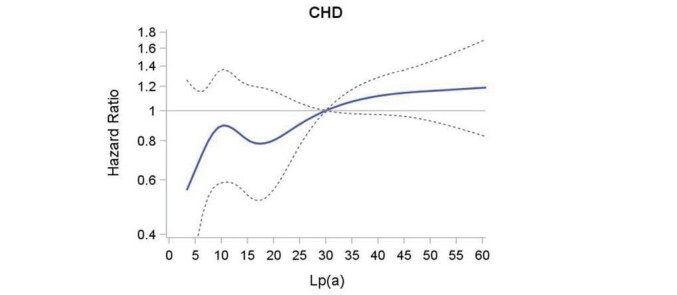
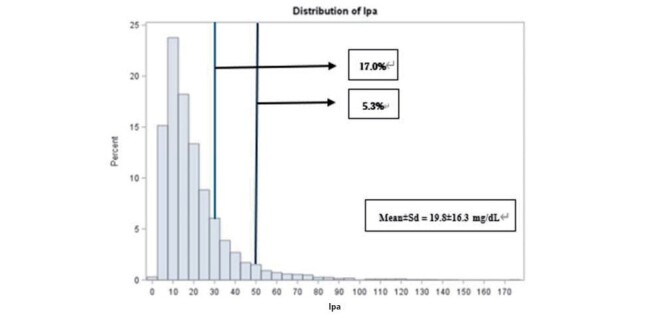
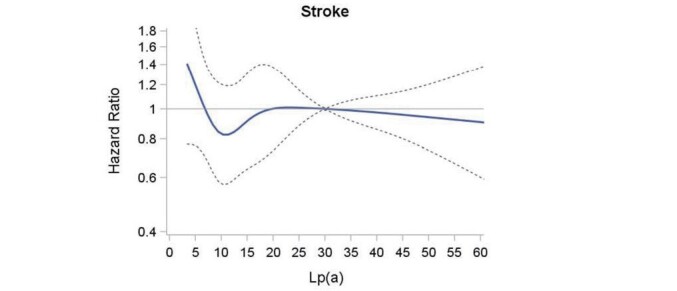
Results: At baseline, only 17.0% of participants had Lp(a) levels ≥ 30 mg/dL. Within the median follow-up period of 11.7 years, 164 CHD and 234 stroke events were detected. In the multivariable-adjusted regression model, Lp(a) ≥ 30 mg/dL was associated with an increased risk of CHD (HR, 1.52 [95% CI, 1.05-2.21]). Every 10-ml/dL increment in Lp(a) level was associated with a 7.9% increase in CHD risk. The association with CHD did not change significantly after adjusting for total cholesterol level or lipid-lowering drugs. In contrast, increased Lp(a) levels were not associated with stroke risk or any subtype.
Conclusions: Lp(a) ≥ 30 mg/dL was associated with an increased risk of CHD in the Japanese population.



 京公网安备 11010802042870号
京ICP备2023020795号-1
京公网安备 11010802042870号
京ICP备2023020795号-1

 分享
分享

 求助内容:
求助内容: 应助结果提醒方式:
 扫码关注我们
