{"title":"The Role of Neutrophil Extracellular Traps in Atherosclerosis: From the Molecular to the Clinical Level.","authors":"Yongfang Yuan, Changxin Sun, Xinyi Liu, Lanqing Hu, Zeping Wang, Xiaoya Li, Jingyi Zhang, Dexiu Li, Xiaonan Zhang, Min Wu, Longtao Liu","doi":"10.2147/JIR.S507330","DOIUrl":null,"url":null,"abstract":"<p><p>Atherosclerosis is a chronic inflammatory condition that is typified by the deposition of lipids and the subsequent inflammation of medium and large arteries. Neutrophil extracellular traps (NETs) are fibrous meshworks of DNA, histones, and granzymes expelled by activated neutrophils in response to a variety of pathogenic conditions. In addition to their role in pathogen eradication, NETs have been demonstrated to play a pivotal role in the development of atherosclerosis. This article presents a review of the bidirectional interactions in which atherosclerosis-related risk factors stimulate the formation of NETs, which in turn support disease progression. This article emphasizes the involvement of NETs in the various stages of atherogenesis and development, influencing multiple factors such as the vascular endothelium, platelets, the inflammatory milieu, and lipid metabolism. The findings of this study offer new insights and avenues for further investigation into the processes underlying the formation and regulation of the vascular inflammatory microenvironment in atherosclerosis. Finally, potential targeted therapeutic strategies for NETs are discussed to facilitate their progression to clinical practice (Graphical Abstract).</p>","PeriodicalId":16107,"journal":{"name":"Journal of Inflammation Research","volume":"18 ","pages":"4421-4433"},"PeriodicalIF":4.1000,"publicationDate":"2025-03-26","publicationTypes":"Journal Article","fieldsOfStudy":null,"isOpenAccess":false,"openAccessPdf":"https://www.ncbi.nlm.nih.gov/pmc/articles/PMC11955173/pdf/","citationCount":"0","resultStr":null,"platform":"Semanticscholar","paperid":null,"PeriodicalName":"Journal of Inflammation Research","FirstCategoryId":"3","ListUrlMain":"https://doi.org/10.2147/JIR.S507330","RegionNum":2,"RegionCategory":"医学","ArticlePicture":[],"TitleCN":null,"AbstractTextCN":null,"PMCID":null,"EPubDate":"2025/1/1 0:00:00","PubModel":"eCollection","JCR":"Q2","JCRName":"IMMUNOLOGY","Score":null,"Total":0}
引用次数: 0
Abstract
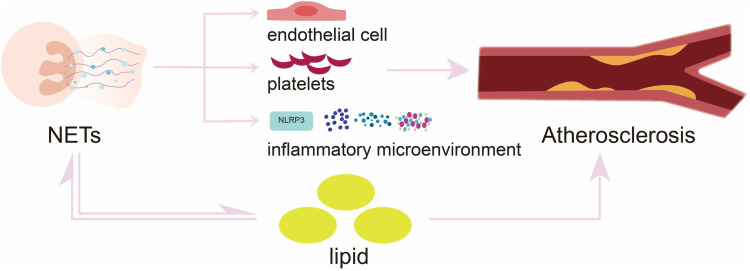
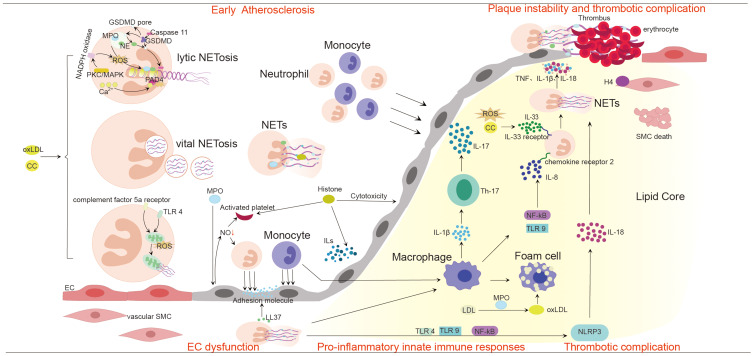
Atherosclerosis is a chronic inflammatory condition that is typified by the deposition of lipids and the subsequent inflammation of medium and large arteries. Neutrophil extracellular traps (NETs) are fibrous meshworks of DNA, histones, and granzymes expelled by activated neutrophils in response to a variety of pathogenic conditions. In addition to their role in pathogen eradication, NETs have been demonstrated to play a pivotal role in the development of atherosclerosis. This article presents a review of the bidirectional interactions in which atherosclerosis-related risk factors stimulate the formation of NETs, which in turn support disease progression. This article emphasizes the involvement of NETs in the various stages of atherogenesis and development, influencing multiple factors such as the vascular endothelium, platelets, the inflammatory milieu, and lipid metabolism. The findings of this study offer new insights and avenues for further investigation into the processes underlying the formation and regulation of the vascular inflammatory microenvironment in atherosclerosis. Finally, potential targeted therapeutic strategies for NETs are discussed to facilitate their progression to clinical practice (Graphical Abstract).
期刊介绍:
An international, peer-reviewed, open access, online journal that welcomes laboratory and clinical findings on the molecular basis, cell biology and pharmacology of inflammation.




 京公网安备 11010802042870号
京ICP备2023020795号-1
京公网安备 11010802042870号
京ICP备2023020795号-1

 分享
分享
 求助内容:
求助内容: 应助结果提醒方式:
 扫码关注我们
