{"title":"Recurrence of Histiocytic Necrotizing Lymphadenitis in Children: A 10-year Multicenter Retrospective Study.","authors":"Yong-Ping Xie, Yan-Wen Xu, Yan Li, Hu Zhang, Shan-Shan Xu, Mei-Na Lu, Yi-Ping Chen, Jian-Mei Tian, Xin-Fang Huang, Zhi-Feng Liu, Zhi-Gang Gao, Li-Su Huang","doi":"10.2147/JIR.S504413","DOIUrl":null,"url":null,"abstract":"<p><strong>Purpose: </strong>Histiocytic necrotizing lymphadenitis (HNL), or Kikuchi-Fujimoto disease, is prone to recurrence in children. However, the frequency and risk factors associated with recurrence remain unclear.</p><p><strong>Patients and methods: </strong>This study included all children with pathology-confirmed HNL from five hospitals over ten years (2013-2023). This study employed STROBE analysis to investigate the association between clinical characteristics and HNL, which was subsequently verified through in both a derivation group and a validation group. Initial clinical features were collected, and data were randomly divided into derivation and validation sets (3:2 ratio). Cox regression analysis identified risk factors, and receiver operating characteristic curves were used to develop a prediction model. Flow cytometry focused on assessing CD4<sup>+</sup> T-lymphocytes in lymphoid tissue.</p><p><strong>Results: </strong>Of the 593 HNL cases, 88 (14.8%) experienced recurrence during a median follow-up of 3 years. Cumulative recurrence rates at the first, fifth, and ninth years were 8.7%, 20.0%, and 32.2%, respectively. Factors associated with recurrence included age ≤ 6-year-old (Hazard ratio [HR] 3.6, 95% confident interval [CI], 2.0-6.4), C-reactive protein > 16 mg/L (HR, 1.9, 95% CI, 1.0-3.6), blood CD4<sup>+</sup> T-lymphocytes ≤ 30% (HR, 4.4, 95% CI, 1.0-18.7), ferritin > 150 μg/L (HR, 2.3, 95% CI, 1.1-5.3) and platelets ≤ 200×10<sup>9</sup>/L (HR 1.8, 95% CI, 1.0-3.2). The prediction model demonstrated areas under the curve of 0.81 for the derivation dataset and 0.77 for the validation dataset, classifying patients into low, medium, and high-risk categories, with corresponding recurrence rates of 5.2%, 19.0%, and 42.9%. Lower lymphoid CD4<sup>+</sup> T-lymphocyte counts were also observed in the recurrent group.</p><p><strong>Conclusion: </strong>The recurrence of HNL increases over time. Key factors, including C-reactive protein (CRP) levels, CD4<sup>+</sup> T-lymphocyte counts, ferritin, platelets, and age at diagnosis may contribute to recurrence risk.</p>","PeriodicalId":16107,"journal":{"name":"Journal of Inflammation Research","volume":"18 ","pages":"4307-4318"},"PeriodicalIF":4.1000,"publicationDate":"2025-03-24","publicationTypes":"Journal Article","fieldsOfStudy":null,"isOpenAccess":false,"openAccessPdf":"https://www.ncbi.nlm.nih.gov/pmc/articles/PMC11951921/pdf/","citationCount":"0","resultStr":null,"platform":"Semanticscholar","paperid":null,"PeriodicalName":"Journal of Inflammation Research","FirstCategoryId":"3","ListUrlMain":"https://doi.org/10.2147/JIR.S504413","RegionNum":2,"RegionCategory":"医学","ArticlePicture":[],"TitleCN":null,"AbstractTextCN":null,"PMCID":null,"EPubDate":"2025/1/1 0:00:00","PubModel":"eCollection","JCR":"Q2","JCRName":"IMMUNOLOGY","Score":null,"Total":0}
引用次数: 0
Abstract
Purpose: Histiocytic necrotizing lymphadenitis (HNL), or Kikuchi-Fujimoto disease, is prone to recurrence in children. However, the frequency and risk factors associated with recurrence remain unclear.
Patients and methods: This study included all children with pathology-confirmed HNL from five hospitals over ten years (2013-2023). This study employed STROBE analysis to investigate the association between clinical characteristics and HNL, which was subsequently verified through in both a derivation group and a validation group. Initial clinical features were collected, and data were randomly divided into derivation and validation sets (3:2 ratio). Cox regression analysis identified risk factors, and receiver operating characteristic curves were used to develop a prediction model. Flow cytometry focused on assessing CD4+ T-lymphocytes in lymphoid tissue.
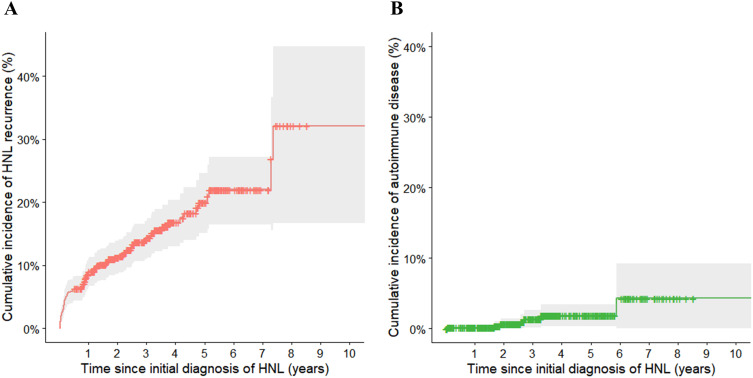
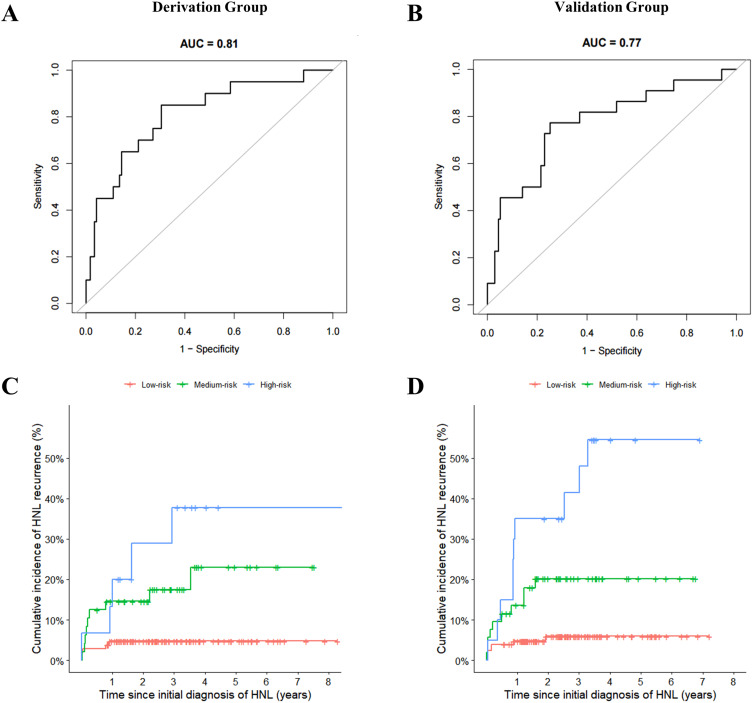
Results: Of the 593 HNL cases, 88 (14.8%) experienced recurrence during a median follow-up of 3 years. Cumulative recurrence rates at the first, fifth, and ninth years were 8.7%, 20.0%, and 32.2%, respectively. Factors associated with recurrence included age ≤ 6-year-old (Hazard ratio [HR] 3.6, 95% confident interval [CI], 2.0-6.4), C-reactive protein > 16 mg/L (HR, 1.9, 95% CI, 1.0-3.6), blood CD4+ T-lymphocytes ≤ 30% (HR, 4.4, 95% CI, 1.0-18.7), ferritin > 150 μg/L (HR, 2.3, 95% CI, 1.1-5.3) and platelets ≤ 200×109/L (HR 1.8, 95% CI, 1.0-3.2). The prediction model demonstrated areas under the curve of 0.81 for the derivation dataset and 0.77 for the validation dataset, classifying patients into low, medium, and high-risk categories, with corresponding recurrence rates of 5.2%, 19.0%, and 42.9%. Lower lymphoid CD4+ T-lymphocyte counts were also observed in the recurrent group.
Conclusion: The recurrence of HNL increases over time. Key factors, including C-reactive protein (CRP) levels, CD4+ T-lymphocyte counts, ferritin, platelets, and age at diagnosis may contribute to recurrence risk.
期刊介绍:
An international, peer-reviewed, open access, online journal that welcomes laboratory and clinical findings on the molecular basis, cell biology and pharmacology of inflammation.





 京公网安备 11010802042870号
京ICP备2023020795号-1
京公网安备 11010802042870号
京ICP备2023020795号-1

 分享
分享
 求助内容:
求助内容: 应助结果提醒方式:
 扫码关注我们
