Sarena Banu, Katharina C Wollenberg Valero, Francisco Rivero
{"title":"Simulated Heat Waves Affect Cell Fate and Fitness in the Social Amoeba Dictyostelium discoideum.","authors":"Sarena Banu, Katharina C Wollenberg Valero, Francisco Rivero","doi":"10.1007/s00248-025-02519-y","DOIUrl":null,"url":null,"abstract":"<p><p>The effects of heatwaves at organism and population levels have been widely investigated; however, little is known about how they affect the development of cell populations and the fitness of the resulting organism. Disruptions caused by heatwaves are especially critical during early developmental stages in organisms lacking parental developmental protection or care. Here we use the social amoeba Dictyostelium discoideum, a soil microbe with a life cycle that transitions between single-cell and multicellular stages. D. discoideum thrives optimally at 22 °C and elevated temperatures impair (27 °C) or completely arrest (30 °C) growth, development, and spore yield. We established a simulated heatwave model in which vegetative cells were exposed to 27 °C for 3 days and studied the effects on the expression of early and cell type specific developmental genes using real-time quantitative PCR. A single heatwave severely impaired the expression of cyclic AMP-dependent early developmental gene markers (carA, acaA, pkaR, gtaC, tgrC1, and csaA) as well as that of prespore markers (cotB and spiA), while the expression of the prestalk marker ecmA was less affected. When mixed with heat-stressed cells, reporter cells expressing β-galactosidase grown at 22 °C preferentially occupy the spore mass of the fruiting body. Chimera assays of wild-type and reporter cells grown at optimal temperature or subjected to a heatwave confirmed a decreased fitness (contribution to chimeric fruiting bodies). We conclude that exposure of unprotected organisms at the single cell stage to a single heatwave has the potential to negatively impact their ability to cope with environmental extremes.</p>","PeriodicalId":18708,"journal":{"name":"Microbial Ecology","volume":"88 1","pages":"21"},"PeriodicalIF":4.0000,"publicationDate":"2025-04-01","publicationTypes":"Journal Article","fieldsOfStudy":null,"isOpenAccess":false,"openAccessPdf":"https://www.ncbi.nlm.nih.gov/pmc/articles/PMC11961495/pdf/","citationCount":"0","resultStr":null,"platform":"Semanticscholar","paperid":null,"PeriodicalName":"Microbial Ecology","FirstCategoryId":"99","ListUrlMain":"https://doi.org/10.1007/s00248-025-02519-y","RegionNum":3,"RegionCategory":"生物学","ArticlePicture":[],"TitleCN":null,"AbstractTextCN":null,"PMCID":null,"EPubDate":"","PubModel":"","JCR":"Q2","JCRName":"ECOLOGY","Score":null,"Total":0}
引用次数: 0
Abstract
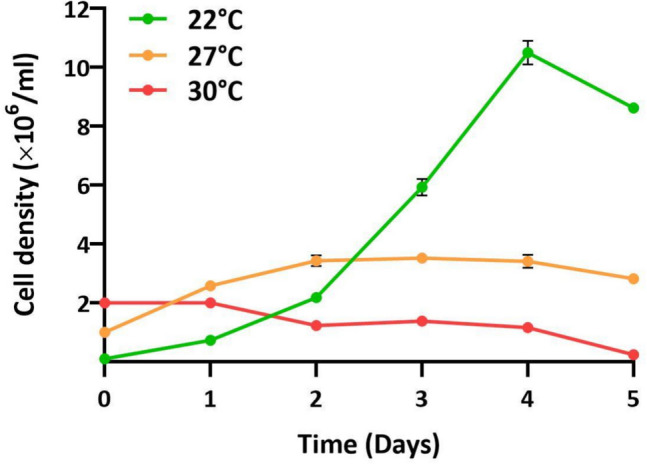
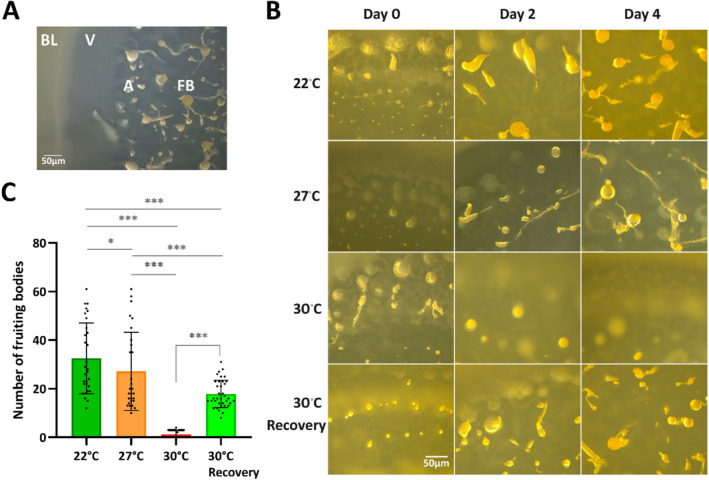
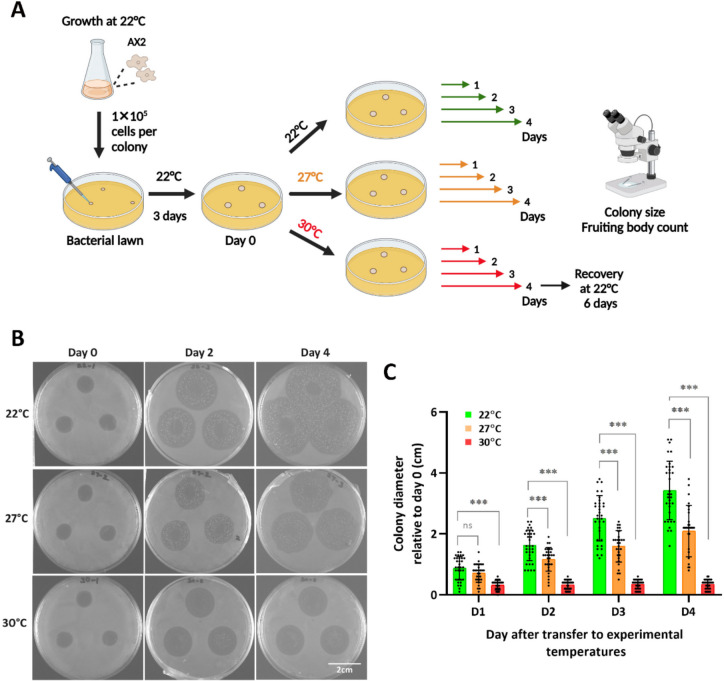
The effects of heatwaves at organism and population levels have been widely investigated; however, little is known about how they affect the development of cell populations and the fitness of the resulting organism. Disruptions caused by heatwaves are especially critical during early developmental stages in organisms lacking parental developmental protection or care. Here we use the social amoeba Dictyostelium discoideum, a soil microbe with a life cycle that transitions between single-cell and multicellular stages. D. discoideum thrives optimally at 22 °C and elevated temperatures impair (27 °C) or completely arrest (30 °C) growth, development, and spore yield. We established a simulated heatwave model in which vegetative cells were exposed to 27 °C for 3 days and studied the effects on the expression of early and cell type specific developmental genes using real-time quantitative PCR. A single heatwave severely impaired the expression of cyclic AMP-dependent early developmental gene markers (carA, acaA, pkaR, gtaC, tgrC1, and csaA) as well as that of prespore markers (cotB and spiA), while the expression of the prestalk marker ecmA was less affected. When mixed with heat-stressed cells, reporter cells expressing β-galactosidase grown at 22 °C preferentially occupy the spore mass of the fruiting body. Chimera assays of wild-type and reporter cells grown at optimal temperature or subjected to a heatwave confirmed a decreased fitness (contribution to chimeric fruiting bodies). We conclude that exposure of unprotected organisms at the single cell stage to a single heatwave has the potential to negatively impact their ability to cope with environmental extremes.
期刊介绍:
The journal Microbial Ecology was founded more than 50 years ago by Dr. Ralph Mitchell, Gordon McKay Professor of Applied Biology at Harvard University in Cambridge, MA. The journal has evolved to become a premier location for the presentation of manuscripts that represent advances in the field of microbial ecology. The journal has become a dedicated international forum for the presentation of high-quality scientific investigations of how microorganisms interact with their environment, with each other and with their hosts. Microbial Ecology offers articles of original research in full paper and note formats, as well as brief reviews and topical position papers.



 京公网安备 11010802042870号
京ICP备2023020795号-1
京公网安备 11010802042870号
京ICP备2023020795号-1

 分享
分享
 求助内容:
求助内容: 应助结果提醒方式:
 扫码关注我们
