Igor Getmanov, Qingxiao Wang, Heng Wang, Atif Shamim and Dalaver H. Anjum
{"title":"Microwave characterization of plasmonic antennas through electron energy loss spectroscopy†","authors":"Igor Getmanov, Qingxiao Wang, Heng Wang, Atif Shamim and Dalaver H. Anjum","doi":"10.1039/D4NA00960F","DOIUrl":null,"url":null,"abstract":"<p >The absence of suitable equipment has long hindered traditional microwave characterization of nano-antennas and their effective design at frequencies beyond several terahertz, limiting the exploration of the myriad applications of plasmonic antennas by the microwave engineering community and necessitating a paradigm shift in characterization methods. This work addresses this challenge by introducing a novel approach employing electron energy loss spectroscopy (EELS) to characterize input impedance and scattering parameters of plasmonic antennas from mid-infrared to optical frequencies. Central to this method is a newly developed theoretical framework that links electron energy loss probability with microwave scattering parameters, crucial for antenna design. We validated this approach through a study of a single plasmonic dipole, finding a good correspondence between the measured EEL spectra and our theoretical model, supported by our developed simulation model. Drawing upon this correlation, we proposed an algorithm for the reverse procedure of extracting <em>S</em>-parameters and input impedance from experimental EEL probability. Spatial profiles of input impedance and <em>S</em>-parameters for a single plasmonic dipole were experimentally characterized across the broad frequency spectrum ranging from 25 to 150 THz and compared with simulation results, revealing a robust correlation, particularly at resonant frequencies. Our non-contact method could serve as an alternative approach to microwave parameters characterization, functioning similarly to a vector network analyzer (VNA) but extending its capabilities to much higher frequencies, where VNAs are not available.</p>","PeriodicalId":18806,"journal":{"name":"Nanoscale Advances","volume":" 9","pages":" 2695-2708"},"PeriodicalIF":4.6000,"publicationDate":"2025-03-19","publicationTypes":"Journal Article","fieldsOfStudy":null,"isOpenAccess":false,"openAccessPdf":"https://www.ncbi.nlm.nih.gov/pmc/articles/PMC11949246/pdf/","citationCount":"0","resultStr":null,"platform":"Semanticscholar","paperid":null,"PeriodicalName":"Nanoscale Advances","FirstCategoryId":"88","ListUrlMain":"https://pubs.rsc.org/en/content/articlelanding/2025/na/d4na00960f","RegionNum":3,"RegionCategory":"材料科学","ArticlePicture":[],"TitleCN":null,"AbstractTextCN":null,"PMCID":null,"EPubDate":"","PubModel":"","JCR":"Q2","JCRName":"CHEMISTRY, MULTIDISCIPLINARY","Score":null,"Total":0}
引用次数: 0
Abstract
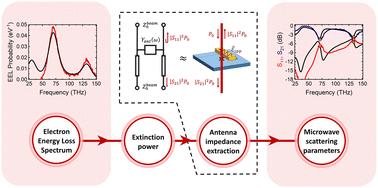
The absence of suitable equipment has long hindered traditional microwave characterization of nano-antennas and their effective design at frequencies beyond several terahertz, limiting the exploration of the myriad applications of plasmonic antennas by the microwave engineering community and necessitating a paradigm shift in characterization methods. This work addresses this challenge by introducing a novel approach employing electron energy loss spectroscopy (EELS) to characterize input impedance and scattering parameters of plasmonic antennas from mid-infrared to optical frequencies. Central to this method is a newly developed theoretical framework that links electron energy loss probability with microwave scattering parameters, crucial for antenna design. We validated this approach through a study of a single plasmonic dipole, finding a good correspondence between the measured EEL spectra and our theoretical model, supported by our developed simulation model. Drawing upon this correlation, we proposed an algorithm for the reverse procedure of extracting S-parameters and input impedance from experimental EEL probability. Spatial profiles of input impedance and S-parameters for a single plasmonic dipole were experimentally characterized across the broad frequency spectrum ranging from 25 to 150 THz and compared with simulation results, revealing a robust correlation, particularly at resonant frequencies. Our non-contact method could serve as an alternative approach to microwave parameters characterization, functioning similarly to a vector network analyzer (VNA) but extending its capabilities to much higher frequencies, where VNAs are not available.



 京公网安备 11010802042870号
京ICP备2023020795号-1
京公网安备 11010802042870号
京ICP备2023020795号-1

 分享
分享
 求助内容:
求助内容: 应助结果提醒方式:
 扫码关注我们
