Jacob Anthony Batuhan, Reynan Hernandez, Florentina Villanueva, Airen Sigue, Kevyn Yu, Kate Wad-Asen, Beatriz Carandang, Jeremie Bartelheimer
{"title":"Enablers and barriers to the use of portable ultrasound devices for antenatal care in rural health centers in the Philippines.","authors":"Jacob Anthony Batuhan, Reynan Hernandez, Florentina Villanueva, Airen Sigue, Kevyn Yu, Kate Wad-Asen, Beatriz Carandang, Jeremie Bartelheimer","doi":"10.1177/20503121251330991","DOIUrl":null,"url":null,"abstract":"<p><strong>Objectives: </strong>This qualitative study aims to examine the enablers and barriers to portable ultrasound device utilization for antenatal care in rural Philippine health centers, with the goal of improving maternal outcomes and reducing maternal mortality.</p><p><strong>Methods: </strong>We conducted focus group discussions with 18 healthcare workers (midwives, a nurse, and a radiologic technician) and 20 pregnant women across 5 rural health centers. We used inductive thematic analysis to identify system-related, provider-related, and client-related enablers and barriers.</p><p><strong>Results: </strong>Enablers included free ultrasound services, hospital policies requiring prenatal scans, provider training, awareness creation, patient interest and acceptance, and confidence in HCWs' capabilities. Barriers comprised resource limitations, distance to facilities, insufficient HCW skills, time constraints, emotional fears, traditional beliefs, misconceptions, and lack of trust in providers' competence.</p><p><strong>Conclusion: </strong>Addressing resource gaps, ongoing provider training, and patient education may enhance portable ultrasound device uptake and significantly improve maternal health outcomes in low-resource settings.</p>","PeriodicalId":21398,"journal":{"name":"SAGE Open Medicine","volume":"13 ","pages":"20503121251330991"},"PeriodicalIF":2.1000,"publicationDate":"2025-03-28","publicationTypes":"Journal Article","fieldsOfStudy":null,"isOpenAccess":false,"openAccessPdf":"https://www.ncbi.nlm.nih.gov/pmc/articles/PMC11956504/pdf/","citationCount":"0","resultStr":null,"platform":"Semanticscholar","paperid":null,"PeriodicalName":"SAGE Open Medicine","FirstCategoryId":"1085","ListUrlMain":"https://doi.org/10.1177/20503121251330991","RegionNum":0,"RegionCategory":null,"ArticlePicture":[],"TitleCN":null,"AbstractTextCN":null,"PMCID":null,"EPubDate":"2025/1/1 0:00:00","PubModel":"eCollection","JCR":"Q2","JCRName":"MEDICINE, GENERAL & INTERNAL","Score":null,"Total":0}
引用次数: 0
Abstract
Objectives: This qualitative study aims to examine the enablers and barriers to portable ultrasound device utilization for antenatal care in rural Philippine health centers, with the goal of improving maternal outcomes and reducing maternal mortality.
Methods: We conducted focus group discussions with 18 healthcare workers (midwives, a nurse, and a radiologic technician) and 20 pregnant women across 5 rural health centers. We used inductive thematic analysis to identify system-related, provider-related, and client-related enablers and barriers.
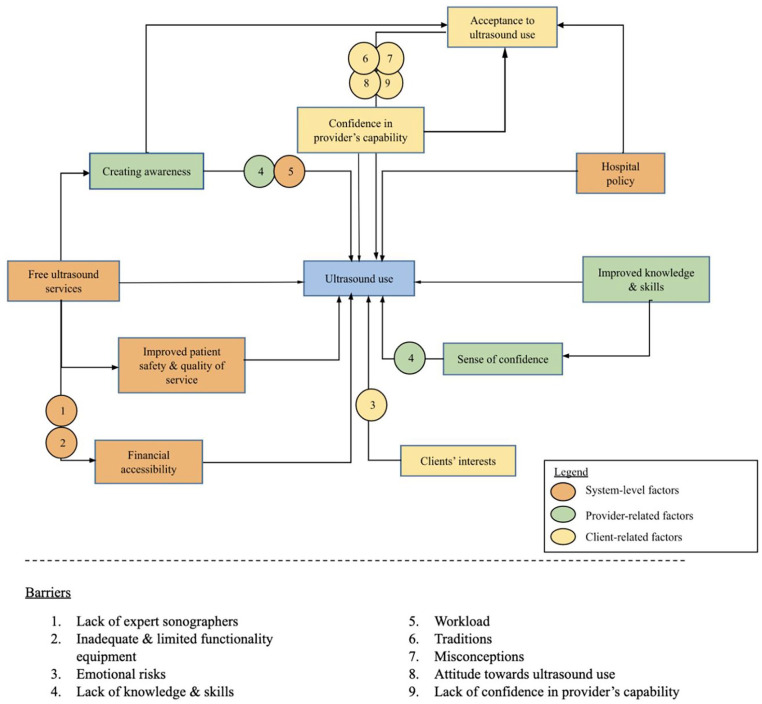
Results: Enablers included free ultrasound services, hospital policies requiring prenatal scans, provider training, awareness creation, patient interest and acceptance, and confidence in HCWs' capabilities. Barriers comprised resource limitations, distance to facilities, insufficient HCW skills, time constraints, emotional fears, traditional beliefs, misconceptions, and lack of trust in providers' competence.
Conclusion: Addressing resource gaps, ongoing provider training, and patient education may enhance portable ultrasound device uptake and significantly improve maternal health outcomes in low-resource settings.





 京公网安备 11010802042870号
京ICP备2023020795号-1
京公网安备 11010802042870号
京ICP备2023020795号-1

 分享
分享
 求助内容:
求助内容: 应助结果提醒方式:
 扫码关注我们
