Mark E Artz, Hardev S Grewal, Yawei Zhang, Perry B Johnson, Mohammad Saki, Niek Schreuder, Eric D Brooks, Jiyeon Park
{"title":"Operational Improvement of a Proton Therapy System From Reduced Energy Layer Switching Time.","authors":"Mark E Artz, Hardev S Grewal, Yawei Zhang, Perry B Johnson, Mohammad Saki, Niek Schreuder, Eric D Brooks, Jiyeon Park","doi":"10.1016/j.ijpt.2025.100742","DOIUrl":null,"url":null,"abstract":"<p><strong>Purpose: </strong>This study reports the potential operational improvement provided by reduced energy layer switching time and total beam delivery time of a 3-room IBA ProteusPLUS system.</p><p><strong>Materials and methods: </strong>Eight treatment fields, including various disease sites and a reference cube, were analyzed for energy layer switching time and total delivery time before and after an energy layer switching time upgrade. The upgraded beam delivery time estimated the total treatment capacity for a 12-h treatment day using a 3-room system with a single common cyclotron. The potential increase in revenue was estimated using Medicare reimbursement rates for proton therapy intermediate.</p><p><strong>Results: </strong>The average layer switching time was reduced from 6.33 to 1.86 s, reducing the average field delivery time from 240 to 113 s. Overall, the average energy layer switching time reduction was 70.6%, and the average total treatment field delivery time was reduced by 52.6%. Head and neck cancer fields experienced the greatest treatment time reduction of 59.5%, reducing from 236 to 95.5 s. The treatment field delivery time reduction allowed an increase from 60 to 127 patients per day, an increase of 112%.</p><p><strong>Conclusion: </strong>Reductions in energy layer switching time significantly decreased treatment field delivery time. Reduced treatment field delivery time may provide clinical benefits to patients through improved patient alignment and comfort. Increased treatment capacity could also improve patient access to proton therapy for disease sites that may experience clinical benefits, such as head and neck cancer.</p>","PeriodicalId":36923,"journal":{"name":"International Journal of Particle Therapy","volume":"16 ","pages":"100742"},"PeriodicalIF":2.0000,"publicationDate":"2025-02-25","publicationTypes":"Journal Article","fieldsOfStudy":null,"isOpenAccess":false,"openAccessPdf":"https://www.ncbi.nlm.nih.gov/pmc/articles/PMC11957529/pdf/","citationCount":"0","resultStr":null,"platform":"Semanticscholar","paperid":null,"PeriodicalName":"International Journal of Particle Therapy","FirstCategoryId":"1085","ListUrlMain":"https://doi.org/10.1016/j.ijpt.2025.100742","RegionNum":0,"RegionCategory":null,"ArticlePicture":[],"TitleCN":null,"AbstractTextCN":null,"PMCID":null,"EPubDate":"2025/6/1 0:00:00","PubModel":"eCollection","JCR":"Q3","JCRName":"ONCOLOGY","Score":null,"Total":0}
引用次数: 0
Abstract
Purpose: This study reports the potential operational improvement provided by reduced energy layer switching time and total beam delivery time of a 3-room IBA ProteusPLUS system.
Materials and methods: Eight treatment fields, including various disease sites and a reference cube, were analyzed for energy layer switching time and total delivery time before and after an energy layer switching time upgrade. The upgraded beam delivery time estimated the total treatment capacity for a 12-h treatment day using a 3-room system with a single common cyclotron. The potential increase in revenue was estimated using Medicare reimbursement rates for proton therapy intermediate.
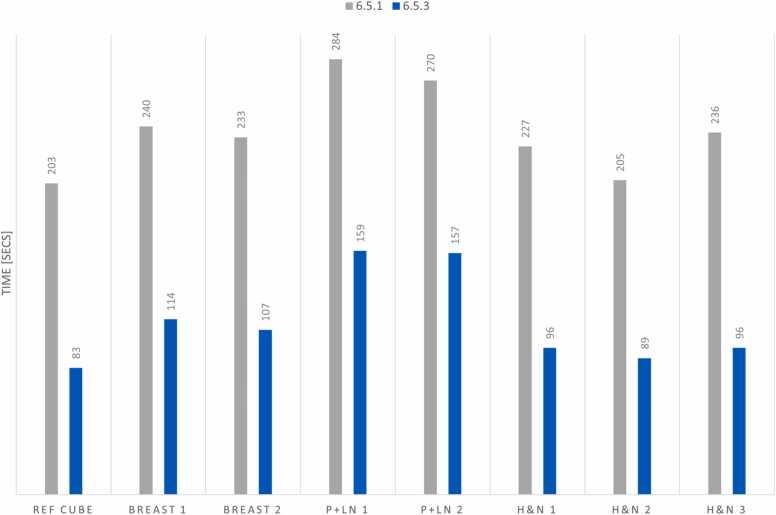
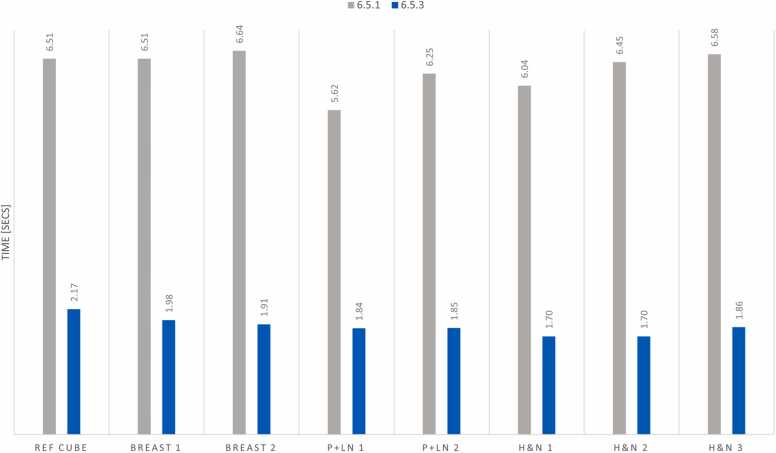
Results: The average layer switching time was reduced from 6.33 to 1.86 s, reducing the average field delivery time from 240 to 113 s. Overall, the average energy layer switching time reduction was 70.6%, and the average total treatment field delivery time was reduced by 52.6%. Head and neck cancer fields experienced the greatest treatment time reduction of 59.5%, reducing from 236 to 95.5 s. The treatment field delivery time reduction allowed an increase from 60 to 127 patients per day, an increase of 112%.
Conclusion: Reductions in energy layer switching time significantly decreased treatment field delivery time. Reduced treatment field delivery time may provide clinical benefits to patients through improved patient alignment and comfort. Increased treatment capacity could also improve patient access to proton therapy for disease sites that may experience clinical benefits, such as head and neck cancer.





 京公网安备 11010802042870号
京ICP备2023020795号-1
京公网安备 11010802042870号
京ICP备2023020795号-1

 分享
分享
 求助内容:
求助内容: 应助结果提醒方式:
 扫码关注我们
