Joice Cavalcanti Lima, Lívia de Souza Ramos, Pedro Fernandes Barbosa, Iuri Casemiro Barcellos, Marta Helena Branquinha, André Luis Souza Dos Santos
{"title":"Biofilm production by the multidrug-resistant fungus <i>Candida haemulonii</i> is affected by aspartic peptidase inhibitor.","authors":"Joice Cavalcanti Lima, Lívia de Souza Ramos, Pedro Fernandes Barbosa, Iuri Casemiro Barcellos, Marta Helena Branquinha, André Luis Souza Dos Santos","doi":"10.3934/microbiol.2025012","DOIUrl":null,"url":null,"abstract":"<p><p><i>Candida haemulonii</i> is an emerging, opportunistic, and multidrug-resistant fungal pathogen. Recently, our group reported the ability of <i>C. haemulonii</i> to form biofilm and secrete aspartic-type peptidases (Saps). Herein, we investigated the correlation between Saps production and biofilm formation along <i>C. haemulonii</i> growth in yeast carbon base medium supplemented with albumin (a Sap-inducing condition) and in the presence of the classical Sap inhibitor pepstatin A. Under these conditions, the biofilm biomass increased on a polystyrene surface, reaching its maximum at 96 h, while maximum biofilm viability was detected at 48 h. The release of Saps during biofilm formation showed an inverse trend, with the highest enzymatic activity measured after 24 h. In the presence of pepstatin A, a significant reduction in biofilm parameters (biomass and viability), as well as in albumin consumption by biofilm-forming cells was detected. These findings underscore the importance of Saps during the biofilm development in <i>C. haemulonii</i>.</p>","PeriodicalId":46108,"journal":{"name":"AIMS Microbiology","volume":"11 1","pages":"228-241"},"PeriodicalIF":4.1000,"publicationDate":"2025-03-21","publicationTypes":"Journal Article","fieldsOfStudy":null,"isOpenAccess":false,"openAccessPdf":"https://www.ncbi.nlm.nih.gov/pmc/articles/PMC11950678/pdf/","citationCount":"0","resultStr":null,"platform":"Semanticscholar","paperid":null,"PeriodicalName":"AIMS Microbiology","FirstCategoryId":"1085","ListUrlMain":"https://doi.org/10.3934/microbiol.2025012","RegionNum":0,"RegionCategory":null,"ArticlePicture":[],"TitleCN":null,"AbstractTextCN":null,"PMCID":null,"EPubDate":"2025/1/1 0:00:00","PubModel":"eCollection","JCR":"Q3","JCRName":"MICROBIOLOGY","Score":null,"Total":0}
引用次数: 0
Abstract
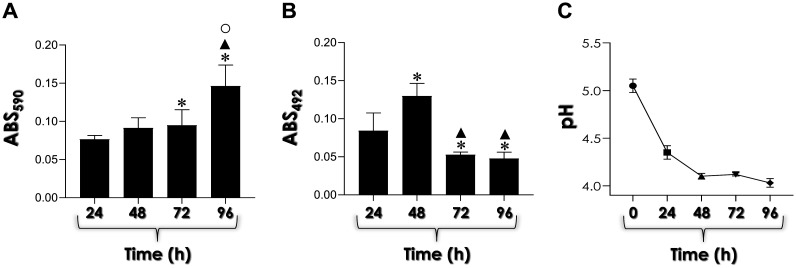
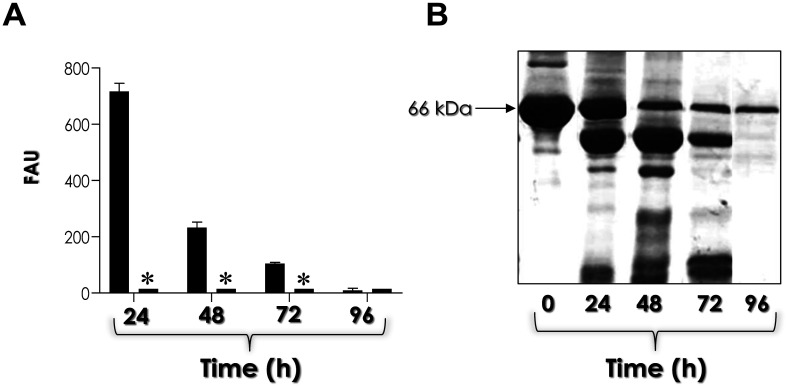
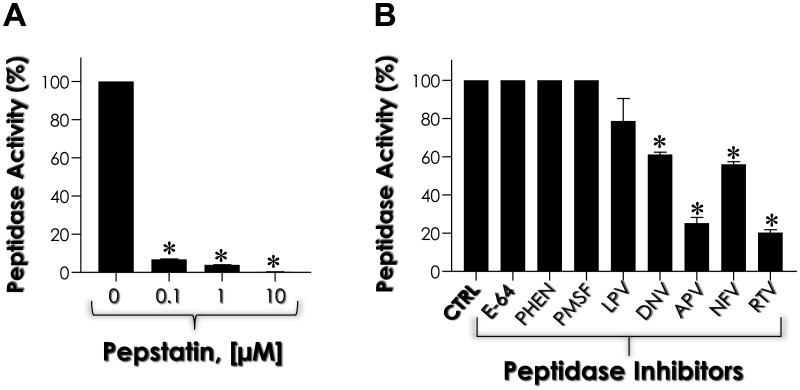
Candida haemulonii is an emerging, opportunistic, and multidrug-resistant fungal pathogen. Recently, our group reported the ability of C. haemulonii to form biofilm and secrete aspartic-type peptidases (Saps). Herein, we investigated the correlation between Saps production and biofilm formation along C. haemulonii growth in yeast carbon base medium supplemented with albumin (a Sap-inducing condition) and in the presence of the classical Sap inhibitor pepstatin A. Under these conditions, the biofilm biomass increased on a polystyrene surface, reaching its maximum at 96 h, while maximum biofilm viability was detected at 48 h. The release of Saps during biofilm formation showed an inverse trend, with the highest enzymatic activity measured after 24 h. In the presence of pepstatin A, a significant reduction in biofilm parameters (biomass and viability), as well as in albumin consumption by biofilm-forming cells was detected. These findings underscore the importance of Saps during the biofilm development in C. haemulonii.




 京公网安备 11010802042870号
京ICP备2023020795号-1
京公网安备 11010802042870号
京ICP备2023020795号-1

 分享
分享
 求助内容:
求助内容: 应助结果提醒方式:
 扫码关注我们
