Wenting Liu, Wengao Li, Lili Deng, Xian Luo, Yibing Tan, Jiagen Xiang, Yan Wu, Yanan Hu, Hengwen Sun, Yuan Yang
{"title":"Characteristics and influencing factors of fear of cancer recurrence among family caregivers of breast cancer patients: a latent class analysis.","authors":"Wenting Liu, Wengao Li, Lili Deng, Xian Luo, Yibing Tan, Jiagen Xiang, Yan Wu, Yanan Hu, Hengwen Sun, Yuan Yang","doi":"10.1186/s12912-025-02964-7","DOIUrl":null,"url":null,"abstract":"<p><strong>Background: </strong>Family caregivers of breast cancer patients often experience significant psychological challenges, including depression, anxiety, and fear of cancer recurrence (FCR), yet these issues receive insufficient attention. This study aims to explore the heterogeneity of FCR among family caregivers and identify distinct subgroups based on their FCR levels.</p><p><strong>Methods: </strong>A cross-sectional survey was conducted with 866 family caregivers of breast cancer patients at two tertiary hospitals in Guangzhou, Guangdong Province. All participants completed the Fear of Cancer Recurrence Scale (FCR-7), the Patient Health Questionnaire (PHQ-9), and the Generalized Anxiety Scale (GAD-7) to assess their levels of FCR, depression, and anxiety. Latent class analysis (LCA) was used to identify subgroups of FCR, and multiple logistic regression analyses were performed to explore factors influencing FCR.</p><p><strong>Results: </strong>Three distinct subgroups of FCR were identified: low FCR group (16.17%), moderate FCR group (13.16%), and high FCR group (70.67%). Predictors of higher FCR included lower income, higher anxiety, and higher depression levels.</p><p><strong>Conclusions: </strong>Family caregivers of breast cancer patients exhibit varying levels of FCR, with significant predictors being income, anxiety, and depression. Targeted interventions (e.g., psychoeducation, stress management, mindfulness exercises, and cognitive-behavioral therapy) that address these factors may help improve the mental health and well-being of family caregivers.</p>","PeriodicalId":48580,"journal":{"name":"BMC Nursing","volume":"24 1","pages":"352"},"PeriodicalIF":3.9000,"publicationDate":"2025-03-31","publicationTypes":"Journal Article","fieldsOfStudy":null,"isOpenAccess":false,"openAccessPdf":"https://www.ncbi.nlm.nih.gov/pmc/articles/PMC11959734/pdf/","citationCount":"0","resultStr":null,"platform":"Semanticscholar","paperid":null,"PeriodicalName":"BMC Nursing","FirstCategoryId":"3","ListUrlMain":"https://doi.org/10.1186/s12912-025-02964-7","RegionNum":2,"RegionCategory":"医学","ArticlePicture":[],"TitleCN":null,"AbstractTextCN":null,"PMCID":null,"EPubDate":"","PubModel":"","JCR":"Q1","JCRName":"NURSING","Score":null,"Total":0}
引用次数: 0
Abstract
Background: Family caregivers of breast cancer patients often experience significant psychological challenges, including depression, anxiety, and fear of cancer recurrence (FCR), yet these issues receive insufficient attention. This study aims to explore the heterogeneity of FCR among family caregivers and identify distinct subgroups based on their FCR levels.
Methods: A cross-sectional survey was conducted with 866 family caregivers of breast cancer patients at two tertiary hospitals in Guangzhou, Guangdong Province. All participants completed the Fear of Cancer Recurrence Scale (FCR-7), the Patient Health Questionnaire (PHQ-9), and the Generalized Anxiety Scale (GAD-7) to assess their levels of FCR, depression, and anxiety. Latent class analysis (LCA) was used to identify subgroups of FCR, and multiple logistic regression analyses were performed to explore factors influencing FCR.
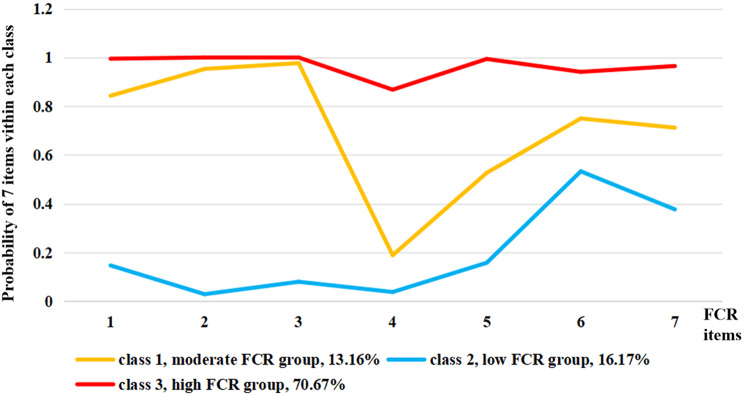
Results: Three distinct subgroups of FCR were identified: low FCR group (16.17%), moderate FCR group (13.16%), and high FCR group (70.67%). Predictors of higher FCR included lower income, higher anxiety, and higher depression levels.
Conclusions: Family caregivers of breast cancer patients exhibit varying levels of FCR, with significant predictors being income, anxiety, and depression. Targeted interventions (e.g., psychoeducation, stress management, mindfulness exercises, and cognitive-behavioral therapy) that address these factors may help improve the mental health and well-being of family caregivers.
期刊介绍:
BMC Nursing is an open access, peer-reviewed journal that considers articles on all aspects of nursing research, training, education and practice.



 京公网安备 11010802042870号
京ICP备2023020795号-1
京公网安备 11010802042870号
京ICP备2023020795号-1

 分享
分享
 求助内容:
求助内容: 应助结果提醒方式:
 扫码关注我们
