Jung Ah Kim, Seung Hyun Jang, Sun Yung Joo, Se Jin Kim, Jae Young Choi, Jinsei Jung, Heon Yung Gee
{"title":"Systematic genetic assessment of hearing loss using whole-genome sequencing identifies pathogenic variants","authors":"Jung Ah Kim, Seung Hyun Jang, Sun Yung Joo, Se Jin Kim, Jae Young Choi, Jinsei Jung, Heon Yung Gee","doi":"10.1038/s12276-025-01428-x","DOIUrl":null,"url":null,"abstract":"Hearing loss is a clinically and genetically heterogeneous sensorineural disease that affects approximately 1 out of 1000 newborns. For the molecular diagnosis of genetic hearing loss, target panel or whole-exome sequencing (WES) have been widely used due to their cost-effectiveness and efficacy. Despite the advantages of WES, the plausible diagnoses in a substantial number of patients remain elusive due to its limited coverage. Here we utilized whole-genome sequencing (WGS) on a large cohort of individuals with hearing loss to overcome the drawbacks of WES and find the advantages of WGS. We implemented a systematic workflow to identify coding region variants, cryptic splice variants, mitochondrial variants, copy number variants, cis-regulatory variants and transposable element insertions. WGS was conducted on 140 families with hearing loss. Causative variations were identified in 37 of these families, accounting for 26% of the total. WGS possessed the capability to find genetic variations that are not identifiable using WES. The identified variants by WGS in this study encompassed aberrant splicing variants in EYA1 and CDH23, mitochondrial variants in MT-RNR1 and MT-CO1, structural variants in STRC, and Alu insertion in SLC17A8. These findings highlight the benefits of WGS. With the decreasing cost of WGS, its usage will become more prevalent, allowing more precise identification of the genetic causes of hearing loss. Hearing loss is a common condition that affects many people worldwide. Understanding its genetic causes can help physicians provide better treatments. Researchers have used whole-exome sequencing (WES) to study these genes, but this method covers only a small part of the genome. This study explores the use of whole-genome sequencing (WGS), which examines the entire genome, to find more genetic causes of hearing loss. The study involved 577 families with hearing loss. Researchers performed WGS on 140 families and compared these results with those obtained from performing WES on 437 families. They looked for genetic variants in known hearing loss genes and other parts of the genome. WGS was able to identify additional variants that WES missed, such as those in noncoding regions and mitochondrial DNA. The results showed that WGS could find more potential causes of hearing loss than WES. This summary was initially drafted using artificial intelligence, then revised and fact-checked by the author.","PeriodicalId":50466,"journal":{"name":"Experimental and Molecular Medicine","volume":"57 4","pages":"775-787"},"PeriodicalIF":12.9000,"publicationDate":"2025-04-01","publicationTypes":"Journal Article","fieldsOfStudy":null,"isOpenAccess":false,"openAccessPdf":"https://www.ncbi.nlm.nih.gov/pmc/articles/PMC12046045/pdf/","citationCount":"0","resultStr":null,"platform":"Semanticscholar","paperid":null,"PeriodicalName":"Experimental and Molecular Medicine","FirstCategoryId":"3","ListUrlMain":"https://www.nature.com/articles/s12276-025-01428-x","RegionNum":2,"RegionCategory":"医学","ArticlePicture":[],"TitleCN":null,"AbstractTextCN":null,"PMCID":null,"EPubDate":"","PubModel":"","JCR":"Q1","JCRName":"BIOCHEMISTRY & MOLECULAR BIOLOGY","Score":null,"Total":0}
引用次数: 0
Abstract
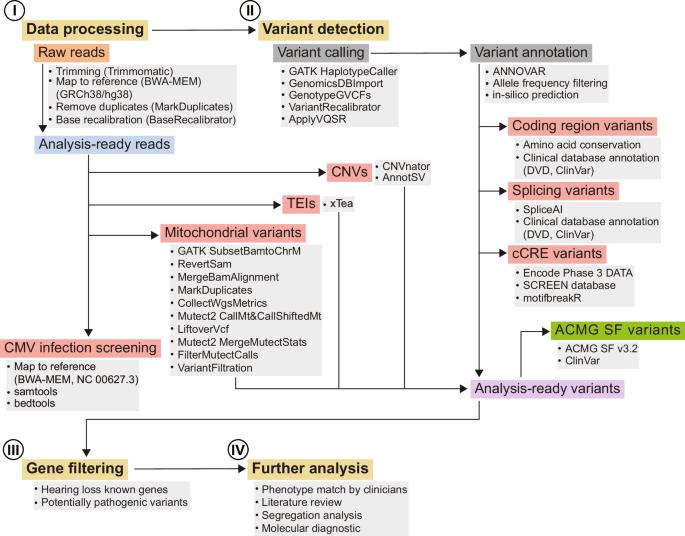
Hearing loss is a clinically and genetically heterogeneous sensorineural disease that affects approximately 1 out of 1000 newborns. For the molecular diagnosis of genetic hearing loss, target panel or whole-exome sequencing (WES) have been widely used due to their cost-effectiveness and efficacy. Despite the advantages of WES, the plausible diagnoses in a substantial number of patients remain elusive due to its limited coverage. Here we utilized whole-genome sequencing (WGS) on a large cohort of individuals with hearing loss to overcome the drawbacks of WES and find the advantages of WGS. We implemented a systematic workflow to identify coding region variants, cryptic splice variants, mitochondrial variants, copy number variants, cis-regulatory variants and transposable element insertions. WGS was conducted on 140 families with hearing loss. Causative variations were identified in 37 of these families, accounting for 26% of the total. WGS possessed the capability to find genetic variations that are not identifiable using WES. The identified variants by WGS in this study encompassed aberrant splicing variants in EYA1 and CDH23, mitochondrial variants in MT-RNR1 and MT-CO1, structural variants in STRC, and Alu insertion in SLC17A8. These findings highlight the benefits of WGS. With the decreasing cost of WGS, its usage will become more prevalent, allowing more precise identification of the genetic causes of hearing loss. Hearing loss is a common condition that affects many people worldwide. Understanding its genetic causes can help physicians provide better treatments. Researchers have used whole-exome sequencing (WES) to study these genes, but this method covers only a small part of the genome. This study explores the use of whole-genome sequencing (WGS), which examines the entire genome, to find more genetic causes of hearing loss. The study involved 577 families with hearing loss. Researchers performed WGS on 140 families and compared these results with those obtained from performing WES on 437 families. They looked for genetic variants in known hearing loss genes and other parts of the genome. WGS was able to identify additional variants that WES missed, such as those in noncoding regions and mitochondrial DNA. The results showed that WGS could find more potential causes of hearing loss than WES. This summary was initially drafted using artificial intelligence, then revised and fact-checked by the author.
期刊介绍:
Experimental & Molecular Medicine (EMM) stands as Korea's pioneering biochemistry journal, established in 1964 and rejuvenated in 1996 as an Open Access, fully peer-reviewed international journal. Dedicated to advancing translational research and showcasing recent breakthroughs in the biomedical realm, EMM invites submissions encompassing genetic, molecular, and cellular studies of human physiology and diseases. Emphasizing the correlation between experimental and translational research and enhanced clinical benefits, the journal actively encourages contributions employing specific molecular tools. Welcoming studies that bridge basic discoveries with clinical relevance, alongside articles demonstrating clear in vivo significance and novelty, Experimental & Molecular Medicine proudly serves as an open-access, online-only repository of cutting-edge medical research.



 京公网安备 11010802042870号
京ICP备2023020795号-1
京公网安备 11010802042870号
京ICP备2023020795号-1

 分享
分享
 求助内容:
求助内容: 应助结果提醒方式:
 扫码关注我们
