{"title":"Conversation between skin microbiota and the host: from early life to adulthood","authors":"Jimin Cha, Tae-Gyun Kim, Ji-Hwan Ryu","doi":"10.1038/s12276-025-01427-y","DOIUrl":null,"url":null,"abstract":"Host life is inextricably linked to commensal microbiota, which play a crucial role in maintaining homeostasis and immune activation. A diverse array of commensal microbiota on the skin interacts with the host, influencing the skin physiology in various ways. Early-life exposure to commensal microbiota has long-lasting effects, and disruption of the epidermal barrier or transient exposure to these microorganisms can lead to skin dysbiosis and inflammation. Several commensal skin microbiota have the potential to function as either commensals or pathogens, both influencing and being influenced by the pathogenesis of skin inflammatory diseases. Here we explore the impact of various commensal skin microbiota on the host and elucidate the interactions between skin microbiota and host systems. A deeper understanding of these interactions may open new avenues for developing effective strategies to address skin diseases. The skin is our body’s largest organ and acts as a barrier against the outside world. It hosts a variety of tiny organisms, known as microbiota, which include bacteria, fungi and viruses. These microbiota help to keep our skin healthy. However, scientists are still learning how these organisms interact with our skin and immune system. Researchers have found that certain bacteria, such as Staphylococcus epidermidis, help to repair skin and maintain its health. They conducted studies using mice and human skin samples to understand these interactions better. The research showed that these bacteria can influence immune responses and even help in healing wounds. The study highlights that the balance of skin microbiota is crucial for preventing skin diseases such as atopic dermatitis and psoriasis. When this balance is disrupted, it can lead to inflammation and other skin issues. This summary was initially drafted using artificial intelligence, then revised and fact-checked by the author.","PeriodicalId":50466,"journal":{"name":"Experimental and Molecular Medicine","volume":"57 4","pages":"703-713"},"PeriodicalIF":12.9000,"publicationDate":"2025-04-01","publicationTypes":"Journal Article","fieldsOfStudy":null,"isOpenAccess":false,"openAccessPdf":"https://www.ncbi.nlm.nih.gov/pmc/articles/PMC12045987/pdf/","citationCount":"0","resultStr":null,"platform":"Semanticscholar","paperid":null,"PeriodicalName":"Experimental and Molecular Medicine","FirstCategoryId":"3","ListUrlMain":"https://www.nature.com/articles/s12276-025-01427-y","RegionNum":2,"RegionCategory":"医学","ArticlePicture":[],"TitleCN":null,"AbstractTextCN":null,"PMCID":null,"EPubDate":"","PubModel":"","JCR":"Q1","JCRName":"BIOCHEMISTRY & MOLECULAR BIOLOGY","Score":null,"Total":0}
引用次数: 0
Abstract
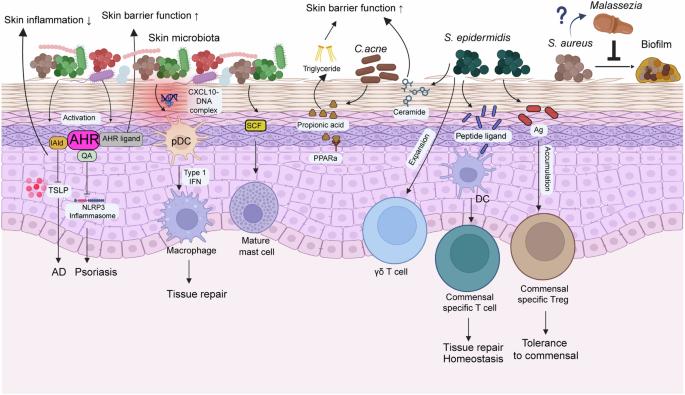
Host life is inextricably linked to commensal microbiota, which play a crucial role in maintaining homeostasis and immune activation. A diverse array of commensal microbiota on the skin interacts with the host, influencing the skin physiology in various ways. Early-life exposure to commensal microbiota has long-lasting effects, and disruption of the epidermal barrier or transient exposure to these microorganisms can lead to skin dysbiosis and inflammation. Several commensal skin microbiota have the potential to function as either commensals or pathogens, both influencing and being influenced by the pathogenesis of skin inflammatory diseases. Here we explore the impact of various commensal skin microbiota on the host and elucidate the interactions between skin microbiota and host systems. A deeper understanding of these interactions may open new avenues for developing effective strategies to address skin diseases. The skin is our body’s largest organ and acts as a barrier against the outside world. It hosts a variety of tiny organisms, known as microbiota, which include bacteria, fungi and viruses. These microbiota help to keep our skin healthy. However, scientists are still learning how these organisms interact with our skin and immune system. Researchers have found that certain bacteria, such as Staphylococcus epidermidis, help to repair skin and maintain its health. They conducted studies using mice and human skin samples to understand these interactions better. The research showed that these bacteria can influence immune responses and even help in healing wounds. The study highlights that the balance of skin microbiota is crucial for preventing skin diseases such as atopic dermatitis and psoriasis. When this balance is disrupted, it can lead to inflammation and other skin issues. This summary was initially drafted using artificial intelligence, then revised and fact-checked by the author.
期刊介绍:
Experimental & Molecular Medicine (EMM) stands as Korea's pioneering biochemistry journal, established in 1964 and rejuvenated in 1996 as an Open Access, fully peer-reviewed international journal. Dedicated to advancing translational research and showcasing recent breakthroughs in the biomedical realm, EMM invites submissions encompassing genetic, molecular, and cellular studies of human physiology and diseases. Emphasizing the correlation between experimental and translational research and enhanced clinical benefits, the journal actively encourages contributions employing specific molecular tools. Welcoming studies that bridge basic discoveries with clinical relevance, alongside articles demonstrating clear in vivo significance and novelty, Experimental & Molecular Medicine proudly serves as an open-access, online-only repository of cutting-edge medical research.



 京公网安备 11010802042870号
京ICP备2023020795号-1
京公网安备 11010802042870号
京ICP备2023020795号-1

 分享
分享
 求助内容:
求助内容: 应助结果提醒方式:
 扫码关注我们
