{"title":"The life expectancy gap: Socioeconomic differences in life expectancy between areas in Germany.","authors":"Jens Hoebel, Niels Michalski, Jens Baumert, Enno Nowossadeck, Fabian Tetzlaff","doi":"10.25646/13026","DOIUrl":null,"url":null,"abstract":"<p><strong>Background: </strong>This study examines differences in life expectancy between Germany's most affluent and most deprived areas.</p><p><strong>Methods: </strong>Nationwide data from the cause-of-death statistics from 2003 to 2022 were linked with official population data to calculate the average life expectancy of females and males in each of Germany's districts. Regression analysis was used to assess the association with the German Index of Socioeconomic Deprivation (GISD) at district level and calculate the life expectancy gap between the most and least deprived areas.</p><p><strong>Results: </strong>In the period 2020 - 2022, life expectancy in the most deprived areas was 4.3 years (females) and 7.2 years (males) lower than in the least deprived areas. In the period 2003 - 2005, this life expectancy gap was still 2.6 and 5.7 years. The widening of the life expectancy gap resulted from a less favourable development of life expectancy in the most deprived areas. It was already evident before and intensified during the COVID-19 pandemic.</p><p><strong>Conclusions: </strong>The increasing life expectancy gap indicates that health inequality in Germany is increasing. As a result, the development of a strategy to improve health equity is more important than ever to be placed on the policy agenda.</p>","PeriodicalId":73767,"journal":{"name":"Journal of health monitoring","volume":"10 1","pages":"e13026"},"PeriodicalIF":0.0000,"publicationDate":"2025-03-17","publicationTypes":"Journal Article","fieldsOfStudy":null,"isOpenAccess":false,"openAccessPdf":"https://www.ncbi.nlm.nih.gov/pmc/articles/PMC11948288/pdf/","citationCount":"0","resultStr":null,"platform":"Semanticscholar","paperid":null,"PeriodicalName":"Journal of health monitoring","FirstCategoryId":"1085","ListUrlMain":"https://doi.org/10.25646/13026","RegionNum":0,"RegionCategory":null,"ArticlePicture":[],"TitleCN":null,"AbstractTextCN":null,"PMCID":null,"EPubDate":"2025/3/1 0:00:00","PubModel":"eCollection","JCR":"","JCRName":"","Score":null,"Total":0}
引用次数: 0
Abstract
Background: This study examines differences in life expectancy between Germany's most affluent and most deprived areas.
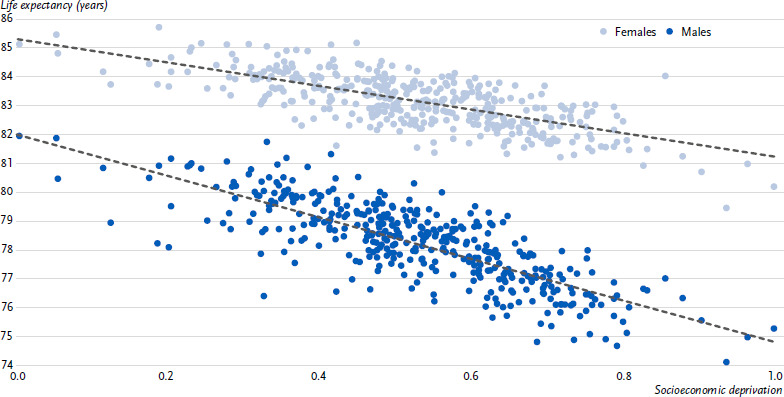
Methods: Nationwide data from the cause-of-death statistics from 2003 to 2022 were linked with official population data to calculate the average life expectancy of females and males in each of Germany's districts. Regression analysis was used to assess the association with the German Index of Socioeconomic Deprivation (GISD) at district level and calculate the life expectancy gap between the most and least deprived areas.
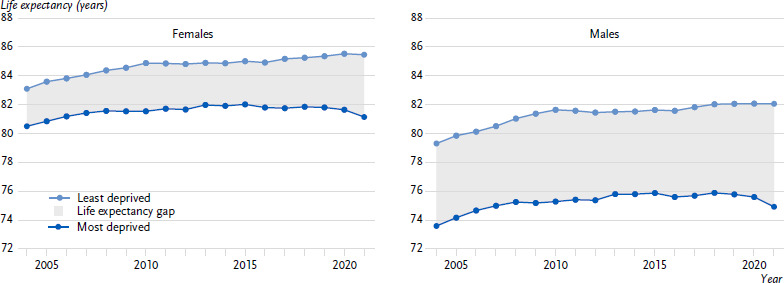
Results: In the period 2020 - 2022, life expectancy in the most deprived areas was 4.3 years (females) and 7.2 years (males) lower than in the least deprived areas. In the period 2003 - 2005, this life expectancy gap was still 2.6 and 5.7 years. The widening of the life expectancy gap resulted from a less favourable development of life expectancy in the most deprived areas. It was already evident before and intensified during the COVID-19 pandemic.
Conclusions: The increasing life expectancy gap indicates that health inequality in Germany is increasing. As a result, the development of a strategy to improve health equity is more important than ever to be placed on the policy agenda.



 京公网安备 11010802042870号
京ICP备2023020795号-1
京公网安备 11010802042870号
京ICP备2023020795号-1

 分享
分享

 求助内容:
求助内容: 应助结果提醒方式:
 扫码关注我们
