Eloi Gagnon, Dipender Gill, Stephen Burgess, Benoit J Arsenault
{"title":"Remnant cholesterol concentrations best explain the cardiovascular benefit of APOC3 genetic inhibition: a drug target Mendelian randomization study.","authors":"Eloi Gagnon, Dipender Gill, Stephen Burgess, Benoit J Arsenault","doi":"10.1093/ehjopen/oeaf018","DOIUrl":null,"url":null,"abstract":"<p><strong>Aims: </strong>Apolipoprotein C-III (APOC3) inhibitors are approved for hypertriglyceridaemia. Genetic evidence suggests that APOC3 inhibition may also prevent coronary artery disease (CAD), but mechanisms remain unclear.</p><p><strong>Methods and results: </strong>To clarify how APOC3 inhibition could prevent CAD, we performed two-step cis-Mendelian randomization using genetic variants in the <i>APOC3</i> gene region associated with plasma levels of APOC3. For comparison, we investigated proprotein convertase subtilisin/kexin type 9 (PCSK9). Potential mediators included apolipoprotein B, triglycerides, LDL-cholesterol, and remnant cholesterol measured by nuclear magnetic resonance spectroscopy in mostly fasting samples from Karjalainen et al., and in non-fasting samples from the UK Biobank. CAD data were from CARDIoGRAMplusC4D. APOC3 associations with apolipoprotein B and remnant cholesterol levels were two-fold larger in the study by Karjalainen et al. (55% fasted individuals) when compared with the UK Biobank study (non-fasted individuals). Genetically predicted lower APOC3 and PCSK9 levels were similarly associated with reduced CAD risk (OR = 0.83, 95% CI = 0.75-0.92, <i>P</i> = 4.6e-04 and 0.76, 95% CI = 0.73-0.80, <i>P</i> = 1.6e-31, respectively). In the two-step cis-Mendelian randomization analysis, the association between genetically predicted APOC3 and CAD was attenuated to null when adjusting for apolipoprotein B, triglycerides, or remnant cholesterol. Multivariable Mendelian randomization using genome-wide variants showed that remnant cholesterol, not triglycerides, was conditionally associated with CAD risk.</p><p><strong>Conclusion: </strong>Remnant cholesterol best explains the mechanism through which APOC3 inhibition could prevent CAD. APOC3 inhibition may influence fasting remnant cholesterol to a greater extent than non-fasting remnant cholesterol. People with high levels of remnant cholesterol could benefit from APOC3 inhibition.</p>","PeriodicalId":93995,"journal":{"name":"European heart journal open","volume":"5 2","pages":"oeaf018"},"PeriodicalIF":0.0000,"publicationDate":"2025-03-04","publicationTypes":"Journal Article","fieldsOfStudy":null,"isOpenAccess":false,"openAccessPdf":"https://www.ncbi.nlm.nih.gov/pmc/articles/PMC11951255/pdf/","citationCount":"0","resultStr":null,"platform":"Semanticscholar","paperid":null,"PeriodicalName":"European heart journal open","FirstCategoryId":"1085","ListUrlMain":"https://doi.org/10.1093/ehjopen/oeaf018","RegionNum":0,"RegionCategory":null,"ArticlePicture":[],"TitleCN":null,"AbstractTextCN":null,"PMCID":null,"EPubDate":"2025/3/1 0:00:00","PubModel":"eCollection","JCR":"","JCRName":"","Score":null,"Total":0}
引用次数: 0
Abstract
Aims: Apolipoprotein C-III (APOC3) inhibitors are approved for hypertriglyceridaemia. Genetic evidence suggests that APOC3 inhibition may also prevent coronary artery disease (CAD), but mechanisms remain unclear.
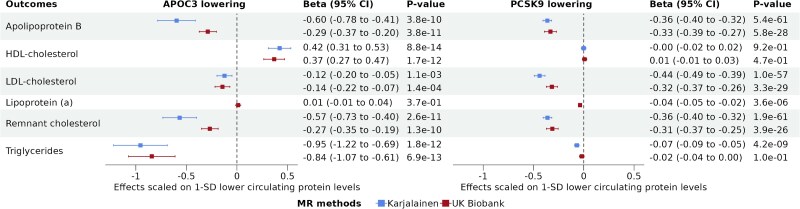
Methods and results: To clarify how APOC3 inhibition could prevent CAD, we performed two-step cis-Mendelian randomization using genetic variants in the APOC3 gene region associated with plasma levels of APOC3. For comparison, we investigated proprotein convertase subtilisin/kexin type 9 (PCSK9). Potential mediators included apolipoprotein B, triglycerides, LDL-cholesterol, and remnant cholesterol measured by nuclear magnetic resonance spectroscopy in mostly fasting samples from Karjalainen et al., and in non-fasting samples from the UK Biobank. CAD data were from CARDIoGRAMplusC4D. APOC3 associations with apolipoprotein B and remnant cholesterol levels were two-fold larger in the study by Karjalainen et al. (55% fasted individuals) when compared with the UK Biobank study (non-fasted individuals). Genetically predicted lower APOC3 and PCSK9 levels were similarly associated with reduced CAD risk (OR = 0.83, 95% CI = 0.75-0.92, P = 4.6e-04 and 0.76, 95% CI = 0.73-0.80, P = 1.6e-31, respectively). In the two-step cis-Mendelian randomization analysis, the association between genetically predicted APOC3 and CAD was attenuated to null when adjusting for apolipoprotein B, triglycerides, or remnant cholesterol. Multivariable Mendelian randomization using genome-wide variants showed that remnant cholesterol, not triglycerides, was conditionally associated with CAD risk.
Conclusion: Remnant cholesterol best explains the mechanism through which APOC3 inhibition could prevent CAD. APOC3 inhibition may influence fasting remnant cholesterol to a greater extent than non-fasting remnant cholesterol. People with high levels of remnant cholesterol could benefit from APOC3 inhibition.
载脂蛋白C-III (APOC3)抑制剂被批准用于治疗高甘油三酯血症。遗传证据表明,APOC3抑制也可能预防冠状动脉疾病(CAD),但机制尚不清楚。方法和结果:为了阐明APOC3抑制如何预防CAD,我们使用与APOC3血浆水平相关的APOC3基因区域的遗传变异进行了两步顺式孟德尔随机化。为了进行比较,我们研究了蛋白转化酶枯草杆菌素/酶切蛋白9型(PCSK9)。潜在的介质包括载脂蛋白B、甘油三酯、低密度脂蛋白胆固醇和残余胆固醇,这些介质通过核磁共振波谱法在Karjalainen等人的大部分空腹样本和UK Biobank的非空腹样本中测量。CAD数据来自CARDIoGRAMplusC4D。在Karjalainen等人的研究中(55%禁食个体),与英国生物银行研究(非禁食个体)相比,APOC3与载脂蛋白B和残余胆固醇水平的关联要大两倍。遗传预测较低的APOC3和PCSK9水平与降低CAD风险相似(OR = 0.83, 95% CI = 0.75-0.92, P = 4.6e-04和0.76,95% CI = 0.73-0.80, P = 1.6e-31)。在两步顺式孟德尔随机化分析中,当调整载脂蛋白B、甘油三酯或残余胆固醇时,基因预测的APOC3与CAD之间的关联减弱为零。使用全基因组变异的多变量孟德尔随机化显示,残余胆固醇而非甘油三酯与CAD风险有条件相关。结论:残余胆固醇能很好地解释apo3抑制预防冠心病的机制。与非空腹残余胆固醇相比,APOC3抑制对空腹残余胆固醇的影响更大。残余胆固醇水平高的人可以从APOC3抑制中获益。





 京公网安备 11010802042870号
京ICP备2023020795号-1
京公网安备 11010802042870号
京ICP备2023020795号-1

 分享
分享

 求助内容:
求助内容: 应助结果提醒方式:
 扫码关注我们
