Panukorn Sombut, Matthias Meier, Moritz Eder, Thomas Angerler, Oscar Gamba, Michael Schmid, Ulrike Diebold, Cesare Franchini and Gareth S. Parkinson
{"title":"The surface phase diagram of Fe3O4(001) revisited†","authors":"Panukorn Sombut, Matthias Meier, Moritz Eder, Thomas Angerler, Oscar Gamba, Michael Schmid, Ulrike Diebold, Cesare Franchini and Gareth S. Parkinson","doi":"10.1039/D5LF00022J","DOIUrl":null,"url":null,"abstract":"<p >Understanding how the physical and electronic structures of metal-oxide surfaces evolve under varying conditions is crucial for optimizing their performance in applications such as catalysis. In this study, we compute the surface phase diagram of the Fe<small><sub>3</sub></small>O<small><sub>4</sub></small>(001) facet using density functional theory (DFT)-based calculations, with an emphasis on understanding the terminations observed in surface science experiments. Our results reveal two stable terminations in addition to the subsurface cation vacancy (SCV) structure, which dominates under oxidizing conditions. The commonly reported octahedral Fe pair, also known as the Fe-dimer termination, is stable within an oxygen chemical potential range of −3.1 eV < <em>μ</em><small><sub>O</sub></small> < −2.3 eV. We identify the lowest-energy structure of this surface as the one proposed by J. R. Rustad, E. Wasserman and A. R. Felmy, A Molecular Dynamics Investigation of Surface Reconstruction on Magnetite (001), <em>Surf. Sci.</em>, 1999, <strong>432</strong>, 1–2, where a tetrahedrally coordinated Fe<small><sub>A</sub></small> atom is replaced by two octahedrally coordinated Fe<small><sub>B</sub></small> atoms in the surface layer. This transformation serves as a precursor to the emergence of an FeO-like termination under highly reducing conditions. A key insight from our study is the importance of thoroughly sampling different charge-order configurations to identify the global minima across varying stoichiometries.</p>","PeriodicalId":101138,"journal":{"name":"RSC Applied Interfaces","volume":" 3","pages":" 673-683"},"PeriodicalIF":0.0000,"publicationDate":"2025-03-14","publicationTypes":"Journal Article","fieldsOfStudy":null,"isOpenAccess":false,"openAccessPdf":"https://www.ncbi.nlm.nih.gov/pmc/articles/PMC11947718/pdf/","citationCount":"0","resultStr":null,"platform":"Semanticscholar","paperid":null,"PeriodicalName":"RSC Applied Interfaces","FirstCategoryId":"1085","ListUrlMain":"https://pubs.rsc.org/en/content/articlelanding/2025/lf/d5lf00022j","RegionNum":0,"RegionCategory":null,"ArticlePicture":[],"TitleCN":null,"AbstractTextCN":null,"PMCID":null,"EPubDate":"","PubModel":"","JCR":"","JCRName":"","Score":null,"Total":0}
引用次数: 0
Abstract
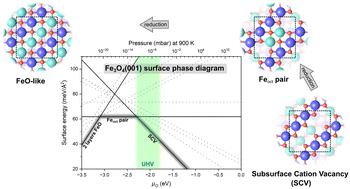
Understanding how the physical and electronic structures of metal-oxide surfaces evolve under varying conditions is crucial for optimizing their performance in applications such as catalysis. In this study, we compute the surface phase diagram of the Fe3O4(001) facet using density functional theory (DFT)-based calculations, with an emphasis on understanding the terminations observed in surface science experiments. Our results reveal two stable terminations in addition to the subsurface cation vacancy (SCV) structure, which dominates under oxidizing conditions. The commonly reported octahedral Fe pair, also known as the Fe-dimer termination, is stable within an oxygen chemical potential range of −3.1 eV < μO < −2.3 eV. We identify the lowest-energy structure of this surface as the one proposed by J. R. Rustad, E. Wasserman and A. R. Felmy, A Molecular Dynamics Investigation of Surface Reconstruction on Magnetite (001), Surf. Sci., 1999, 432, 1–2, where a tetrahedrally coordinated FeA atom is replaced by two octahedrally coordinated FeB atoms in the surface layer. This transformation serves as a precursor to the emergence of an FeO-like termination under highly reducing conditions. A key insight from our study is the importance of thoroughly sampling different charge-order configurations to identify the global minima across varying stoichiometries.
了解金属氧化物表面的物理和电子结构在不同条件下如何演变,对于优化它们在催化等应用中的性能至关重要。在本研究中,我们使用基于密度泛函理论(DFT)的计算方法计算了 Fe3O4(001)面的表面相图,重点是理解在表面科学实验中观察到的终止。我们的结果表明,除了在氧化条件下占主导地位的次表面阳离子空位(SCV)结构外,还有两种稳定的终止。通常报道的八面体 Fe 对,也称为 Fe-二聚体终止,在氧化学势范围 -3.1 eV < μ O < -2.3 eV 内是稳定的。我们确定该表面的最低能量结构是由 J. R. Rustad、E. Wasserman 和 A. R. Felmy 提出的,A Molecular Dynamics Investigation of Surface Reconstruction on Magnetite (001),Surf.Sci.,1999,432,1-2,其中一个四面体配位的 FeA 原子被表面层中两个八面体配位的 FeB 原子取代。这种转变是在高度还原条件下出现类 FeO 终止层的前兆。我们的研究得出的一个重要启示是,必须对不同的电荷阶构型进行全面采样,以确定不同化学计量的全局最小值。



 京公网安备 11010802042870号
京ICP备2023020795号-1
京公网安备 11010802042870号
京ICP备2023020795号-1

 分享
分享

 求助内容:
求助内容: 应助结果提醒方式:
 扫码关注我们
