Halogen-Atom Transfer Enabled Z-Selective Styrene Synthesis via Dual Cobalt and Photocatalysis Through Coupling of Unactivated Alkyl Iodides With Terminal Arylalkynes
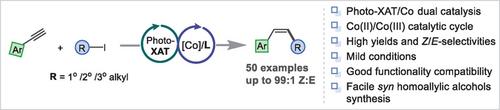
{"title":"Halogen-Atom Transfer Enabled Z-Selective Styrene Synthesis via Dual Cobalt and Photocatalysis Through Coupling of Unactivated Alkyl Iodides With Terminal Arylalkynes","authors":"Anxiang Huang, Zhao Liu, Ruobin Wang, Xinran Chang, Mingxing Feng, Yuxin Xiang, Xiaotian Qi, Jun Zhu","doi":"10.1002/anie.202501630","DOIUrl":null,"url":null,"abstract":"<p>An efficient <i>Z</i>-selective cobalt-catalyzed reductive hydroalkylation of terminal aryl alkynes with unactivated alkyl iodides has been achieved, providing a straightforward and modular route to access 1,2-disubstituted <i>Z</i>-styrenes. This reaction operates under mild conditions without requiring over-stoichiometric amounts of metal terminal reductants. Excellent <i>Z/E</i> ratios and good to excellent yields can be achieved for diverse and complex scaffolds with remarkable functional-group compatibility. One potential utility of this reaction is demonstrated by the efficient synthesis of several <i>syn</i> homoallylic alcohols in a one-pot two-step sequence. Control experiments strongly support that the halogen-atom transfer (XAT) process is the key to generating carbon radicals. DFT studies suggest that the catalytic system involves the Co(II)/Co(III) cycle and the steric repulsion between the Co(II) catalyst, and the alkenyl radical in radical capture by Co(II) is the dominant factor controlling the <i>Z/E</i> selectivity. This approach represents the first example of merging photo-XAT with cobalt-catalyzed reductive coupling of terminal aryl alkynes with unactivated alkyl iodides.</p>","PeriodicalId":125,"journal":{"name":"Angewandte Chemie International Edition","volume":"64 23","pages":""},"PeriodicalIF":16.9000,"publicationDate":"2025-04-01","publicationTypes":"Journal Article","fieldsOfStudy":null,"isOpenAccess":false,"openAccessPdf":"","citationCount":"0","resultStr":null,"platform":"Semanticscholar","paperid":null,"PeriodicalName":"Angewandte Chemie International Edition","FirstCategoryId":"92","ListUrlMain":"https://onlinelibrary.wiley.com/doi/10.1002/anie.202501630","RegionNum":1,"RegionCategory":"化学","ArticlePicture":[],"TitleCN":null,"AbstractTextCN":null,"PMCID":null,"EPubDate":"","PubModel":"","JCR":"Q1","JCRName":"CHEMISTRY, MULTIDISCIPLINARY","Score":null,"Total":0}
引用次数: 0
Abstract
An efficient Z-selective cobalt-catalyzed reductive hydroalkylation of terminal aryl alkynes with unactivated alkyl iodides has been achieved, providing a straightforward and modular route to access 1,2-disubstituted Z-styrenes. This reaction operates under mild conditions without requiring over-stoichiometric amounts of metal terminal reductants. Excellent Z/E ratios and good to excellent yields can be achieved for diverse and complex scaffolds with remarkable functional-group compatibility. One potential utility of this reaction is demonstrated by the efficient synthesis of several syn homoallylic alcohols in a one-pot two-step sequence. Control experiments strongly support that the halogen-atom transfer (XAT) process is the key to generating carbon radicals. DFT studies suggest that the catalytic system involves the Co(II)/Co(III) cycle and the steric repulsion between the Co(II) catalyst, and the alkenyl radical in radical capture by Co(II) is the dominant factor controlling the Z/E selectivity. This approach represents the first example of merging photo-XAT with cobalt-catalyzed reductive coupling of terminal aryl alkynes with unactivated alkyl iodides.
期刊介绍:
Angewandte Chemie, a journal of the German Chemical Society (GDCh), maintains a leading position among scholarly journals in general chemistry with an impressive Impact Factor of 16.6 (2022 Journal Citation Reports, Clarivate, 2023). Published weekly in a reader-friendly format, it features new articles almost every day. Established in 1887, Angewandte Chemie is a prominent chemistry journal, offering a dynamic blend of Review-type articles, Highlights, Communications, and Research Articles on a weekly basis, making it unique in the field.




 京公网安备 11010802042870号
京ICP备2023020795号-1
京公网安备 11010802042870号
京ICP备2023020795号-1

 分享
分享
 求助内容:
求助内容: 应助结果提醒方式:
 扫码关注我们
