{"title":"Engineering durable antioxidative nanoreactors as synthetic organelles for autoregulatory cellular protection against oxidative stress","authors":"Panyue Wen , Anjaneyulu Dirisala , Haocheng Guo , Xueying Liu , Shingo Kobayashi , Hiroaki Kinoh , Takahisa Anada , Masaru Tanaka , Kazunori Kataoka , Junjie Li","doi":"10.1016/j.jconrel.2025.113683","DOIUrl":null,"url":null,"abstract":"<div><div>Polymersomes, which are polymer vesicles containing an aqueous cavity enclosed in a polymer membrane, hold enormous potential for biomedical applications. In recent years, enzyme-loaded polymersomes, serving as therapeutic nanoreactors, have drawn substantial interest. A crucial requirement for effective catalytic function is to impart semipermeability to the vesicular membrane while maintaining its role as a protective barrier for encapsulated enzymes. However, achieving both long-term stability and optimal membrane permeability for sustained functionality remains a challenge in many reported examples. In this study, we introduce ROS-responsive polyion complex vesicles (PICsomes) loaded with antioxidant enzymes (catalase) as antioxidative nanoreactors. The intrinsic semipermeability and crosslinked network structure of the membrane enable long-lasting catalytic function of catalase. The nanoreactor exhibits inherent cell-protective properties against oxidative stress in fibroblasts due to the ROS-scavenging ability of polymers. Notably, triggered by ROS, the nanoreactor demonstrates autoregulatory control of redox homeostasis. This is because the cysteamine released by PICsomes not only acts as a free radical scavenger but also facilitates the transport of L-cysteine into cells, thereby enhancing glutathione (GSH) biosynthesis. The results further demonstrate significant long blood circulation of PICsomes loaded with catalase and strong protection effects against bloodstream oxidative stress, paving the way for the further development of truly effective in vivo therapeutics. These findings underscore the potential of the engineered antioxidative nanoreactor with durable functionality as synthetic organelles for cellular protection against oxidative stress.</div></div>","PeriodicalId":15450,"journal":{"name":"Journal of Controlled Release","volume":"382 ","pages":"Article 113683"},"PeriodicalIF":11.5000,"publicationDate":"2025-04-02","publicationTypes":"Journal Article","fieldsOfStudy":null,"isOpenAccess":false,"openAccessPdf":"","citationCount":"0","resultStr":null,"platform":"Semanticscholar","paperid":null,"PeriodicalName":"Journal of Controlled Release","FirstCategoryId":"3","ListUrlMain":"https://www.sciencedirect.com/science/article/pii/S0168365925003037","RegionNum":1,"RegionCategory":"医学","ArticlePicture":[],"TitleCN":null,"AbstractTextCN":null,"PMCID":null,"EPubDate":"","PubModel":"","JCR":"Q1","JCRName":"CHEMISTRY, MULTIDISCIPLINARY","Score":null,"Total":0}
引用次数: 0
Abstract
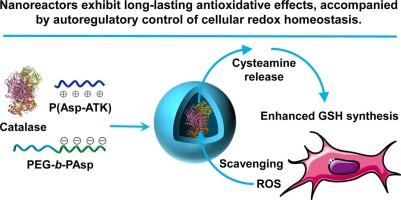
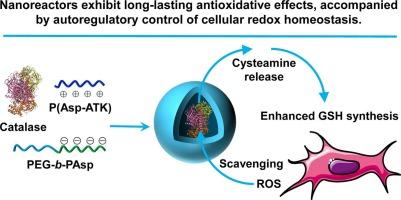
Polymersomes, which are polymer vesicles containing an aqueous cavity enclosed in a polymer membrane, hold enormous potential for biomedical applications. In recent years, enzyme-loaded polymersomes, serving as therapeutic nanoreactors, have drawn substantial interest. A crucial requirement for effective catalytic function is to impart semipermeability to the vesicular membrane while maintaining its role as a protective barrier for encapsulated enzymes. However, achieving both long-term stability and optimal membrane permeability for sustained functionality remains a challenge in many reported examples. In this study, we introduce ROS-responsive polyion complex vesicles (PICsomes) loaded with antioxidant enzymes (catalase) as antioxidative nanoreactors. The intrinsic semipermeability and crosslinked network structure of the membrane enable long-lasting catalytic function of catalase. The nanoreactor exhibits inherent cell-protective properties against oxidative stress in fibroblasts due to the ROS-scavenging ability of polymers. Notably, triggered by ROS, the nanoreactor demonstrates autoregulatory control of redox homeostasis. This is because the cysteamine released by PICsomes not only acts as a free radical scavenger but also facilitates the transport of L-cysteine into cells, thereby enhancing glutathione (GSH) biosynthesis. The results further demonstrate significant long blood circulation of PICsomes loaded with catalase and strong protection effects against bloodstream oxidative stress, paving the way for the further development of truly effective in vivo therapeutics. These findings underscore the potential of the engineered antioxidative nanoreactor with durable functionality as synthetic organelles for cellular protection against oxidative stress.
期刊介绍:
The Journal of Controlled Release (JCR) proudly serves as the Official Journal of the Controlled Release Society and the Japan Society of Drug Delivery System.
Dedicated to the broad field of delivery science and technology, JCR publishes high-quality research articles covering drug delivery systems and all facets of formulations. This includes the physicochemical and biological properties of drugs, design and characterization of dosage forms, release mechanisms, in vivo testing, and formulation research and development across pharmaceutical, diagnostic, agricultural, environmental, cosmetic, and food industries.
Priority is given to manuscripts that contribute to the fundamental understanding of principles or demonstrate the advantages of novel technologies in terms of safety and efficacy over current clinical standards. JCR strives to be a leading platform for advancements in delivery science and technology.



 京公网安备 11010802042870号
京ICP备2023020795号-1
京公网安备 11010802042870号
京ICP备2023020795号-1

 分享
分享
 求助内容:
求助内容: 应助结果提醒方式:
 扫码关注我们
