Andrew McLain , Amanda Kowalczyk , Paulina Baran-Rachwalska , Flavia Maria Sutera , Louise J. Robertson , Nadia Sukusu Nielsen , Jan J. Enghild , Diego Cobice , Filippo Bonelli , Vanessa Barbaro , Stefano Ferrari , Benjamin Patterson , Luca Moore , John Marshall , M. Andrew Nesbit , Tara Moore
{"title":"TGFBI R124H mutant allele silencing in granular corneal dystrophy type 2 using topical siRNA delivery","authors":"Andrew McLain , Amanda Kowalczyk , Paulina Baran-Rachwalska , Flavia Maria Sutera , Louise J. Robertson , Nadia Sukusu Nielsen , Jan J. Enghild , Diego Cobice , Filippo Bonelli , Vanessa Barbaro , Stefano Ferrari , Benjamin Patterson , Luca Moore , John Marshall , M. Andrew Nesbit , Tara Moore","doi":"10.1016/j.jconrel.2025.113681","DOIUrl":null,"url":null,"abstract":"<div><div>In recent years, success has been achieved in treating several eye conditions with oligonucleotide-based therapies. Herein, we outline the experimentation involved in progressing selection and development of a lead therapeutic siRNA for R124H mutation of <em>TGFBI</em> gene which causes Granular Corneal Dystrophy Type 2 (GCD2/Avellino CD). Firstly, a series of siRNA designs, generated by a gene walk across the R124H <em>TGFBI</em> mutation site, were tested and a lead siRNA identified. The lead siRNA was delivered into an immortalised human corneal epithelial cell line to assess on-target efficacy and off-target effects. The <em>in vivo</em> efficacy of the lead R124H <em>TGFBI</em> siRNA, complexed with Bio-Courier technology, silicon stabilized hybrid lipid nanoparticles (sshLNP), was assessed in a mouse model of GCD2 which expressed the human R124H <em>TGFBI</em> transgene. Following topical siRNA application for 5 consecutive days, expression of the R124H mutant <em>TGFB</em>I transgene was measured and shown to be reduced by 22.4 % (± 15.7 %, <em>p</em> < 0.05).</div><div>We investigated gene expression in the mouse cornea and showed expression of murine <em>Tgfbi</em> was 20-fold lower than TGFBI in human cornea, and expression of the mutant <em>TGFBI</em> transgene was a further 3-fold lower. This estimated 60-fold lower mutant transgene expression may explain the low frequency of corneal deposits observed in this mouse model, limiting its usefulness to test whether siRNA silencing is capable of phenotypic improvement or regression of GCD2/Avellino corneal dystrophy.</div><div>We assessed WT TGFBI silencing in human primary corneal epithelial cells (PCEC) derived from human corneal limbal biopsy material, which express TGFBI at a similar level to human corneal biopsy. We demonstrated that a single 100 nM siRNA treatment, delivered by the sshLNP to the primary human corneal epithelial cells, gave 26.6 % (± 6.6 %, <em>p</em> < 0.001) reduction in TGFBI mRNA and a 15.4 % (±10.5 %, <em>p</em> < 0.05 %) reduction in TGFBi protein after 48 h. In consideration of the mutant gene expression levels in existing models of GCD2 disease, an <em>ex vivo</em> model of mutation-expressing primary corneal epithelial cells generated from corneal limbal biopsies from GCD2 patients would be more suitable than existing transgenic mouse models for future pre-clinical work in the development of gene silencing therapies for corneal dystrophies.</div></div>","PeriodicalId":15450,"journal":{"name":"Journal of Controlled Release","volume":"382 ","pages":"Article 113681"},"PeriodicalIF":11.5000,"publicationDate":"2025-06-10","publicationTypes":"Journal Article","fieldsOfStudy":null,"isOpenAccess":false,"openAccessPdf":"","citationCount":"0","resultStr":null,"platform":"Semanticscholar","paperid":null,"PeriodicalName":"Journal of Controlled Release","FirstCategoryId":"3","ListUrlMain":"https://www.sciencedirect.com/science/article/pii/S0168365925003013","RegionNum":1,"RegionCategory":"医学","ArticlePicture":[],"TitleCN":null,"AbstractTextCN":null,"PMCID":null,"EPubDate":"2025/4/2 0:00:00","PubModel":"Epub","JCR":"Q1","JCRName":"CHEMISTRY, MULTIDISCIPLINARY","Score":null,"Total":0}
引用次数: 0
Abstract
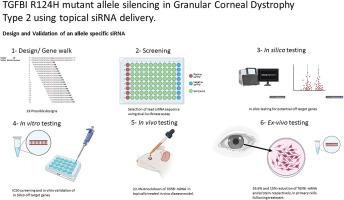
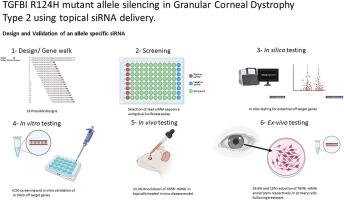
In recent years, success has been achieved in treating several eye conditions with oligonucleotide-based therapies. Herein, we outline the experimentation involved in progressing selection and development of a lead therapeutic siRNA for R124H mutation of TGFBI gene which causes Granular Corneal Dystrophy Type 2 (GCD2/Avellino CD). Firstly, a series of siRNA designs, generated by a gene walk across the R124H TGFBI mutation site, were tested and a lead siRNA identified. The lead siRNA was delivered into an immortalised human corneal epithelial cell line to assess on-target efficacy and off-target effects. The in vivo efficacy of the lead R124H TGFBI siRNA, complexed with Bio-Courier technology, silicon stabilized hybrid lipid nanoparticles (sshLNP), was assessed in a mouse model of GCD2 which expressed the human R124H TGFBI transgene. Following topical siRNA application for 5 consecutive days, expression of the R124H mutant TGFBI transgene was measured and shown to be reduced by 22.4 % (± 15.7 %, p < 0.05).
We investigated gene expression in the mouse cornea and showed expression of murine Tgfbi was 20-fold lower than TGFBI in human cornea, and expression of the mutant TGFBI transgene was a further 3-fold lower. This estimated 60-fold lower mutant transgene expression may explain the low frequency of corneal deposits observed in this mouse model, limiting its usefulness to test whether siRNA silencing is capable of phenotypic improvement or regression of GCD2/Avellino corneal dystrophy.
We assessed WT TGFBI silencing in human primary corneal epithelial cells (PCEC) derived from human corneal limbal biopsy material, which express TGFBI at a similar level to human corneal biopsy. We demonstrated that a single 100 nM siRNA treatment, delivered by the sshLNP to the primary human corneal epithelial cells, gave 26.6 % (± 6.6 %, p < 0.001) reduction in TGFBI mRNA and a 15.4 % (±10.5 %, p < 0.05 %) reduction in TGFBi protein after 48 h. In consideration of the mutant gene expression levels in existing models of GCD2 disease, an ex vivo model of mutation-expressing primary corneal epithelial cells generated from corneal limbal biopsies from GCD2 patients would be more suitable than existing transgenic mouse models for future pre-clinical work in the development of gene silencing therapies for corneal dystrophies.
期刊介绍:
The Journal of Controlled Release (JCR) proudly serves as the Official Journal of the Controlled Release Society and the Japan Society of Drug Delivery System.
Dedicated to the broad field of delivery science and technology, JCR publishes high-quality research articles covering drug delivery systems and all facets of formulations. This includes the physicochemical and biological properties of drugs, design and characterization of dosage forms, release mechanisms, in vivo testing, and formulation research and development across pharmaceutical, diagnostic, agricultural, environmental, cosmetic, and food industries.
Priority is given to manuscripts that contribute to the fundamental understanding of principles or demonstrate the advantages of novel technologies in terms of safety and efficacy over current clinical standards. JCR strives to be a leading platform for advancements in delivery science and technology.



 京公网安备 11010802042870号
京ICP备2023020795号-1
京公网安备 11010802042870号
京ICP备2023020795号-1

 分享
分享
 求助内容:
求助内容: 应助结果提醒方式:
 扫码关注我们
