Dennis To , Christian Steinbring , Leonie I. Weber , Fabrizio Ricci , Ilaria Polidori , Annika Postina , Markus Hartl , Andreas Bernkop-Schnürch
{"title":"Design of lipid-based formulations for oral delivery of a BASP1 peptide targeting MYC-dependent gastrointestinal cancer cells","authors":"Dennis To , Christian Steinbring , Leonie I. Weber , Fabrizio Ricci , Ilaria Polidori , Annika Postina , Markus Hartl , Andreas Bernkop-Schnürch","doi":"10.1016/j.jconrel.2025.113677","DOIUrl":null,"url":null,"abstract":"<div><h3>Hypothesis</h3><div>Oral delivery of the proliferation-inhibiting brain acid-soluble protein 1 effector domain peptide (Myr-NT) towards MYC-dependent gastrointestinal tumors can be achieved by forming hydrophobic ion pairs (HIPs) and incorporating them into lipid-based formulations.</div></div><div><h3>Experiments</h3><div>Hydrophobic ion pairing of fluorescently-labelled Myr-NT (Myr-NT-TAMRA) was performed, increase in lipophilicity was assessed, and the most promising HIP was subsequently incorporated into a nanoemulsion. Stability of the peptide towards degradation by trypsin was evaluated. Anti-proliferative and anti-invasive measurements were performed upon application of the loaded nanoemulsion on various MYC-dependent human cancer cell lines. Cellular uptake and molecular effect were complementary investigated by confocal laser scanning microscopy (CLSM) and by immunoblot analyses, respectively.</div></div><div><h3>Findings</h3><div>HIPs of Myr-NT-TAMRA exhibited up to 10,000-fold increase in lipophilicity, thereby enabling incorporation into a nanoemulsion. The formulation significantly boosted stability of incorporated peptide towards enzymatic degradation by trypsin. Furthermore, anti-proliferative measurements on human cancer cell lines revealed superior biological activity of the loaded nanoemulsion compared to the native peptide particularly in lymphoma cells, but also in colorectal cancer cells. Thereby, a correlation with proliferation inhibition as well as differences in MYC protein expression were observed. Finally, CLSM imaging revealed up to 15-fold increased cellular uptake of Myr-NT-TAMRA from the nanoemulsion confirming efficient intracellular delivery of the peptide.</div></div><div><h3>Conclusion</h3><div>Myr-NT can be efficiently delivered into intestinal tumor cells using orally administered lipid-based formulations.</div></div>","PeriodicalId":15450,"journal":{"name":"Journal of Controlled Release","volume":"382 ","pages":"Article 113677"},"PeriodicalIF":11.5000,"publicationDate":"2025-04-02","publicationTypes":"Journal Article","fieldsOfStudy":null,"isOpenAccess":false,"openAccessPdf":"","citationCount":"0","resultStr":null,"platform":"Semanticscholar","paperid":null,"PeriodicalName":"Journal of Controlled Release","FirstCategoryId":"3","ListUrlMain":"https://www.sciencedirect.com/science/article/pii/S0168365925002974","RegionNum":1,"RegionCategory":"医学","ArticlePicture":[],"TitleCN":null,"AbstractTextCN":null,"PMCID":null,"EPubDate":"","PubModel":"","JCR":"Q1","JCRName":"CHEMISTRY, MULTIDISCIPLINARY","Score":null,"Total":0}
引用次数: 0
Abstract
Hypothesis
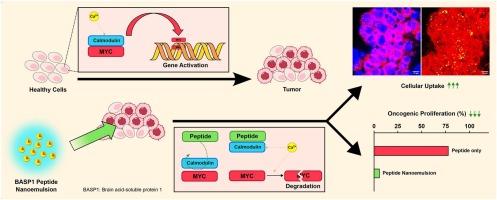
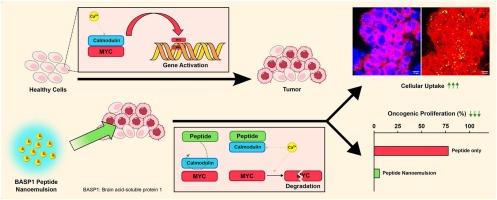
Oral delivery of the proliferation-inhibiting brain acid-soluble protein 1 effector domain peptide (Myr-NT) towards MYC-dependent gastrointestinal tumors can be achieved by forming hydrophobic ion pairs (HIPs) and incorporating them into lipid-based formulations.
Experiments
Hydrophobic ion pairing of fluorescently-labelled Myr-NT (Myr-NT-TAMRA) was performed, increase in lipophilicity was assessed, and the most promising HIP was subsequently incorporated into a nanoemulsion. Stability of the peptide towards degradation by trypsin was evaluated. Anti-proliferative and anti-invasive measurements were performed upon application of the loaded nanoemulsion on various MYC-dependent human cancer cell lines. Cellular uptake and molecular effect were complementary investigated by confocal laser scanning microscopy (CLSM) and by immunoblot analyses, respectively.
Findings
HIPs of Myr-NT-TAMRA exhibited up to 10,000-fold increase in lipophilicity, thereby enabling incorporation into a nanoemulsion. The formulation significantly boosted stability of incorporated peptide towards enzymatic degradation by trypsin. Furthermore, anti-proliferative measurements on human cancer cell lines revealed superior biological activity of the loaded nanoemulsion compared to the native peptide particularly in lymphoma cells, but also in colorectal cancer cells. Thereby, a correlation with proliferation inhibition as well as differences in MYC protein expression were observed. Finally, CLSM imaging revealed up to 15-fold increased cellular uptake of Myr-NT-TAMRA from the nanoemulsion confirming efficient intracellular delivery of the peptide.
Conclusion
Myr-NT can be efficiently delivered into intestinal tumor cells using orally administered lipid-based formulations.
期刊介绍:
The Journal of Controlled Release (JCR) proudly serves as the Official Journal of the Controlled Release Society and the Japan Society of Drug Delivery System.
Dedicated to the broad field of delivery science and technology, JCR publishes high-quality research articles covering drug delivery systems and all facets of formulations. This includes the physicochemical and biological properties of drugs, design and characterization of dosage forms, release mechanisms, in vivo testing, and formulation research and development across pharmaceutical, diagnostic, agricultural, environmental, cosmetic, and food industries.
Priority is given to manuscripts that contribute to the fundamental understanding of principles or demonstrate the advantages of novel technologies in terms of safety and efficacy over current clinical standards. JCR strives to be a leading platform for advancements in delivery science and technology.



 京公网安备 11010802042870号
京ICP备2023020795号-1
京公网安备 11010802042870号
京ICP备2023020795号-1

 分享
分享
 求助内容:
求助内容: 应助结果提醒方式:
 扫码关注我们
