{"title":"Drug-Carrying Bottlebrush Copolymers via ROMP of Anionically Polymerized Hyperbranched Polyglycerol","authors":"Linxin Ge, Li Xu, Yueming Xu, Shumu Li, Xingchao Huang, Xiaojun Jiang, Yongjia Yang, Yu-ang Cui, Fang Wang, Li Deng, Zhiying Yang, Bingyin Jiang","doi":"10.1021/acs.macromol.5c00126","DOIUrl":null,"url":null,"abstract":"This work presents the synthesis of bottlebrush copolymers with anionically polymerized hyperbranched polyglycerol (HPG) side chains via ring-opening metathesis polymerization (ROMP). The efficacy and mechanism of the bottlebrush copolymer and its macromonomer as carriers for the insoluble drug paclitaxel (PTX) were evaluated. Starting with <i>O</i>-(2-aminoethyl)polyethylene glycol (H<sub>2</sub>N-PEG–OH), the terminal −NH<sub>2</sub> group was first protected by the triphenylmethyl (Trt) group, and then anionic ring-opening polymerization of PG was initiated from the −OH group by CsOH. Subsequently, ROMP was performed to obtain bottlebrush HPG with a degree of polymerization reaching 200. The abundant −OH groups of HPG were reacted with succinic anhydride and then PTX. The resulting covalent-bonded bottlebrush-PTX conjugate (denoted as BB-5-PTX) is amphiphilic and displayed two stages of self-assembly in the aqueous phase at a concentration above the critical micelle concentration (CMC). The antitumor activity of BB-5-PTX was examined at concentrations below the CMC and showed a notable enhancement compared to its macromonomer-PTX counterpart (MM-4-PTX<sub>7</sub>). Cellular uptake studies and flow cytometry unveiled the mechanism of this increased efficacy. Despite endocytosing fewer molecules, the bottlebrush copolymer effectively delivers more drug units across the cell membrane due to its amphiphilicity and higher number of binding sites per molecule than its corresponding macromonomer.","PeriodicalId":51,"journal":{"name":"Macromolecules","volume":"16 1","pages":""},"PeriodicalIF":5.2000,"publicationDate":"2025-04-02","publicationTypes":"Journal Article","fieldsOfStudy":null,"isOpenAccess":false,"openAccessPdf":"","citationCount":"0","resultStr":null,"platform":"Semanticscholar","paperid":null,"PeriodicalName":"Macromolecules","FirstCategoryId":"92","ListUrlMain":"https://doi.org/10.1021/acs.macromol.5c00126","RegionNum":1,"RegionCategory":"化学","ArticlePicture":[],"TitleCN":null,"AbstractTextCN":null,"PMCID":null,"EPubDate":"","PubModel":"","JCR":"Q1","JCRName":"POLYMER SCIENCE","Score":null,"Total":0}
引用次数: 0
Abstract
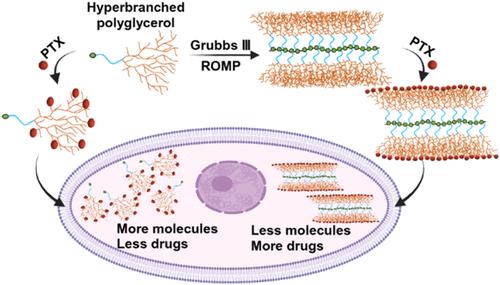
This work presents the synthesis of bottlebrush copolymers with anionically polymerized hyperbranched polyglycerol (HPG) side chains via ring-opening metathesis polymerization (ROMP). The efficacy and mechanism of the bottlebrush copolymer and its macromonomer as carriers for the insoluble drug paclitaxel (PTX) were evaluated. Starting with O-(2-aminoethyl)polyethylene glycol (H2N-PEG–OH), the terminal −NH2 group was first protected by the triphenylmethyl (Trt) group, and then anionic ring-opening polymerization of PG was initiated from the −OH group by CsOH. Subsequently, ROMP was performed to obtain bottlebrush HPG with a degree of polymerization reaching 200. The abundant −OH groups of HPG were reacted with succinic anhydride and then PTX. The resulting covalent-bonded bottlebrush-PTX conjugate (denoted as BB-5-PTX) is amphiphilic and displayed two stages of self-assembly in the aqueous phase at a concentration above the critical micelle concentration (CMC). The antitumor activity of BB-5-PTX was examined at concentrations below the CMC and showed a notable enhancement compared to its macromonomer-PTX counterpart (MM-4-PTX7). Cellular uptake studies and flow cytometry unveiled the mechanism of this increased efficacy. Despite endocytosing fewer molecules, the bottlebrush copolymer effectively delivers more drug units across the cell membrane due to its amphiphilicity and higher number of binding sites per molecule than its corresponding macromonomer.
期刊介绍:
Macromolecules publishes original, fundamental, and impactful research on all aspects of polymer science. Topics of interest include synthesis (e.g., controlled polymerizations, polymerization catalysis, post polymerization modification, new monomer structures and polymer architectures, and polymerization mechanisms/kinetics analysis); phase behavior, thermodynamics, dynamic, and ordering/disordering phenomena (e.g., self-assembly, gelation, crystallization, solution/melt/solid-state characteristics); structure and properties (e.g., mechanical and rheological properties, surface/interfacial characteristics, electronic and transport properties); new state of the art characterization (e.g., spectroscopy, scattering, microscopy, rheology), simulation (e.g., Monte Carlo, molecular dynamics, multi-scale/coarse-grained modeling), and theoretical methods. Renewable/sustainable polymers, polymer networks, responsive polymers, electro-, magneto- and opto-active macromolecules, inorganic polymers, charge-transporting polymers (ion-containing, semiconducting, and conducting), nanostructured polymers, and polymer composites are also of interest. Typical papers published in Macromolecules showcase important and innovative concepts, experimental methods/observations, and theoretical/computational approaches that demonstrate a fundamental advance in the understanding of polymers.



 京公网安备 11010802042870号
京ICP备2023020795号-1
京公网安备 11010802042870号
京ICP备2023020795号-1

 分享
分享
 求助内容:
求助内容: 应助结果提醒方式:
 扫码关注我们
