Annu Sharma , Harsh Satiya , Nandhini J. Usharani , Subrata Biswas , S.S. Bhattacharya
{"title":"High-entropy titanate perovskites: Nanoarchitectonics and structure-property investigations","authors":"Annu Sharma , Harsh Satiya , Nandhini J. Usharani , Subrata Biswas , S.S. Bhattacharya","doi":"10.1016/j.jallcom.2025.180185","DOIUrl":null,"url":null,"abstract":"<div><div>Phase-pure medium and high entropy (ABO<sub>3</sub>) perovskites with multiple cations at site A and Ti at site B – (CaLaNaSr)TiO<sub>3</sub>, (CaNaNdSr)TiO<sub>3</sub>, (CaNaPrSr)TiO<sub>3</sub>, (CaLaNaPbSr)TiO<sub>3</sub>, (CaNaNdPbSr)TiO<sub>3</sub> and [CaNaPbSr(LaNdPr)]TiO<sub>3</sub> – were synthesised by a reverse co-precipitation process followed by a suitable calcination step. The calcination temperature was determined by studying the phase evolution, formation, and transformation so that a phase-pure tetragonal perovskite structure could be attained in all six systems studied. Electron microscopy revealed the particles to be highly crystalline and nano sized. The various vibrational modes and tetragonality in the lattice as well as defect states were studied using Raman spectroscopy. The band gaps of the phase-pure systems were determined using diffuse reflectance spectroscopy (DRS). The indirect band gaps of the six synthesised systems were found to be in the range of 2.51 – 3.07 eV, while the direct band gaps were in the range of 2.97 – 3.37 eV, which were less than those of the individual titanates and oxides due to the formation of defect states. The systems containing Pb showed the lowest band gap when compared to other systems. Broadband spectroscopy was used to determine the dielectric properties of the synthesised systems. The systems containing Pb showed higher dielectric constant values owing to their high tetragonality. The synthesised materials pose potential for photocatalytic applications due to their reduced band gap values.</div></div>","PeriodicalId":344,"journal":{"name":"Journal of Alloys and Compounds","volume":"1024 ","pages":"Article 180185"},"PeriodicalIF":6.3000,"publicationDate":"2025-04-20","publicationTypes":"Journal Article","fieldsOfStudy":null,"isOpenAccess":false,"openAccessPdf":"","citationCount":"0","resultStr":null,"platform":"Semanticscholar","paperid":null,"PeriodicalName":"Journal of Alloys and Compounds","FirstCategoryId":"88","ListUrlMain":"https://www.sciencedirect.com/science/article/pii/S0925838825017438","RegionNum":2,"RegionCategory":"材料科学","ArticlePicture":[],"TitleCN":null,"AbstractTextCN":null,"PMCID":null,"EPubDate":"2025/4/1 0:00:00","PubModel":"Epub","JCR":"Q2","JCRName":"CHEMISTRY, PHYSICAL","Score":null,"Total":0}
引用次数: 0
Abstract
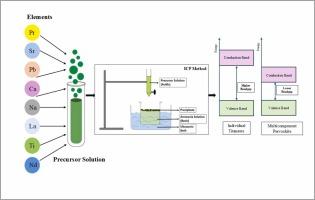
Phase-pure medium and high entropy (ABO3) perovskites with multiple cations at site A and Ti at site B – (CaLaNaSr)TiO3, (CaNaNdSr)TiO3, (CaNaPrSr)TiO3, (CaLaNaPbSr)TiO3, (CaNaNdPbSr)TiO3 and [CaNaPbSr(LaNdPr)]TiO3 – were synthesised by a reverse co-precipitation process followed by a suitable calcination step. The calcination temperature was determined by studying the phase evolution, formation, and transformation so that a phase-pure tetragonal perovskite structure could be attained in all six systems studied. Electron microscopy revealed the particles to be highly crystalline and nano sized. The various vibrational modes and tetragonality in the lattice as well as defect states were studied using Raman spectroscopy. The band gaps of the phase-pure systems were determined using diffuse reflectance spectroscopy (DRS). The indirect band gaps of the six synthesised systems were found to be in the range of 2.51 – 3.07 eV, while the direct band gaps were in the range of 2.97 – 3.37 eV, which were less than those of the individual titanates and oxides due to the formation of defect states. The systems containing Pb showed the lowest band gap when compared to other systems. Broadband spectroscopy was used to determine the dielectric properties of the synthesised systems. The systems containing Pb showed higher dielectric constant values owing to their high tetragonality. The synthesised materials pose potential for photocatalytic applications due to their reduced band gap values.
期刊介绍:
The Journal of Alloys and Compounds is intended to serve as an international medium for the publication of work on solid materials comprising compounds as well as alloys. Its great strength lies in the diversity of discipline which it encompasses, drawing together results from materials science, solid-state chemistry and physics.



 京公网安备 11010802042870号
京ICP备2023020795号-1
京公网安备 11010802042870号
京ICP备2023020795号-1

 分享
分享
 求助内容:
求助内容: 应助结果提醒方式:
 扫码关注我们
