{"title":"Advances in Tandem Mass Spectrometry Imaging for Next-Generation Spatial Metabolomics","authors":"Yao Qian, Xiaoxiao Ma","doi":"10.1021/acs.analchem.5c00157","DOIUrl":null,"url":null,"abstract":"Spatial metabolomics based on mass spectrometry imaging (MSI) is a promising approach for fundamental biological research and disease biomarker discovery. It simultaneously reveals the spatial distributions of hundreds of metabolites across tissue sections. While previous MSI experiments predominantly rely on high-resolution mass analysis for metabolite annotation, the high specificity in resolving molecular structures is essential to distinguish isomers or isobars to obtain ultimate identities of the metabolites. This is also critical for correlating their biological functions with spatial distribution patterns. Tandem mass spectrometry (MS/MS) is effectively used to obtain molecular structural information and has been integrated into MSI for spatial mapping of structurally distinct biomolecules, though typically with low coverage. The main technical challenge in achieving high-coverage, high-structure-resolving spatial mapping of biomolecules lies in the limited amount of sample available from each tissue pixel in conventional MS/MS analysis, which restricts the number of MS/MS scans that can be conducted on the metabolite precursors of interest. In this Perspective, we highlight recent developments in advanced MS/MS imaging strategies aimed at achieving high-coverage spatial metabolomics.","PeriodicalId":27,"journal":{"name":"Analytical Chemistry","volume":"25 1","pages":""},"PeriodicalIF":6.7000,"publicationDate":"2025-04-02","publicationTypes":"Journal Article","fieldsOfStudy":null,"isOpenAccess":false,"openAccessPdf":"","citationCount":"0","resultStr":null,"platform":"Semanticscholar","paperid":null,"PeriodicalName":"Analytical Chemistry","FirstCategoryId":"92","ListUrlMain":"https://doi.org/10.1021/acs.analchem.5c00157","RegionNum":1,"RegionCategory":"化学","ArticlePicture":[],"TitleCN":null,"AbstractTextCN":null,"PMCID":null,"EPubDate":"","PubModel":"","JCR":"Q1","JCRName":"CHEMISTRY, ANALYTICAL","Score":null,"Total":0}
引用次数: 0
Abstract
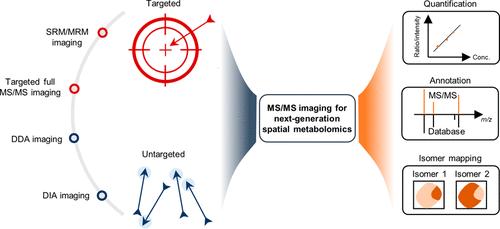
Spatial metabolomics based on mass spectrometry imaging (MSI) is a promising approach for fundamental biological research and disease biomarker discovery. It simultaneously reveals the spatial distributions of hundreds of metabolites across tissue sections. While previous MSI experiments predominantly rely on high-resolution mass analysis for metabolite annotation, the high specificity in resolving molecular structures is essential to distinguish isomers or isobars to obtain ultimate identities of the metabolites. This is also critical for correlating their biological functions with spatial distribution patterns. Tandem mass spectrometry (MS/MS) is effectively used to obtain molecular structural information and has been integrated into MSI for spatial mapping of structurally distinct biomolecules, though typically with low coverage. The main technical challenge in achieving high-coverage, high-structure-resolving spatial mapping of biomolecules lies in the limited amount of sample available from each tissue pixel in conventional MS/MS analysis, which restricts the number of MS/MS scans that can be conducted on the metabolite precursors of interest. In this Perspective, we highlight recent developments in advanced MS/MS imaging strategies aimed at achieving high-coverage spatial metabolomics.
期刊介绍:
Analytical Chemistry, a peer-reviewed research journal, focuses on disseminating new and original knowledge across all branches of analytical chemistry. Fundamental articles may explore general principles of chemical measurement science and need not directly address existing or potential analytical methodology. They can be entirely theoretical or report experimental results. Contributions may cover various phases of analytical operations, including sampling, bioanalysis, electrochemistry, mass spectrometry, microscale and nanoscale systems, environmental analysis, separations, spectroscopy, chemical reactions and selectivity, instrumentation, imaging, surface analysis, and data processing. Papers discussing known analytical methods should present a significant, original application of the method, a notable improvement, or results on an important analyte.



 京公网安备 11010802042870号
京ICP备2023020795号-1
京公网安备 11010802042870号
京ICP备2023020795号-1

 分享
分享
 求助内容:
求助内容: 应助结果提醒方式:
 扫码关注我们
