Longdan Tang, Xia Chen, Zhuoyang Xie, Qiong Xiang, Jin Liu, Li Li and Zidong Wei
{"title":"Metal–oxygen bonding characteristics dictate activity and stability differences of RuO2 and IrO2 in the acidic oxygen evolution reaction†","authors":"Longdan Tang, Xia Chen, Zhuoyang Xie, Qiong Xiang, Jin Liu, Li Li and Zidong Wei","doi":"10.1039/D5CP00666J","DOIUrl":null,"url":null,"abstract":"<p >Ruthenium dioxide (RuO<small><sub>2</sub></small>) and iridium dioxide (IrO<small><sub>2</sub></small>) serve as benchmark electrocatalysts for the acidic oxygen evolution reaction (OER), yet their intrinsic activity–stability relationships remain elusive. Herein, we employ density functional theory (DFT) calculations to systematically investigate the origin of divergent OER catalytic behaviors between RuO<small><sub>2</sub></small> and IrO<small><sub>2</sub></small> in acidic media. Mechanistic analyses reveal that RuO<small><sub>2</sub></small> follows the adsorbate evolution mechanism with superior activity (theoretical overpotential: 0.698 V <em>vs.</em> 0.909 V for IrO<small><sub>2</sub></small>), while IrO<small><sub>2</sub></small> demonstrates enhanced stability due to a higher dissolution energy change (>2.9 eV <em>vs.</em> −0.306 eV for RuO<small><sub>2</sub></small>). Electronic structure analysis reveals that RuO<small><sub>2</sub></small> exhibits ionic-dominated metal–oxygen bonds with delocalized electron distribution, facilitating intermediate desorption but promoting detrimental RuO<small><sub>4</sub></small><small><sup>2−</sup></small> dissolution. In contrast, IrO<small><sub>2</sub></small> features covalent bonding characteristics with more electron filling in Ir–oxygen bonds (2.942 <em>vs.</em> 2.412 for RuO<small><sub>2</sub></small>), thereby stabilizing surface intermediates against dissolution at the expense of higher OER barriers. This work establishes a clear correlation between the bonding nature and electrocatalytic performance metrics, offering fundamental insights for the rational design of acid-stable OER electrocatalysts with optimized activity–stability relationships.</p>","PeriodicalId":99,"journal":{"name":"Physical Chemistry Chemical Physics","volume":" 18","pages":" 9369-9378"},"PeriodicalIF":2.9000,"publicationDate":"2025-04-02","publicationTypes":"Journal Article","fieldsOfStudy":null,"isOpenAccess":false,"openAccessPdf":"","citationCount":"0","resultStr":null,"platform":"Semanticscholar","paperid":null,"PeriodicalName":"Physical Chemistry Chemical Physics","FirstCategoryId":"92","ListUrlMain":"https://pubs.rsc.org/en/content/articlelanding/2025/cp/d5cp00666j","RegionNum":3,"RegionCategory":"化学","ArticlePicture":[],"TitleCN":null,"AbstractTextCN":null,"PMCID":null,"EPubDate":"","PubModel":"","JCR":"Q3","JCRName":"CHEMISTRY, PHYSICAL","Score":null,"Total":0}
引用次数: 0
Abstract
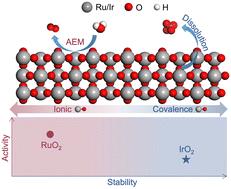
Ruthenium dioxide (RuO2) and iridium dioxide (IrO2) serve as benchmark electrocatalysts for the acidic oxygen evolution reaction (OER), yet their intrinsic activity–stability relationships remain elusive. Herein, we employ density functional theory (DFT) calculations to systematically investigate the origin of divergent OER catalytic behaviors between RuO2 and IrO2 in acidic media. Mechanistic analyses reveal that RuO2 follows the adsorbate evolution mechanism with superior activity (theoretical overpotential: 0.698 V vs. 0.909 V for IrO2), while IrO2 demonstrates enhanced stability due to a higher dissolution energy change (>2.9 eV vs. −0.306 eV for RuO2). Electronic structure analysis reveals that RuO2 exhibits ionic-dominated metal–oxygen bonds with delocalized electron distribution, facilitating intermediate desorption but promoting detrimental RuO42− dissolution. In contrast, IrO2 features covalent bonding characteristics with more electron filling in Ir–oxygen bonds (2.942 vs. 2.412 for RuO2), thereby stabilizing surface intermediates against dissolution at the expense of higher OER barriers. This work establishes a clear correlation between the bonding nature and electrocatalytic performance metrics, offering fundamental insights for the rational design of acid-stable OER electrocatalysts with optimized activity–stability relationships.
期刊介绍:
Physical Chemistry Chemical Physics (PCCP) is an international journal co-owned by 19 physical chemistry and physics societies from around the world. This journal publishes original, cutting-edge research in physical chemistry, chemical physics and biophysical chemistry. To be suitable for publication in PCCP, articles must include significant innovation and/or insight into physical chemistry; this is the most important criterion that reviewers and Editors will judge against when evaluating submissions.
The journal has a broad scope and welcomes contributions spanning experiment, theory, computation and data science. Topical coverage includes spectroscopy, dynamics, kinetics, statistical mechanics, thermodynamics, electrochemistry, catalysis, surface science, quantum mechanics, quantum computing and machine learning. Interdisciplinary research areas such as polymers and soft matter, materials, nanoscience, energy, surfaces/interfaces, and biophysical chemistry are welcomed if they demonstrate significant innovation and/or insight into physical chemistry. Joined experimental/theoretical studies are particularly appreciated when complementary and based on up-to-date approaches.





 京公网安备 11010802042870号
京ICP备2023020795号-1
京公网安备 11010802042870号
京ICP备2023020795号-1

 分享
分享
 求助内容:
求助内容: 应助结果提醒方式:
 扫码关注我们
