{"title":"FAP-targeted delivery of radioiodinated probes: A progressive albumin-driven strategy for tumor theranostics","authors":"Huifeng Li , Dongsheng Xia , Lingxin Meng , Jingru Zhang , Xuedong Chen , Rongqiang Zhuang , Jinxiong Huang , Yesen Li , Jianyang Fang , Xianzhong Zhang , Zhide Guo","doi":"10.1016/j.jconrel.2025.113678","DOIUrl":null,"url":null,"abstract":"<div><div>Fibroblasts activated protein (FAP) appears to be a promising target for tumor theranostics. However, the development of radioiodinated probes for FAP has been slow. In this study, a progressive abumin-driven strategy was adopted to improve the FAP-targeted delivery of radioiodinated probes for tumor theranostics. A series of FAP-targeted probes (namely [<sup>131</sup>I]IPB-FAPI, [<sup>131</sup>I]IPB-FAPI-A1, [<sup>131</sup>I]IPB-FAPI-A3, [<sup>131</sup>I]FSDD<sub>3</sub>I) were synthesized by incorporating an albumin-binding moiety (4-(<em>p</em>-iodophenyl)butyric acid, 4-IPBA) labeled with radioiodine. The specificity and binding characteristics of the radiotracers to FAP and human serum albumin (HSA) were confirmed. SPECT imaging results showed that the [<sup>131</sup>I]FSDD<sub>3</sub>I had more prominent tumor retention property and superior target-to-nontarget ratio, which were consistent with the biodistribution results. As expected, the FAP-targeted therapy with 11.1 MBq [<sup>131</sup>I]FSDD<sub>3</sub>I significantly inhibited tumor growth. In conclusion, this proof-of-concept study employed a progressive design strategy to enhance pharmacokinetics of radioiodinated FAP-targeted probes. Among these radioiodinated FAPI probes, <sup>131</sup>I-labeled FSDD<sub>3</sub>I ([<sup>131</sup>I]FSDD<sub>3</sub>I) emerged as a standout candidate with superior competitive advantages for application in radioiodine-guided internal irradiation therapy.</div></div>","PeriodicalId":15450,"journal":{"name":"Journal of Controlled Release","volume":"382 ","pages":"Article 113678"},"PeriodicalIF":11.5000,"publicationDate":"2025-06-10","publicationTypes":"Journal Article","fieldsOfStudy":null,"isOpenAccess":false,"openAccessPdf":"","citationCount":"0","resultStr":null,"platform":"Semanticscholar","paperid":null,"PeriodicalName":"Journal of Controlled Release","FirstCategoryId":"3","ListUrlMain":"https://www.sciencedirect.com/science/article/pii/S0168365925002986","RegionNum":1,"RegionCategory":"医学","ArticlePicture":[],"TitleCN":null,"AbstractTextCN":null,"PMCID":null,"EPubDate":"2025/4/1 0:00:00","PubModel":"Epub","JCR":"Q1","JCRName":"CHEMISTRY, MULTIDISCIPLINARY","Score":null,"Total":0}
引用次数: 0
Abstract
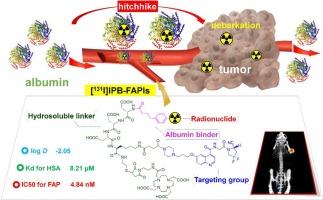
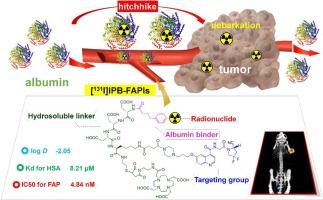
Fibroblasts activated protein (FAP) appears to be a promising target for tumor theranostics. However, the development of radioiodinated probes for FAP has been slow. In this study, a progressive abumin-driven strategy was adopted to improve the FAP-targeted delivery of radioiodinated probes for tumor theranostics. A series of FAP-targeted probes (namely [131I]IPB-FAPI, [131I]IPB-FAPI-A1, [131I]IPB-FAPI-A3, [131I]FSDD3I) were synthesized by incorporating an albumin-binding moiety (4-(p-iodophenyl)butyric acid, 4-IPBA) labeled with radioiodine. The specificity and binding characteristics of the radiotracers to FAP and human serum albumin (HSA) were confirmed. SPECT imaging results showed that the [131I]FSDD3I had more prominent tumor retention property and superior target-to-nontarget ratio, which were consistent with the biodistribution results. As expected, the FAP-targeted therapy with 11.1 MBq [131I]FSDD3I significantly inhibited tumor growth. In conclusion, this proof-of-concept study employed a progressive design strategy to enhance pharmacokinetics of radioiodinated FAP-targeted probes. Among these radioiodinated FAPI probes, 131I-labeled FSDD3I ([131I]FSDD3I) emerged as a standout candidate with superior competitive advantages for application in radioiodine-guided internal irradiation therapy.
期刊介绍:
The Journal of Controlled Release (JCR) proudly serves as the Official Journal of the Controlled Release Society and the Japan Society of Drug Delivery System.
Dedicated to the broad field of delivery science and technology, JCR publishes high-quality research articles covering drug delivery systems and all facets of formulations. This includes the physicochemical and biological properties of drugs, design and characterization of dosage forms, release mechanisms, in vivo testing, and formulation research and development across pharmaceutical, diagnostic, agricultural, environmental, cosmetic, and food industries.
Priority is given to manuscripts that contribute to the fundamental understanding of principles or demonstrate the advantages of novel technologies in terms of safety and efficacy over current clinical standards. JCR strives to be a leading platform for advancements in delivery science and technology.



 京公网安备 11010802042870号
京ICP备2023020795号-1
京公网安备 11010802042870号
京ICP备2023020795号-1

 分享
分享
 求助内容:
求助内容: 应助结果提醒方式:
 扫码关注我们
