Joel Kingston Ramesh, Sasan Rostami, Jayaprakasan Rajesh, R. Margrate Bhackiyavathi Princess, Radhika Govindaraju, Jinho Kim, Rainer Adelung, Palanisamy Rajkumar and Mozaffar Abdollahifar
{"title":"ZnMn2O4 applications in batteries and supercapacitors: a comprehensive review","authors":"Joel Kingston Ramesh, Sasan Rostami, Jayaprakasan Rajesh, R. Margrate Bhackiyavathi Princess, Radhika Govindaraju, Jinho Kim, Rainer Adelung, Palanisamy Rajkumar and Mozaffar Abdollahifar","doi":"10.1039/D5TA00815H","DOIUrl":null,"url":null,"abstract":"<p >ZnMn<small><sub>2</sub></small>O<small><sub>4</sub></small> (ZMO) has emerged as a promising material for energy storage applications due to its high theoretical capacity, low cost, and environmental friendliness. This review comprehensively explores the structure, synthesis methods, and performance of ZMO in various energy storage systems, including supercapacitors and batteries such as lithium-ion (LIBs), sodium-ion (SIBs) and zinc-ion (ZIBs) batteries, due to its exceptional electrochemical properties. The influence of various synthesis techniques on the structural and morphological features of ZMO, which directly impact its electrochemical performance will be discussed. The review also delves into the charge storage mechanism of ZMO in supercapacitors, examining the effects of morphology, composites, and doping on its performance. Additionally, the use of ZMO as an anode material for LIBs and SIBs and its potential as a cathode material in ZIBs are discussed. The review also addresses key challenges and proposes strategies to enhance performance including incorporating conductive materials, synergizing with other materials, and doping. An outlook on the current challenges, future directions, and potential pathways for performance enhancement is also presented.</p>","PeriodicalId":82,"journal":{"name":"Journal of Materials Chemistry A","volume":" 20","pages":" 14540-14579"},"PeriodicalIF":9.5000,"publicationDate":"2025-04-02","publicationTypes":"Journal Article","fieldsOfStudy":null,"isOpenAccess":false,"openAccessPdf":"https://pubs.rsc.org/en/content/articlepdf/2025/ta/d5ta00815h?page=search","citationCount":"0","resultStr":null,"platform":"Semanticscholar","paperid":null,"PeriodicalName":"Journal of Materials Chemistry A","FirstCategoryId":"88","ListUrlMain":"https://pubs.rsc.org/en/content/articlelanding/2025/ta/d5ta00815h","RegionNum":2,"RegionCategory":"材料科学","ArticlePicture":[],"TitleCN":null,"AbstractTextCN":null,"PMCID":null,"EPubDate":"","PubModel":"","JCR":"Q1","JCRName":"CHEMISTRY, PHYSICAL","Score":null,"Total":0}
引用次数: 0
Abstract
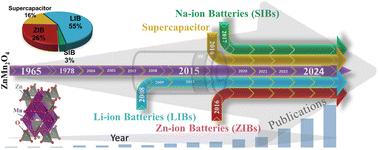
ZnMn2O4 (ZMO) has emerged as a promising material for energy storage applications due to its high theoretical capacity, low cost, and environmental friendliness. This review comprehensively explores the structure, synthesis methods, and performance of ZMO in various energy storage systems, including supercapacitors and batteries such as lithium-ion (LIBs), sodium-ion (SIBs) and zinc-ion (ZIBs) batteries, due to its exceptional electrochemical properties. The influence of various synthesis techniques on the structural and morphological features of ZMO, which directly impact its electrochemical performance will be discussed. The review also delves into the charge storage mechanism of ZMO in supercapacitors, examining the effects of morphology, composites, and doping on its performance. Additionally, the use of ZMO as an anode material for LIBs and SIBs and its potential as a cathode material in ZIBs are discussed. The review also addresses key challenges and proposes strategies to enhance performance including incorporating conductive materials, synergizing with other materials, and doping. An outlook on the current challenges, future directions, and potential pathways for performance enhancement is also presented.
期刊介绍:
The Journal of Materials Chemistry A, B & C covers a wide range of high-quality studies in the field of materials chemistry, with each section focusing on specific applications of the materials studied. Journal of Materials Chemistry A emphasizes applications in energy and sustainability, including topics such as artificial photosynthesis, batteries, and fuel cells. Journal of Materials Chemistry B focuses on applications in biology and medicine, while Journal of Materials Chemistry C covers applications in optical, magnetic, and electronic devices. Example topic areas within the scope of Journal of Materials Chemistry A include catalysis, green/sustainable materials, sensors, and water treatment, among others.



 京公网安备 11010802042870号
京ICP备2023020795号-1
京公网安备 11010802042870号
京ICP备2023020795号-1

 分享
分享
 求助内容:
求助内容: 应助结果提醒方式:
 扫码关注我们
