Synergistic engineering of micron-sized porous silicon anodes via Ge doping and liquid metal alloy modification for high-energy-density lithium-ion batteries†
Lin Sun, Lijun Wang, Yang Liu, Hongyu Wang and Zhong Jin
{"title":"Synergistic engineering of micron-sized porous silicon anodes via Ge doping and liquid metal alloy modification for high-energy-density lithium-ion batteries†","authors":"Lin Sun, Lijun Wang, Yang Liu, Hongyu Wang and Zhong Jin","doi":"10.1039/D5TA00298B","DOIUrl":null,"url":null,"abstract":"<p >In contrast to nanosilicon, micron-sized silicon anodes have gained widespread attention due to their high energy density, favorable processability, and reduced side reactions. However, these anodes are plagued by several significant challenges. They undergo substantial volume changes, and suffer from sluggish lithium-ion transport kinetics and the loss of electrical contact. In this study, micron-sized porous silicon (pSi) obtained through acid etching of an Al<small><sub>60</sub></small>Si<small><sub>40</sub></small> alloy was utilized as the starting material. A novel approach combining high-energy ball milling and wet chemistry methods was adopted to dope Ge atoms into pSi and modify it with a liquid GaInSn metal (LM) alloy (designated as pSi/Ge@LM). The incorporation of Ge heteroatoms and LM offers multiple benefits. Firstly, it enhances the tap density of pSi. Secondly, it effectively boosts the electron transport performance of the material. Moreover, the excellent metallic properties and liquid fluidity of LM endow it with a unique “self-healing” function. Both the half-cells and full-cells assembled with the pSi/Ge@LM electrode demonstrate outstanding electrochemical performance. Specifically, in the half-cells, when cycled at a current density of 1 A g<small><sup>−1</sup></small> for 400 times, the pSi/Ge@LM electrode retains a remarkably high specific capacity of 1011 mA h g<small><sup>−1</sup></small>. Even at a high current density of 3 A g<small><sup>−1</sup></small>, it still delivers a reversible capacity of over 900 mA h g<small><sup>−1</sup></small>. It is anticipated that this research will offer novel insights and valuable guidance for the development of high-energy-density micron-sized silicon anodes.</p>","PeriodicalId":82,"journal":{"name":"Journal of Materials Chemistry A","volume":" 19","pages":" 14346-14352"},"PeriodicalIF":9.2000,"publicationDate":"2025-04-01","publicationTypes":"Journal Article","fieldsOfStudy":null,"isOpenAccess":false,"openAccessPdf":"","citationCount":"0","resultStr":null,"platform":"Semanticscholar","paperid":null,"PeriodicalName":"Journal of Materials Chemistry A","FirstCategoryId":"88","ListUrlMain":"https://pubs.rsc.org/en/content/articlelanding/2025/ta/d5ta00298b","RegionNum":2,"RegionCategory":"材料科学","ArticlePicture":[],"TitleCN":null,"AbstractTextCN":null,"PMCID":null,"EPubDate":"","PubModel":"","JCR":"Q1","JCRName":"CHEMISTRY, PHYSICAL","Score":null,"Total":0}
引用次数: 0
Abstract
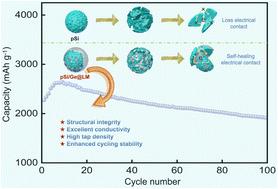
In contrast to nanosilicon, micron-sized silicon anodes have gained widespread attention due to their high energy density, favorable processability, and reduced side reactions. However, these anodes are plagued by several significant challenges. They undergo substantial volume changes, and suffer from sluggish lithium-ion transport kinetics and the loss of electrical contact. In this study, micron-sized porous silicon (pSi) obtained through acid etching of an Al60Si40 alloy was utilized as the starting material. A novel approach combining high-energy ball milling and wet chemistry methods was adopted to dope Ge atoms into pSi and modify it with a liquid GaInSn metal (LM) alloy (designated as pSi/Ge@LM). The incorporation of Ge heteroatoms and LM offers multiple benefits. Firstly, it enhances the tap density of pSi. Secondly, it effectively boosts the electron transport performance of the material. Moreover, the excellent metallic properties and liquid fluidity of LM endow it with a unique “self-healing” function. Both the half-cells and full-cells assembled with the pSi/Ge@LM electrode demonstrate outstanding electrochemical performance. Specifically, in the half-cells, when cycled at a current density of 1 A g−1 for 400 times, the pSi/Ge@LM electrode retains a remarkably high specific capacity of 1011 mA h g−1. Even at a high current density of 3 A g−1, it still delivers a reversible capacity of over 900 mA h g−1. It is anticipated that this research will offer novel insights and valuable guidance for the development of high-energy-density micron-sized silicon anodes.
与纳米硅相比,微米级硅阳极由于其高能量密度、良好的可加工性和较少的副反应而重新受到广泛关注。然而,这些阳极受到几个重大挑战的困扰。它们经历了巨大的体积变化,遭受缓慢的锂离子传输动力学和电接触的损失。本研究以Al60Si40合金酸蚀制备的微米级多孔硅(pSi)为起始材料。采用高能球磨和湿化学相结合的新方法将Ge原子掺杂到pSi中,并用液态GaInSn金属(LM)合金(指定为pSi/Ge@LM)修饰。Ge杂原子和LM的结合提供了多种好处。首先,它提高了pSi的分锥密度。其次,它有效地提高了材料的电子传递性能。此外,LM优异的金属性能和液体流动性使其具有独特的“自愈”功能。用pSi/Ge@LM电极组装的半电池和全电池均表现出优异的电化学性能。具体来说,在半电池中,当以1 a g-1的电流密度循环400次时,pSi/Ge@LM电极保持了1011 mAh g-1的非常高的比容量。即使在3 a g-1的高电流密度下,它仍然提供超过900 mAh g-1的可逆容量。预计本研究将为高能量密度微米级硅阳极的发展提供新的见解和有价值的指导。
期刊介绍:
The Journal of Materials Chemistry A, B & C covers a wide range of high-quality studies in the field of materials chemistry, with each section focusing on specific applications of the materials studied. Journal of Materials Chemistry A emphasizes applications in energy and sustainability, including topics such as artificial photosynthesis, batteries, and fuel cells. Journal of Materials Chemistry B focuses on applications in biology and medicine, while Journal of Materials Chemistry C covers applications in optical, magnetic, and electronic devices. Example topic areas within the scope of Journal of Materials Chemistry A include catalysis, green/sustainable materials, sensors, and water treatment, among others.




 京公网安备 11010802042870号
京ICP备2023020795号-1
京公网安备 11010802042870号
京ICP备2023020795号-1

 分享
分享
 求助内容:
求助内容: 应助结果提醒方式:
 扫码关注我们
