Bin Wang, Chao Zhu, Hai Lei, Hanyu Zhou, Wei Sun, Yue Yang and Peng Ge
{"title":"Regeneration of spent NCM622: reconstructing the rich lattice oxygen surface for enhanced stability†","authors":"Bin Wang, Chao Zhu, Hai Lei, Hanyu Zhou, Wei Sun, Yue Yang and Peng Ge","doi":"10.1039/D5TA00776C","DOIUrl":null,"url":null,"abstract":"<p >Attracted by the economic and environmental value, the direct regeneration of spent Ni–Co–Mn oxides has captured plenty of attention. However, considering the low bonding energy of metal–oxygen, F-elements from binders and LiPF<small><sub>6</sub></small> can be introduced into the bulk phase of regenerated samples, resulting in poor electrochemical properties. Herein, supported by CaO powders, regenerated cathodes were successfully obtained through the formation and removal of CaF<small><sub>2</sub></small>. By tailoring thermal sintering, the as-optimized sample exhibited a smooth surface and an intact morphology/lattice structure. More importantly, benefitting from the formation of oxygen vacancies, a rich oxygen-lattice surface/near-surface was established, exhibiting high stability. As a Li-storage cathode, the as-optimized samples delivered a capacity of 149.7 mA h g<small><sup>−1</sup></small>. The retention ratio remained at approximately 96.3% after 150 loops at 1.0 C. Even at 5.0 C, the capacity reached 134.1 mA h g<small><sup>−1</sup></small>, maintaining ∼84.7% retention after 300 cycles. Detailed kinetic behaviors analysis indicated an improved diffusion coefficient and reduced interfacial resistance, accompanied by a reduction in the voltage gap. Moreover, <em>in situ</em> resistance analysis revealed that stable charge-transfer resistance further alleviated internal stress variation. Thus, this study is expected to illustrate the regeneration process of spent Ni–Co–Mn oxides after the successful removal of F-impurities.</p>","PeriodicalId":82,"journal":{"name":"Journal of Materials Chemistry A","volume":" 18","pages":" 12998-13009"},"PeriodicalIF":9.5000,"publicationDate":"2025-04-02","publicationTypes":"Journal Article","fieldsOfStudy":null,"isOpenAccess":false,"openAccessPdf":"","citationCount":"0","resultStr":null,"platform":"Semanticscholar","paperid":null,"PeriodicalName":"Journal of Materials Chemistry A","FirstCategoryId":"88","ListUrlMain":"https://pubs.rsc.org/en/content/articlelanding/2025/ta/d5ta00776c","RegionNum":2,"RegionCategory":"材料科学","ArticlePicture":[],"TitleCN":null,"AbstractTextCN":null,"PMCID":null,"EPubDate":"","PubModel":"","JCR":"Q1","JCRName":"CHEMISTRY, PHYSICAL","Score":null,"Total":0}
引用次数: 0
Abstract
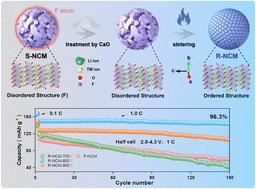
Attracted by the economic and environmental value, the direct regeneration of spent Ni–Co–Mn oxides has captured plenty of attention. However, considering the low bonding energy of metal–oxygen, F-elements from binders and LiPF6 can be introduced into the bulk phase of regenerated samples, resulting in poor electrochemical properties. Herein, supported by CaO powders, regenerated cathodes were successfully obtained through the formation and removal of CaF2. By tailoring thermal sintering, the as-optimized sample exhibited a smooth surface and an intact morphology/lattice structure. More importantly, benefitting from the formation of oxygen vacancies, a rich oxygen-lattice surface/near-surface was established, exhibiting high stability. As a Li-storage cathode, the as-optimized samples delivered a capacity of 149.7 mA h g−1. The retention ratio remained at approximately 96.3% after 150 loops at 1.0 C. Even at 5.0 C, the capacity reached 134.1 mA h g−1, maintaining ∼84.7% retention after 300 cycles. Detailed kinetic behaviors analysis indicated an improved diffusion coefficient and reduced interfacial resistance, accompanied by a reduction in the voltage gap. Moreover, in situ resistance analysis revealed that stable charge-transfer resistance further alleviated internal stress variation. Thus, this study is expected to illustrate the regeneration process of spent Ni–Co–Mn oxides after the successful removal of F-impurities.
废镍钴锰氧化物的直接再生因其经济和环境价值而受到广泛关注。然而,由于金属-氧的键能较低,来自粘结剂和LiPF6的f元素可能被引入到再生样品的体相中,导致其电化学性能较差。在CaO粉的支持下,通过形成和去除CaF2,成功地获得了再生阴极。通过定制热烧结,优化后的样品表面光滑,形貌/晶格结构完整。更重要的是,由于氧空位的形成,形成了富氧晶格表面/近表面,具有很高的稳定性。作为锂存储阴极,优化后的样品的容量为149.7 mA h g−1。在1.0℃下循环150次后,保留率保持在约96.3%,即使在5.0℃下,容量也达到134.1 mA h g−1,在300次循环后保持约84.7%的保留率。详细的动力学行为分析表明,扩散系数提高,界面阻力降低,电压间隙减小。此外,原位电阻分析表明,稳定的电荷传递电阻进一步缓解了内应力变化。因此,本研究有望说明成功去除f杂质后废Ni-Co-Mn氧化物的再生过程。
期刊介绍:
The Journal of Materials Chemistry A, B & C covers a wide range of high-quality studies in the field of materials chemistry, with each section focusing on specific applications of the materials studied. Journal of Materials Chemistry A emphasizes applications in energy and sustainability, including topics such as artificial photosynthesis, batteries, and fuel cells. Journal of Materials Chemistry B focuses on applications in biology and medicine, while Journal of Materials Chemistry C covers applications in optical, magnetic, and electronic devices. Example topic areas within the scope of Journal of Materials Chemistry A include catalysis, green/sustainable materials, sensors, and water treatment, among others.



 京公网安备 11010802042870号
京ICP备2023020795号-1
京公网安备 11010802042870号
京ICP备2023020795号-1

 分享
分享
 求助内容:
求助内容: 应助结果提醒方式:
 扫码关注我们
