Yukun Zhang , Xiongchao Lin , Ning Wang , Zhe He , Caihong Wang , Shu Zhang , Yonggang Wang
{"title":"Study on the microcrystalline structure variation of quinoline-based mesophase and its lithium storage mechanism","authors":"Yukun Zhang , Xiongchao Lin , Ning Wang , Zhe He , Caihong Wang , Shu Zhang , Yonggang Wang","doi":"10.1016/j.jallcom.2025.180181","DOIUrl":null,"url":null,"abstract":"<div><div>Quinoline-based pitch was synthesized through the induction polymerization of quinoline with Cl-containing aromatic hydrocarbons. Subsequently, intermediate quinoline-based mesophase pitch with varying anisotropic degrees and structures was produced through liquid-phase carbonization. Such quinoline-based mesophase pitch was further prepared as the anode material for lithium-ion batteries after further high temperature treatment. The microstructure and microcrystalline size variation with different anisotropic content, as well as their impact on electrochemical performance were systematically examined. The results indicate that quinoline pitch can effectively form a large molecule mesophase streamlined structure, and the long-range ordered structure formed after carbonization exhibits excellent electrochemical performance, with a stable capacity of 365.4 mAh/g at a current density of 0.5 C. Nitrogen can introduce certain defects in the long-range ordered structure, enhancing the diffusion rate of Li<sup>+</sup> in the material. Additionally, this work provides a new method for enhancing electrochemical performance by adjusting the texture orientation through quinoline-based pitch liquid-phase carbonization process, as well as a feasible strategy for improving material electrochemical performance through in-situ nitrogen doping by quinoline.</div></div>","PeriodicalId":344,"journal":{"name":"Journal of Alloys and Compounds","volume":"1023 ","pages":"Article 180181"},"PeriodicalIF":6.3000,"publicationDate":"2025-04-15","publicationTypes":"Journal Article","fieldsOfStudy":null,"isOpenAccess":false,"openAccessPdf":"","citationCount":"0","resultStr":null,"platform":"Semanticscholar","paperid":null,"PeriodicalName":"Journal of Alloys and Compounds","FirstCategoryId":"88","ListUrlMain":"https://www.sciencedirect.com/science/article/pii/S0925838825017396","RegionNum":2,"RegionCategory":"材料科学","ArticlePicture":[],"TitleCN":null,"AbstractTextCN":null,"PMCID":null,"EPubDate":"2025/4/1 0:00:00","PubModel":"Epub","JCR":"Q2","JCRName":"CHEMISTRY, PHYSICAL","Score":null,"Total":0}
引用次数: 0
Abstract
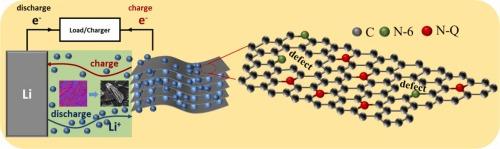
Quinoline-based pitch was synthesized through the induction polymerization of quinoline with Cl-containing aromatic hydrocarbons. Subsequently, intermediate quinoline-based mesophase pitch with varying anisotropic degrees and structures was produced through liquid-phase carbonization. Such quinoline-based mesophase pitch was further prepared as the anode material for lithium-ion batteries after further high temperature treatment. The microstructure and microcrystalline size variation with different anisotropic content, as well as their impact on electrochemical performance were systematically examined. The results indicate that quinoline pitch can effectively form a large molecule mesophase streamlined structure, and the long-range ordered structure formed after carbonization exhibits excellent electrochemical performance, with a stable capacity of 365.4 mAh/g at a current density of 0.5 C. Nitrogen can introduce certain defects in the long-range ordered structure, enhancing the diffusion rate of Li+ in the material. Additionally, this work provides a new method for enhancing electrochemical performance by adjusting the texture orientation through quinoline-based pitch liquid-phase carbonization process, as well as a feasible strategy for improving material electrochemical performance through in-situ nitrogen doping by quinoline.
期刊介绍:
The Journal of Alloys and Compounds is intended to serve as an international medium for the publication of work on solid materials comprising compounds as well as alloys. Its great strength lies in the diversity of discipline which it encompasses, drawing together results from materials science, solid-state chemistry and physics.



 京公网安备 11010802042870号
京ICP备2023020795号-1
京公网安备 11010802042870号
京ICP备2023020795号-1

 分享
分享
 求助内容:
求助内容: 应助结果提醒方式:
 扫码关注我们
