Christopher Schad, Cesar Ray, Carolina Díaz-Norambuena, Sergio Serrano-Buitrago, Florencio Moreno, Beatriz L. Maroto, Inmaculada García-Moreno, Mónica Muñoz-Úbeda, Iván López-Montero, Jorge Bañuelos and Santiago de la Moya
{"title":"Water-soluble BODIPY dyes: a novel approach for their sustainable chemistry and applied photonics†","authors":"Christopher Schad, Cesar Ray, Carolina Díaz-Norambuena, Sergio Serrano-Buitrago, Florencio Moreno, Beatriz L. Maroto, Inmaculada García-Moreno, Mónica Muñoz-Úbeda, Iván López-Montero, Jorge Bañuelos and Santiago de la Moya","doi":"10.1039/D5SC01295C","DOIUrl":null,"url":null,"abstract":"<p >The BODIPY family of organic dyes has emerged as a cornerstone in photonics research development, driving innovation and advancement in various fields of high socio-economic interest. However, the majority of BODIPY dyes exhibit hydrophobic characteristics, resulting in poor solubility in water and other hydrophilic solvents. This solubility is paramount for their optimal utilization in a myriad of photonic applications, particularly in the realms of biology and medicine. Furthermore, it facilitates safer and more sustainable manipulation and chemical modification of these expansive dyes. Nevertheless, bestowing BODIPYs with water solubility while preserving their other essential properties, notably their photophysical signatures, poses a significant challenge. In this context, we present a straightforward general chemical modification aimed at converting conventional hydrophobic BODIPYs into highly hydrophilic variants, thus enabling their efficient solubilization in water and other hydrophilic solvents with minimal disruption to the dye's inherent photophysics. The efficacy of this methodology is demonstrated through the synthesis of a number of water-soluble BODIPY dyes featuring diverse substitution patterns. Furthermore, we showcase their utility in a spectrum of photonics-related applications, including in-water BODIPY chemistry and dye-laser technology, and fluorescence microscopy.</p>","PeriodicalId":9909,"journal":{"name":"Chemical Science","volume":" 18","pages":" 8030-8039"},"PeriodicalIF":7.4000,"publicationDate":"2025-04-02","publicationTypes":"Journal Article","fieldsOfStudy":null,"isOpenAccess":false,"openAccessPdf":"https://pubs.rsc.org/en/content/articlepdf/2025/sc/d5sc01295c?page=search","citationCount":"0","resultStr":null,"platform":"Semanticscholar","paperid":null,"PeriodicalName":"Chemical Science","FirstCategoryId":"92","ListUrlMain":"https://pubs.rsc.org/en/content/articlelanding/2025/sc/d5sc01295c","RegionNum":1,"RegionCategory":"化学","ArticlePicture":[],"TitleCN":null,"AbstractTextCN":null,"PMCID":null,"EPubDate":"","PubModel":"","JCR":"Q1","JCRName":"CHEMISTRY, MULTIDISCIPLINARY","Score":null,"Total":0}
引用次数: 0
Abstract
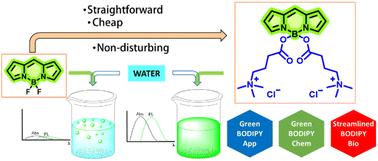
The BODIPY family of organic dyes has emerged as a cornerstone in photonics research development, driving innovation and advancement in various fields of high socio-economic interest. However, the majority of BODIPY dyes exhibit hydrophobic characteristics, resulting in poor solubility in water and other hydrophilic solvents. This solubility is paramount for their optimal utilization in a myriad of photonic applications, particularly in the realms of biology and medicine. Furthermore, it facilitates safer and more sustainable manipulation and chemical modification of these expansive dyes. Nevertheless, bestowing BODIPYs with water solubility while preserving their other essential properties, notably their photophysical signatures, poses a significant challenge. In this context, we present a straightforward general chemical modification aimed at converting conventional hydrophobic BODIPYs into highly hydrophilic variants, thus enabling their efficient solubilization in water and other hydrophilic solvents with minimal disruption to the dye's inherent photophysics. The efficacy of this methodology is demonstrated through the synthesis of a number of water-soluble BODIPY dyes featuring diverse substitution patterns. Furthermore, we showcase their utility in a spectrum of photonics-related applications, including in-water BODIPY chemistry and dye-laser technology, and fluorescence microscopy.
期刊介绍:
Chemical Science is a journal that encompasses various disciplines within the chemical sciences. Its scope includes publishing ground-breaking research with significant implications for its respective field, as well as appealing to a wider audience in related areas. To be considered for publication, articles must showcase innovative and original advances in their field of study and be presented in a manner that is understandable to scientists from diverse backgrounds. However, the journal generally does not publish highly specialized research.





 京公网安备 11010802042870号
京ICP备2023020795号-1
京公网安备 11010802042870号
京ICP备2023020795号-1

 分享
分享
 求助内容:
求助内容: 应助结果提醒方式:
 扫码关注我们
