Yi Lu , Ahmed Mahmoud Idris , Ping Lu , Xinyan Jiang , Jin Wang , Hao Zheng , Xiandan Liang , Sheng Li , Zhengquan Li
{"title":"Synergistic electronic modulation of active sites in CsCuCl3 via Zn doping for photocatalytic oxidation of toluene to benzaldehyde","authors":"Yi Lu , Ahmed Mahmoud Idris , Ping Lu , Xinyan Jiang , Jin Wang , Hao Zheng , Xiandan Liang , Sheng Li , Zhengquan Li","doi":"10.1016/j.jcat.2025.116104","DOIUrl":null,"url":null,"abstract":"<div><div>Photocatalytic selective oxidation represents a sustainable approach for valuable chemical transformations, yet achieving high yield and selectivity of products remains a significant challenge. In this work, we demonstrate that electronic structure modulation of CsCuCl<sub>3</sub> halide perovskites enables highly selective photocatalytic oxidation of toluene to benzaldehyde (BD). By strategically doping Zn into CsCuCl<sub>3</sub>, we achieved control over the electronic modulation of catalytic sites, leading to a remarkable BD yield of 4.08 mmol g<sup>−1</sup> h<sup>−1</sup> with 85.4 % selectivity under visible light irradiation. Mechanistic investigations revealed that Zn doping creates an optimal electronic structure, which simultaneously facilitates O<sub>2</sub> activation to form superoxide radicals and promotes selective C–H bond activation of toluene. Density functional theory calculations showed that Zn doping induces charge redistribution at Cu and Cl sites, optimizing surface energetics for both O<sub>2</sub> and toluene adsorption while lowering kinetic barriers for the rate-determining steps. The enhanced charge carrier separation efficiency, confirmed by spectroscopic and electrochemical analyses, further contributes to the superior catalytic performance. This work establishes electronic structure engineering as a powerful strategy for developing high-performance single-component photocatalysts and provides new insights into the selective photocatalytic oxidation reactions.</div></div>","PeriodicalId":346,"journal":{"name":"Journal of Catalysis","volume":"447 ","pages":"Article 116104"},"PeriodicalIF":6.5000,"publicationDate":"2025-07-01","publicationTypes":"Journal Article","fieldsOfStudy":null,"isOpenAccess":false,"openAccessPdf":"","citationCount":"0","resultStr":null,"platform":"Semanticscholar","paperid":null,"PeriodicalName":"Journal of Catalysis","FirstCategoryId":"92","ListUrlMain":"https://www.sciencedirect.com/science/article/pii/S0021951725001691","RegionNum":1,"RegionCategory":"化学","ArticlePicture":[],"TitleCN":null,"AbstractTextCN":null,"PMCID":null,"EPubDate":"2025/4/1 0:00:00","PubModel":"Epub","JCR":"Q2","JCRName":"CHEMISTRY, PHYSICAL","Score":null,"Total":0}
引用次数: 0
Abstract
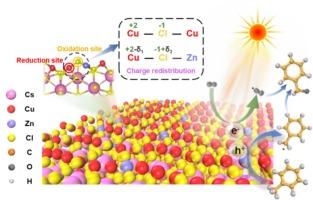
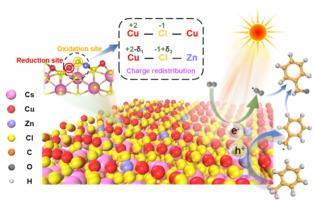
Photocatalytic selective oxidation represents a sustainable approach for valuable chemical transformations, yet achieving high yield and selectivity of products remains a significant challenge. In this work, we demonstrate that electronic structure modulation of CsCuCl3 halide perovskites enables highly selective photocatalytic oxidation of toluene to benzaldehyde (BD). By strategically doping Zn into CsCuCl3, we achieved control over the electronic modulation of catalytic sites, leading to a remarkable BD yield of 4.08 mmol g−1 h−1 with 85.4 % selectivity under visible light irradiation. Mechanistic investigations revealed that Zn doping creates an optimal electronic structure, which simultaneously facilitates O2 activation to form superoxide radicals and promotes selective C–H bond activation of toluene. Density functional theory calculations showed that Zn doping induces charge redistribution at Cu and Cl sites, optimizing surface energetics for both O2 and toluene adsorption while lowering kinetic barriers for the rate-determining steps. The enhanced charge carrier separation efficiency, confirmed by spectroscopic and electrochemical analyses, further contributes to the superior catalytic performance. This work establishes electronic structure engineering as a powerful strategy for developing high-performance single-component photocatalysts and provides new insights into the selective photocatalytic oxidation reactions.
期刊介绍:
The Journal of Catalysis publishes scholarly articles on both heterogeneous and homogeneous catalysis, covering a wide range of chemical transformations. These include various types of catalysis, such as those mediated by photons, plasmons, and electrons. The focus of the studies is to understand the relationship between catalytic function and the underlying chemical properties of surfaces and metal complexes.
The articles in the journal offer innovative concepts and explore the synthesis and kinetics of inorganic solids and homogeneous complexes. Furthermore, they discuss spectroscopic techniques for characterizing catalysts, investigate the interaction of probes and reacting species with catalysts, and employ theoretical methods.
The research presented in the journal should have direct relevance to the field of catalytic processes, addressing either fundamental aspects or applications of catalysis.



 京公网安备 11010802042870号
京ICP备2023020795号-1
京公网安备 11010802042870号
京ICP备2023020795号-1

 分享
分享
 求助内容:
求助内容: 应助结果提醒方式:
 扫码关注我们
