Xinyu Zhao , Dongxiao Wang , Caiwei Deng , Hao Niu , Huawei Yang , Lixia Yang , Liangjiu Bai , Kun Yin , Donglei Wei , Hou Chen
{"title":"Dual noble-metal-free cocatalysts on cobalt nickel oxide nanocages for boosting photocatalytic oxidation desulfurization","authors":"Xinyu Zhao , Dongxiao Wang , Caiwei Deng , Hao Niu , Huawei Yang , Lixia Yang , Liangjiu Bai , Kun Yin , Donglei Wei , Hou Chen","doi":"10.1016/j.jcat.2025.116120","DOIUrl":null,"url":null,"abstract":"<div><div>Photocatalytic aerobic oxidative desulfurization (PAODS) has attracted widespread attention as a sustainable fuel desulfurization method, but the photocatalysts reported so far still suffer from slow sulfide conversion kinetics. Here we propose a MoO<sub>x</sub> and NiCoP co-decorated on CoNiO<sub>2</sub> hollow nanocage (MoO<sub>x</sub>/P-CoNiO<sub>2</sub>) catalyst for boosting the PAODS reactions. The photocatalyst exhibits remarkable photocatalytic activity in oxidizing dibenzothiophene (DBT), attaining a mass activity ratio of 10.4 mmol g<sup>−1</sup> h<sup>−1</sup> and exhibiting excellent repeatability. The strategic incorporation of MoO<sub>x</sub> and NiCoP as dual cocatalysts significantly improved photocatalytic efficiency by facilitating efficient charge separation, enhancing the production of reactive oxygen species (ROS), and providing active sites for oxidizing refractory sulfur compounds. In real diesel desulfurization tests, the catalyst reduced sulfur content from 559.3 ppm to below 10 ppm, meeting the most stringent transportation diesel standards, highlighting its practical applicability for deep desulfurization in industrial settings.</div></div>","PeriodicalId":346,"journal":{"name":"Journal of Catalysis","volume":"447 ","pages":"Article 116120"},"PeriodicalIF":6.5000,"publicationDate":"2025-07-01","publicationTypes":"Journal Article","fieldsOfStudy":null,"isOpenAccess":false,"openAccessPdf":"","citationCount":"0","resultStr":null,"platform":"Semanticscholar","paperid":null,"PeriodicalName":"Journal of Catalysis","FirstCategoryId":"92","ListUrlMain":"https://www.sciencedirect.com/science/article/pii/S002195172500185X","RegionNum":1,"RegionCategory":"化学","ArticlePicture":[],"TitleCN":null,"AbstractTextCN":null,"PMCID":null,"EPubDate":"2025/4/1 0:00:00","PubModel":"Epub","JCR":"Q2","JCRName":"CHEMISTRY, PHYSICAL","Score":null,"Total":0}
引用次数: 0
Abstract
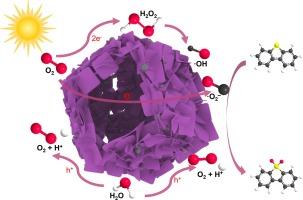
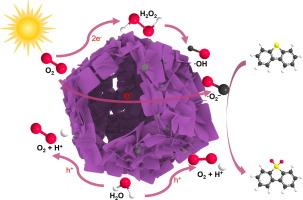
Photocatalytic aerobic oxidative desulfurization (PAODS) has attracted widespread attention as a sustainable fuel desulfurization method, but the photocatalysts reported so far still suffer from slow sulfide conversion kinetics. Here we propose a MoOx and NiCoP co-decorated on CoNiO2 hollow nanocage (MoOx/P-CoNiO2) catalyst for boosting the PAODS reactions. The photocatalyst exhibits remarkable photocatalytic activity in oxidizing dibenzothiophene (DBT), attaining a mass activity ratio of 10.4 mmol g−1 h−1 and exhibiting excellent repeatability. The strategic incorporation of MoOx and NiCoP as dual cocatalysts significantly improved photocatalytic efficiency by facilitating efficient charge separation, enhancing the production of reactive oxygen species (ROS), and providing active sites for oxidizing refractory sulfur compounds. In real diesel desulfurization tests, the catalyst reduced sulfur content from 559.3 ppm to below 10 ppm, meeting the most stringent transportation diesel standards, highlighting its practical applicability for deep desulfurization in industrial settings.
期刊介绍:
The Journal of Catalysis publishes scholarly articles on both heterogeneous and homogeneous catalysis, covering a wide range of chemical transformations. These include various types of catalysis, such as those mediated by photons, plasmons, and electrons. The focus of the studies is to understand the relationship between catalytic function and the underlying chemical properties of surfaces and metal complexes.
The articles in the journal offer innovative concepts and explore the synthesis and kinetics of inorganic solids and homogeneous complexes. Furthermore, they discuss spectroscopic techniques for characterizing catalysts, investigate the interaction of probes and reacting species with catalysts, and employ theoretical methods.
The research presented in the journal should have direct relevance to the field of catalytic processes, addressing either fundamental aspects or applications of catalysis.



 京公网安备 11010802042870号
京ICP备2023020795号-1
京公网安备 11010802042870号
京ICP备2023020795号-1

 分享
分享
 求助内容:
求助内容: 应助结果提醒方式:
 扫码关注我们
