Aditi De, Pandiarajan Devi, Palanichamy Murugan and Subrata Kundu
{"title":"Revolutionizing water splitting performance by probing the influence of electron transfer on the NiCr-LDH/VS2/NF heterostructure†","authors":"Aditi De, Pandiarajan Devi, Palanichamy Murugan and Subrata Kundu","doi":"10.1039/D5TA01733E","DOIUrl":null,"url":null,"abstract":"<p >Electrocatalytic water splitting for the production of green hydrogen addresses the current energy crisis and potential energy storage. Herein, we have fabricated a low-cost, highly efficient transition metal-based heterostructure of NiCr-LDH over VS<small><sub>2</sub></small> using three-dimensional (3D) nickel foam as a substrate. This self-supported NiCr-LDH/VS<small><sub>2</sub></small>/NF heterostructure catalyst works as an excellent bifunctional electrode to catalyze the oxygen evolution reaction (OER) and the hydrogen evolution reaction (HER) by exhibiting very low overpotential values of 209 mV and 116 mV, respectively, to attain 50 mA cm<small><sup>−2</sup></small> current density in 1 M KOH solution. In addition, NiCr-LDH/VS<small><sub>2</sub></small>/NF shows a cell voltage of 1.545 V to attain 10 mA cm<small><sup>−2</sup></small> current density and a 40-hour long-term static stability. The n-type semiconducting NiCr-LDH and p-type conducting VS<small><sub>2</sub></small> enhance the electrocatalytic performance by their synergistic effect, changing the surface-modified electronic structure, and generation of improved thin-nanosheet-like mesoporous morphology with superhydrophilic surfaces. Density functional theory (DFT) calculations confirm an interesting charge repopulation observation in both the layers of NiCr-LDH and VS<small><sub>2</sub></small> that increases the overall electrocatalytic reaction performance (as confirmed by charge density and Bader charge analysis). This material holds impressive application potential that can guide the design and screening of efficient earth-abundant bifunctional electrocatalysts.</p>","PeriodicalId":82,"journal":{"name":"Journal of Materials Chemistry A","volume":" 20","pages":" 14915-14927"},"PeriodicalIF":9.5000,"publicationDate":"2025-04-02","publicationTypes":"Journal Article","fieldsOfStudy":null,"isOpenAccess":false,"openAccessPdf":"","citationCount":"0","resultStr":null,"platform":"Semanticscholar","paperid":null,"PeriodicalName":"Journal of Materials Chemistry A","FirstCategoryId":"88","ListUrlMain":"https://pubs.rsc.org/en/content/articlelanding/2025/ta/d5ta01733e","RegionNum":2,"RegionCategory":"材料科学","ArticlePicture":[],"TitleCN":null,"AbstractTextCN":null,"PMCID":null,"EPubDate":"","PubModel":"","JCR":"Q1","JCRName":"CHEMISTRY, PHYSICAL","Score":null,"Total":0}
引用次数: 0
Abstract
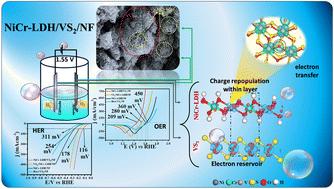
Electrocatalytic water splitting for the production of green hydrogen addresses the current energy crisis and potential energy storage. Herein, we have fabricated a low-cost, highly efficient transition metal-based heterostructure of NiCr-LDH over VS2 using three-dimensional (3D) nickel foam as a substrate. This self-supported NiCr-LDH/VS2/NF heterostructure catalyst works as an excellent bifunctional electrode to catalyze the oxygen evolution reaction (OER) and the hydrogen evolution reaction (HER) by exhibiting very low overpotential values of 209 mV and 116 mV, respectively, to attain 50 mA cm−2 current density in 1 M KOH solution. In addition, NiCr-LDH/VS2/NF shows a cell voltage of 1.545 V to attain 10 mA cm−2 current density and a 40-hour long-term static stability. The n-type semiconducting NiCr-LDH and p-type conducting VS2 enhance the electrocatalytic performance by their synergistic effect, changing the surface-modified electronic structure, and generation of improved thin-nanosheet-like mesoporous morphology with superhydrophilic surfaces. Density functional theory (DFT) calculations confirm an interesting charge repopulation observation in both the layers of NiCr-LDH and VS2 that increases the overall electrocatalytic reaction performance (as confirmed by charge density and Bader charge analysis). This material holds impressive application potential that can guide the design and screening of efficient earth-abundant bifunctional electrocatalysts.
期刊介绍:
The Journal of Materials Chemistry A, B & C covers a wide range of high-quality studies in the field of materials chemistry, with each section focusing on specific applications of the materials studied. Journal of Materials Chemistry A emphasizes applications in energy and sustainability, including topics such as artificial photosynthesis, batteries, and fuel cells. Journal of Materials Chemistry B focuses on applications in biology and medicine, while Journal of Materials Chemistry C covers applications in optical, magnetic, and electronic devices. Example topic areas within the scope of Journal of Materials Chemistry A include catalysis, green/sustainable materials, sensors, and water treatment, among others.



 京公网安备 11010802042870号
京ICP备2023020795号-1
京公网安备 11010802042870号
京ICP备2023020795号-1

 分享
分享
 求助内容:
求助内容: 应助结果提醒方式:
 扫码关注我们
