Yawar Abbas, Rohan B. Ambade, Muhammad Umair Khan, Rui Chang, Yahya Zweiri, Baker Mohammad, Dalaver Anjum and Yarjan Abdul Samad
{"title":"Sustainable high-pressure homogenization of hexagonal boron nitride for triboelectric nanogenerators: advancing self-powered environmental monitoring in portable electronics†","authors":"Yawar Abbas, Rohan B. Ambade, Muhammad Umair Khan, Rui Chang, Yahya Zweiri, Baker Mohammad, Dalaver Anjum and Yarjan Abdul Samad","doi":"10.1039/D4TA08698H","DOIUrl":null,"url":null,"abstract":"<p >The growing demand for low-power, high-density wearable electronics devices and Internet of Things (IoT) technology requires reliable energy modules. Triboelectric nanogenerators (TENGs), an emerging energy harvesting technology, hold great potential to consistently supply power to these IoT devices and low-power consumption devices. Herein, we demonstrate the fabrication of a highly efficient triboelectric nanogenerator (TENG) by synthesizing highly pure two-dimensional (2D) hexagonal boron nitride (hBN) flakes as electropositive materials using the high-pressure homogenizer (HPH) method and fluorinated ethylene propylene (FEP) as electronegative materials. The fabricated device exhibits a highly reliable and repeatable open circuit voltage (<em>V</em><small><sub>oc</sub></small>) of ∼135 V and short circuit current (<em>I</em><small><sub>sc</sub></small>) of ∼17.0 μA at a tapping frequency of 5 Hz. Furthermore, the 2D hBN flakes prepared by HPH exhibit a high-power density of 18 W cm<small><sup>−2</sup></small>, exceeding the previously reported values for hBN-based TENGs. The device can monitor full-range humidity (30% to 100% RH) and distinguish between light and strong tapping. The HPH-prepared 2D hBN-based TENGs powered or operated portable devices such as digital thermometers, stopwatches, and mini-calculators. The HPH-prepared 2D hBN-based TENG device can harvest energy from the mechanical input for an energy-efficient lifestyle because it can continuously charge and discharge the capacitor through continuous pressing and releasing by tapping. Thus, HPH-prepared 2D hBN flakes can be used to create an energy-efficient process to convert mechanical energy into electrical energy, promote sustainability, and advance clean energy technologies.</p>","PeriodicalId":82,"journal":{"name":"Journal of Materials Chemistry A","volume":" 20","pages":" 14773-14785"},"PeriodicalIF":9.5000,"publicationDate":"2025-04-02","publicationTypes":"Journal Article","fieldsOfStudy":null,"isOpenAccess":false,"openAccessPdf":"https://pubs.rsc.org/en/content/articlepdf/2025/ta/d4ta08698h?page=search","citationCount":"0","resultStr":null,"platform":"Semanticscholar","paperid":null,"PeriodicalName":"Journal of Materials Chemistry A","FirstCategoryId":"88","ListUrlMain":"https://pubs.rsc.org/en/content/articlelanding/2025/ta/d4ta08698h","RegionNum":2,"RegionCategory":"材料科学","ArticlePicture":[],"TitleCN":null,"AbstractTextCN":null,"PMCID":null,"EPubDate":"","PubModel":"","JCR":"Q1","JCRName":"CHEMISTRY, PHYSICAL","Score":null,"Total":0}
引用次数: 0
Abstract
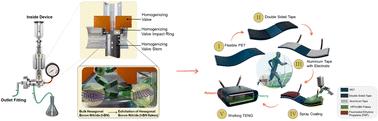
The growing demand for low-power, high-density wearable electronics devices and Internet of Things (IoT) technology requires reliable energy modules. Triboelectric nanogenerators (TENGs), an emerging energy harvesting technology, hold great potential to consistently supply power to these IoT devices and low-power consumption devices. Herein, we demonstrate the fabrication of a highly efficient triboelectric nanogenerator (TENG) by synthesizing highly pure two-dimensional (2D) hexagonal boron nitride (hBN) flakes as electropositive materials using the high-pressure homogenizer (HPH) method and fluorinated ethylene propylene (FEP) as electronegative materials. The fabricated device exhibits a highly reliable and repeatable open circuit voltage (Voc) of ∼135 V and short circuit current (Isc) of ∼17.0 μA at a tapping frequency of 5 Hz. Furthermore, the 2D hBN flakes prepared by HPH exhibit a high-power density of 18 W cm−2, exceeding the previously reported values for hBN-based TENGs. The device can monitor full-range humidity (30% to 100% RH) and distinguish between light and strong tapping. The HPH-prepared 2D hBN-based TENGs powered or operated portable devices such as digital thermometers, stopwatches, and mini-calculators. The HPH-prepared 2D hBN-based TENG device can harvest energy from the mechanical input for an energy-efficient lifestyle because it can continuously charge and discharge the capacitor through continuous pressing and releasing by tapping. Thus, HPH-prepared 2D hBN flakes can be used to create an energy-efficient process to convert mechanical energy into electrical energy, promote sustainability, and advance clean energy technologies.
期刊介绍:
The Journal of Materials Chemistry A, B & C covers a wide range of high-quality studies in the field of materials chemistry, with each section focusing on specific applications of the materials studied. Journal of Materials Chemistry A emphasizes applications in energy and sustainability, including topics such as artificial photosynthesis, batteries, and fuel cells. Journal of Materials Chemistry B focuses on applications in biology and medicine, while Journal of Materials Chemistry C covers applications in optical, magnetic, and electronic devices. Example topic areas within the scope of Journal of Materials Chemistry A include catalysis, green/sustainable materials, sensors, and water treatment, among others.



 京公网安备 11010802042870号
京ICP备2023020795号-1
京公网安备 11010802042870号
京ICP备2023020795号-1

 分享
分享
 求助内容:
求助内容: 应助结果提醒方式:
 扫码关注我们
