Simin Zhang, Jiawei Xu, Jiayong Lu, Zhijian Liu, Zechen Xiao, Wei Guo, Mo Zhang, Yan Wan and Yangming Lin
{"title":"Benzothiophene-based covalent organic frameworks for H2O2 electrosynthesis: the critical role of conjugated structure†","authors":"Simin Zhang, Jiawei Xu, Jiayong Lu, Zhijian Liu, Zechen Xiao, Wei Guo, Mo Zhang, Yan Wan and Yangming Lin","doi":"10.1039/D5TA01794G","DOIUrl":null,"url":null,"abstract":"<p >Covalent organic frameworks (COFs), a class of emerging porous crystalline polymers with high specific surface areas and tunable framework structures, exhibit great potential in the oxygen reduction reaction (ORR). Herein, we synthesized a series of benzothiophene-based COFs with varying benzene ring counts in the linkers and employed these materials to unveil the correlation between the conjugated structure and the selectivity toward H<small><sub>2</sub></small>O<small><sub>2</sub></small> electro-synthesis. The experimental results display that the highest H<small><sub>2</sub></small>O<small><sub>2</sub></small> selectivity (∼90%) is offered by the benzothiophene-based COFs bearing one benzene ring in the linker, exhibiting a negative correlation with the number of benzene rings in the linkers. Theoretical calculations reveal that variations in the number of benzene rings modulate the adsorption strength and sites of key reaction intermediates, thereby altering the 2e<small><sup>−</sup></small> ORR pathway. The decrease in benzene ring counts enables the dominant pathway for 2e<small><sup>−</sup></small> ORR to become the H<small><sub>2</sub></small>O<small><sub>2</sub></small> formation through the nucleophilic attack of the active *O<small><sub>2</sub></small><small><sup>−</sup></small> species, which originates from the electron transfer of <small><sup>3</sup></small>O<small><sub>2</sub></small>, on the carbon atom near the sulfur atom of the thiophene ring. This work highlights the importance of appropriate linkers and provides valuable insights for designing metal-free COF electrocatalysts.</p>","PeriodicalId":82,"journal":{"name":"Journal of Materials Chemistry A","volume":" 20","pages":" 14716-14725"},"PeriodicalIF":9.5000,"publicationDate":"2025-04-02","publicationTypes":"Journal Article","fieldsOfStudy":null,"isOpenAccess":false,"openAccessPdf":"","citationCount":"0","resultStr":null,"platform":"Semanticscholar","paperid":null,"PeriodicalName":"Journal of Materials Chemistry A","FirstCategoryId":"88","ListUrlMain":"https://pubs.rsc.org/en/content/articlelanding/2025/ta/d5ta01794g","RegionNum":2,"RegionCategory":"材料科学","ArticlePicture":[],"TitleCN":null,"AbstractTextCN":null,"PMCID":null,"EPubDate":"","PubModel":"","JCR":"Q1","JCRName":"CHEMISTRY, PHYSICAL","Score":null,"Total":0}
引用次数: 0
Abstract
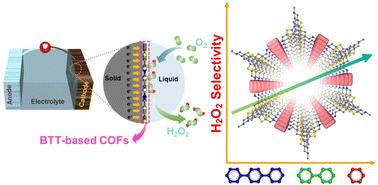
Covalent organic frameworks (COFs), a class of emerging porous crystalline polymers with high specific surface areas and tunable framework structures, exhibit great potential in the oxygen reduction reaction (ORR). Herein, we synthesized a series of benzothiophene-based COFs with varying benzene ring counts in the linkers and employed these materials to unveil the correlation between the conjugated structure and the selectivity toward H2O2 electro-synthesis. The experimental results display that the highest H2O2 selectivity (∼90%) is offered by the benzothiophene-based COFs bearing one benzene ring in the linker, exhibiting a negative correlation with the number of benzene rings in the linkers. Theoretical calculations reveal that variations in the number of benzene rings modulate the adsorption strength and sites of key reaction intermediates, thereby altering the 2e− ORR pathway. The decrease in benzene ring counts enables the dominant pathway for 2e− ORR to become the H2O2 formation through the nucleophilic attack of the active *O2− species, which originates from the electron transfer of 3O2, on the carbon atom near the sulfur atom of the thiophene ring. This work highlights the importance of appropriate linkers and provides valuable insights for designing metal-free COF electrocatalysts.
期刊介绍:
The Journal of Materials Chemistry A, B & C covers a wide range of high-quality studies in the field of materials chemistry, with each section focusing on specific applications of the materials studied. Journal of Materials Chemistry A emphasizes applications in energy and sustainability, including topics such as artificial photosynthesis, batteries, and fuel cells. Journal of Materials Chemistry B focuses on applications in biology and medicine, while Journal of Materials Chemistry C covers applications in optical, magnetic, and electronic devices. Example topic areas within the scope of Journal of Materials Chemistry A include catalysis, green/sustainable materials, sensors, and water treatment, among others.



 京公网安备 11010802042870号
京ICP备2023020795号-1
京公网安备 11010802042870号
京ICP备2023020795号-1

 分享
分享
 求助内容:
求助内容: 应助结果提醒方式:
 扫码关注我们
