Christian Heinekamp, Arkendu Roy, Stephanos Karafiludis, Sourabh Kumar, Ana Guilherme Buzanich, Tomasz M. Stawski, Aistė Miliūtė, Marcus von der Au, Mike Ahrens, Thomas Braun and Franziska Emmerling
{"title":"Zirconium fluoride-supported high-entropy fluoride: a catalyst for enhanced oxygen evolution reaction†","authors":"Christian Heinekamp, Arkendu Roy, Stephanos Karafiludis, Sourabh Kumar, Ana Guilherme Buzanich, Tomasz M. Stawski, Aistė Miliūtė, Marcus von der Au, Mike Ahrens, Thomas Braun and Franziska Emmerling","doi":"10.1039/D4TA08664C","DOIUrl":null,"url":null,"abstract":"<p >Extended hydrogen initiatives promote the urgency of research on water splitting technologies and, therein, oxygen evolution reaction catalysts being developed. A route to access a ZrF<small><sub>4</sub></small> supported high-entropy fluoride catalyst using a facile sol–gel route is presented. The high-entropy character of the catalyst was confirmed by scanning transmission electron microscopy and energy dispersive X-ray spectroscopy (STEM-EDX) as well as inductively coupled plasma-mass spectrometry (ICP-MS). Additional investigations on the local structure were performed using extended X-ray absorption fine structure spectroscopy (EXAFS) and pair distribution function (PDF) analysis. The catalyst shows significant potential for oxygen evolution reaction (OER) in alkaline media with a current density of 100 mA cm<small><sup>−2</sup></small> at approximately 1.60 V, thus outperforming benchmark materials such as IrO<small><sub>2</sub></small>, despite a significant reduction in electrochemical mass loading. A potential mechanism is suggested based on free energy calculation using DFT calculations.</p>","PeriodicalId":82,"journal":{"name":"Journal of Materials Chemistry A","volume":" 26","pages":" 20383-20393"},"PeriodicalIF":9.5000,"publicationDate":"2025-04-01","publicationTypes":"Journal Article","fieldsOfStudy":null,"isOpenAccess":false,"openAccessPdf":"https://pubs.rsc.org/en/content/articlepdf/2025/ta/d4ta08664c?page=search","citationCount":"0","resultStr":null,"platform":"Semanticscholar","paperid":null,"PeriodicalName":"Journal of Materials Chemistry A","FirstCategoryId":"88","ListUrlMain":"https://pubs.rsc.org/en/content/articlelanding/2025/ta/d4ta08664c","RegionNum":2,"RegionCategory":"材料科学","ArticlePicture":[],"TitleCN":null,"AbstractTextCN":null,"PMCID":null,"EPubDate":"","PubModel":"","JCR":"Q1","JCRName":"CHEMISTRY, PHYSICAL","Score":null,"Total":0}
引用次数: 0
Abstract
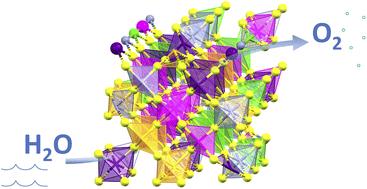
Extended hydrogen initiatives promote the urgency of research on water splitting technologies and, therein, oxygen evolution reaction catalysts being developed. A route to access a ZrF4 supported high-entropy fluoride catalyst using a facile sol–gel route is presented. The high-entropy character of the catalyst was confirmed by scanning transmission electron microscopy and energy dispersive X-ray spectroscopy (STEM-EDX) as well as inductively coupled plasma-mass spectrometry (ICP-MS). Additional investigations on the local structure were performed using extended X-ray absorption fine structure spectroscopy (EXAFS) and pair distribution function (PDF) analysis. The catalyst shows significant potential for oxygen evolution reaction (OER) in alkaline media with a current density of 100 mA cm−2 at approximately 1.60 V, thus outperforming benchmark materials such as IrO2, despite a significant reduction in electrochemical mass loading. A potential mechanism is suggested based on free energy calculation using DFT calculations.
氢能计划的扩展推动了水分离技术研究的紧迫性,其中氧进化反应催化剂的开发也迫在眉睫。本文介绍了一种利用简便的溶胶-凝胶法获得 ZrF4 支持的高熵氟化物催化剂的途径。该催化剂的高熵特性通过扫描透射电子显微镜和能量色散 X 射线光谱法(STEM-EDX)以及电感耦合等离子体质谱法(ICP-MS)得到了证实。此外,还利用扩展 X 射线吸收精细结构光谱(EXAFS)和对分布函数(PDF)分析对局部结构进行了研究。该催化剂在碱性介质中的氧进化反应(OER)中显示出巨大的潜力,在约 1.60 V 的电压下,电流密度为 100 mA cm-2,因此,尽管电化学质量负荷显著降低,但其性能优于 IrO2 等基准材料。利用 DFT 计算自由能,提出了一种潜在的机理。
期刊介绍:
The Journal of Materials Chemistry A, B & C covers a wide range of high-quality studies in the field of materials chemistry, with each section focusing on specific applications of the materials studied. Journal of Materials Chemistry A emphasizes applications in energy and sustainability, including topics such as artificial photosynthesis, batteries, and fuel cells. Journal of Materials Chemistry B focuses on applications in biology and medicine, while Journal of Materials Chemistry C covers applications in optical, magnetic, and electronic devices. Example topic areas within the scope of Journal of Materials Chemistry A include catalysis, green/sustainable materials, sensors, and water treatment, among others.




 京公网安备 11010802042870号
京ICP备2023020795号-1
京公网安备 11010802042870号
京ICP备2023020795号-1

 分享
分享
 求助内容:
求助内容: 应助结果提醒方式:
 扫码关注我们
