Bin-Bin Ge, Dong-Liang Zhong*, Yi-Yu Lu* and Ruo-Gu Kuang,
{"title":"THF-CH4 Hydrate Formation under Static Conditions with the Change of Temperature: Application to CH4 Storage in the Form of Gas Hydrates","authors":"Bin-Bin Ge, Dong-Liang Zhong*, Yi-Yu Lu* and Ruo-Gu Kuang, ","doi":"10.1021/acs.energyfuels.5c00501","DOIUrl":null,"url":null,"abstract":"<p >The hydrate-based solidified natural gas technology offers a promising approach to the storage and transportation of natural gas. A key challenge of this technology is to achieve mild hydrate formation conditions and high gas storage capacity. In this work, the effects of temperature on THF-CH<sub>4</sub> hydrate formation under static conditions were investigated from multiple perspectives including kinetic measurement, thermal analysis, morphology observation, and in situ Raman spectroscopy. Moreover, the storage stability of THF-CH<sub>4</sub> hydrate above the freezing point was explored. The results indicate that 288.15 K is a preferable temperature for increasing the gas uptake of THF-CH<sub>4</sub> hydrate formation among the tested temperatures (280.15, 288.15, and 293.15 K), and the highest gas uptake of 0.0756 mol of gas/mol of water was achieved. The continued growth of cloud-like hydrates in the liquid phase was observed, which enhances CH<sub>4</sub> diffusion for further hydrate growth. In situ Raman spectroscopy measurement revealed a two-stage growth mechanism in the formation of THF-CH<sub>4</sub> hydrate. THF-CH<sub>4</sub> hydrate can be stably stored at atmospheric pressure and 277.15 K, with only a 3% gas evolution from the hydrate. The results presented in this work will provide valuable insights for improving the solidified natural gas storage and transportation technology.</p>","PeriodicalId":35,"journal":{"name":"Energy & Fuels","volume":"39 13","pages":"6232–6240 6232–6240"},"PeriodicalIF":5.3000,"publicationDate":"2025-03-25","publicationTypes":"Journal Article","fieldsOfStudy":null,"isOpenAccess":false,"openAccessPdf":"","citationCount":"0","resultStr":null,"platform":"Semanticscholar","paperid":null,"PeriodicalName":"Energy & Fuels","FirstCategoryId":"5","ListUrlMain":"https://pubs.acs.org/doi/10.1021/acs.energyfuels.5c00501","RegionNum":3,"RegionCategory":"工程技术","ArticlePicture":[],"TitleCN":null,"AbstractTextCN":null,"PMCID":null,"EPubDate":"","PubModel":"","JCR":"Q2","JCRName":"ENERGY & FUELS","Score":null,"Total":0}
引用次数: 0
Abstract
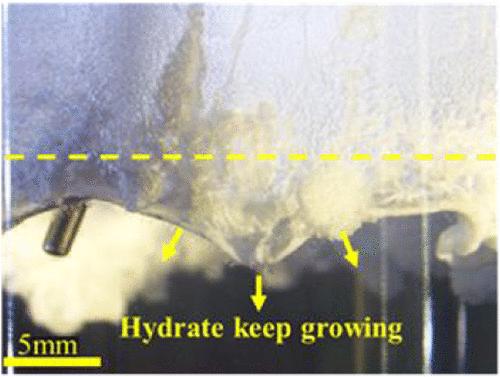
The hydrate-based solidified natural gas technology offers a promising approach to the storage and transportation of natural gas. A key challenge of this technology is to achieve mild hydrate formation conditions and high gas storage capacity. In this work, the effects of temperature on THF-CH4 hydrate formation under static conditions were investigated from multiple perspectives including kinetic measurement, thermal analysis, morphology observation, and in situ Raman spectroscopy. Moreover, the storage stability of THF-CH4 hydrate above the freezing point was explored. The results indicate that 288.15 K is a preferable temperature for increasing the gas uptake of THF-CH4 hydrate formation among the tested temperatures (280.15, 288.15, and 293.15 K), and the highest gas uptake of 0.0756 mol of gas/mol of water was achieved. The continued growth of cloud-like hydrates in the liquid phase was observed, which enhances CH4 diffusion for further hydrate growth. In situ Raman spectroscopy measurement revealed a two-stage growth mechanism in the formation of THF-CH4 hydrate. THF-CH4 hydrate can be stably stored at atmospheric pressure and 277.15 K, with only a 3% gas evolution from the hydrate. The results presented in this work will provide valuable insights for improving the solidified natural gas storage and transportation technology.
期刊介绍:
Energy & Fuels publishes reports of research in the technical area defined by the intersection of the disciplines of chemistry and chemical engineering and the application domain of non-nuclear energy and fuels. This includes research directed at the formation of, exploration for, and production of fossil fuels and biomass; the properties and structure or molecular composition of both raw fuels and refined products; the chemistry involved in the processing and utilization of fuels; fuel cells and their applications; and the analytical and instrumental techniques used in investigations of the foregoing areas.




 京公网安备 11010802042870号
京ICP备2023020795号-1
京公网安备 11010802042870号
京ICP备2023020795号-1

 分享
分享
 求助内容:
求助内容: 应助结果提醒方式:
 扫码关注我们
