Wenxin Du, Xujia Cao, Yuan Lin, Yunyun Gui, Lijun Liu
{"title":"Boosting catalytic reduction of hexavalent chromium over PdNi alloy by electron injection into unoccupied Pd d-band","authors":"Wenxin Du, Xujia Cao, Yuan Lin, Yunyun Gui, Lijun Liu","doi":"10.1016/j.jcis.2025.137465","DOIUrl":null,"url":null,"abstract":"<div><div>Hexavalent chromium (Cr(VI)) in industrial wastewater presents a severe environmental threat. Using formic acid for Cr(VI) reduction offers an efficient and sustainable chromium remediation. While Pd reduces the energy barrier for formic acid dissociation to produce H*, the formation of strong Pd<img>H bonds hinders subsequent Cr(VI) reduction due to elevated energy levels and an increased proportion of unoccupied states in the Pd 4<em>d</em> bands. To address this challenge, we developed a PdNi/TiO<sub>2</sub> nanofibrous catalyst designed to optimize hydrogen adsorption through intermetallic electron transfer within the alloy. Experimental and theoretical results confirm that electrons from Ni are injected into the unoccupied portion of the Pd <em>d</em>-band, downshifting the <em>d</em>-band center upon alloy formation. This electron injection optimizes the electronic states of the Pd active sites, lowering the energy barrier for formic acid dissociation while weakening the Pd<img>H interaction, thereby facilitating the release of H* species. The optimized Pd<sub>6</sub>Ni<sub>4</sub>/TiO<sub>2</sub> achieves an improved turnover frequency (TOF) of 164.8 min<sup>−1</sup> for Cr(VI) reduction, outperforming most previous Pd-based catalysts.</div></div>","PeriodicalId":351,"journal":{"name":"Journal of Colloid and Interface Science","volume":"691 ","pages":"Article 137465"},"PeriodicalIF":9.7000,"publicationDate":"2025-08-01","publicationTypes":"Journal Article","fieldsOfStudy":null,"isOpenAccess":false,"openAccessPdf":"","citationCount":"0","resultStr":null,"platform":"Semanticscholar","paperid":null,"PeriodicalName":"Journal of Colloid and Interface Science","FirstCategoryId":"92","ListUrlMain":"https://www.sciencedirect.com/science/article/pii/S0021979725008562","RegionNum":1,"RegionCategory":"化学","ArticlePicture":[],"TitleCN":null,"AbstractTextCN":null,"PMCID":null,"EPubDate":"2025/3/28 0:00:00","PubModel":"Epub","JCR":"Q1","JCRName":"CHEMISTRY, PHYSICAL","Score":null,"Total":0}
引用次数: 0
Abstract
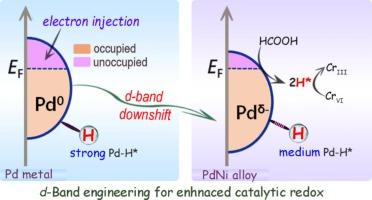
Hexavalent chromium (Cr(VI)) in industrial wastewater presents a severe environmental threat. Using formic acid for Cr(VI) reduction offers an efficient and sustainable chromium remediation. While Pd reduces the energy barrier for formic acid dissociation to produce H*, the formation of strong PdH bonds hinders subsequent Cr(VI) reduction due to elevated energy levels and an increased proportion of unoccupied states in the Pd 4d bands. To address this challenge, we developed a PdNi/TiO2 nanofibrous catalyst designed to optimize hydrogen adsorption through intermetallic electron transfer within the alloy. Experimental and theoretical results confirm that electrons from Ni are injected into the unoccupied portion of the Pd d-band, downshifting the d-band center upon alloy formation. This electron injection optimizes the electronic states of the Pd active sites, lowering the energy barrier for formic acid dissociation while weakening the PdH interaction, thereby facilitating the release of H* species. The optimized Pd6Ni4/TiO2 achieves an improved turnover frequency (TOF) of 164.8 min−1 for Cr(VI) reduction, outperforming most previous Pd-based catalysts.
期刊介绍:
The Journal of Colloid and Interface Science publishes original research findings on the fundamental principles of colloid and interface science, as well as innovative applications in various fields. The criteria for publication include impact, quality, novelty, and originality.
Emphasis:
The journal emphasizes fundamental scientific innovation within the following categories:
A.Colloidal Materials and Nanomaterials
B.Soft Colloidal and Self-Assembly Systems
C.Adsorption, Catalysis, and Electrochemistry
D.Interfacial Processes, Capillarity, and Wetting
E.Biomaterials and Nanomedicine
F.Energy Conversion and Storage, and Environmental Technologies



 京公网安备 11010802042870号
京ICP备2023020795号-1
京公网安备 11010802042870号
京ICP备2023020795号-1

 分享
分享
 求助内容:
求助内容: 应助结果提醒方式:
 扫码关注我们
