Yu Zhao , Yichuan Ma , Qingqing Leng , Qi Zhang , Yuanhang Li , Mengmeng Ji , Hua Yang , Xiaoya Li , Guang Jia , Zhenhua Li , Huifang Liu , Jinchao Zhang
{"title":"Engineered cell nanovesicle antagonists for androgen deprivation therapy of melanoma","authors":"Yu Zhao , Yichuan Ma , Qingqing Leng , Qi Zhang , Yuanhang Li , Mengmeng Ji , Hua Yang , Xiaoya Li , Guang Jia , Zhenhua Li , Huifang Liu , Jinchao Zhang","doi":"10.1016/j.jcis.2025.137468","DOIUrl":null,"url":null,"abstract":"<div><div>Epidemiological studies on melanoma have revealed significant gender disparities, with the incidence and mortality rates being higher in males than in females. Recent studies indicate that androgen contributing to T cell exhaustion and promoting cancer cell proliferation. While clinical androgen deprivation therapies (ADT),particularly the use of androgen receptor (AR) antagonists to block AR signaling, has been employed in clinical settings to reduce androgen levels, antiandrogen drugs often encounter challenges such as poor targeting and selectivity, increased toxicity, low stability, short half-life and the emergence of drug resistance. Here, we establish a nanoantagonists for efficient AR signaling blockade by arming antigen-activated dendritic cells (DCs) nanovesicles with AR antibodies (aAR-NV<sub>OVA</sub>). This innovative approach demonstrates dual therapeutic efficacy: aAR-NV<sub>OVA</sub> effectively disrupts androgen-AR interactions in both melanoma cells and T cells, simultaneously inhibiting tumor proliferation and reversing T cell exhaustion. Furthermore, aAR-NV<sub>OVA</sub> retains the inherent immunostimulatory properties of DCs, facilitating T cell activation and enhancing cytotoxic T lymphocyte infiltration within tumor tissues. As a result, a synergistic effect has been observed in boosting T cell-based immunotherapy by simultaneously enhancing T cell activity and reducing its exhaustion. Our study using aAR-NV<sub>OVA</sub> to antagonize androgen effects offers a promising new strategy for enhancing melanoma immunotherapy.</div></div>","PeriodicalId":351,"journal":{"name":"Journal of Colloid and Interface Science","volume":"691 ","pages":"Article 137468"},"PeriodicalIF":9.7000,"publicationDate":"2025-08-01","publicationTypes":"Journal Article","fieldsOfStudy":null,"isOpenAccess":false,"openAccessPdf":"","citationCount":"0","resultStr":null,"platform":"Semanticscholar","paperid":null,"PeriodicalName":"Journal of Colloid and Interface Science","FirstCategoryId":"92","ListUrlMain":"https://www.sciencedirect.com/science/article/pii/S0021979725008598","RegionNum":1,"RegionCategory":"化学","ArticlePicture":[],"TitleCN":null,"AbstractTextCN":null,"PMCID":null,"EPubDate":"2025/3/28 0:00:00","PubModel":"Epub","JCR":"Q1","JCRName":"CHEMISTRY, PHYSICAL","Score":null,"Total":0}
引用次数: 0
Abstract
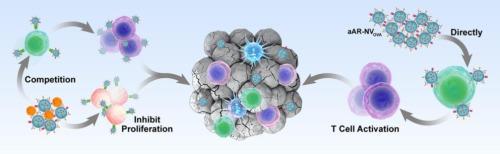
Epidemiological studies on melanoma have revealed significant gender disparities, with the incidence and mortality rates being higher in males than in females. Recent studies indicate that androgen contributing to T cell exhaustion and promoting cancer cell proliferation. While clinical androgen deprivation therapies (ADT),particularly the use of androgen receptor (AR) antagonists to block AR signaling, has been employed in clinical settings to reduce androgen levels, antiandrogen drugs often encounter challenges such as poor targeting and selectivity, increased toxicity, low stability, short half-life and the emergence of drug resistance. Here, we establish a nanoantagonists for efficient AR signaling blockade by arming antigen-activated dendritic cells (DCs) nanovesicles with AR antibodies (aAR-NVOVA). This innovative approach demonstrates dual therapeutic efficacy: aAR-NVOVA effectively disrupts androgen-AR interactions in both melanoma cells and T cells, simultaneously inhibiting tumor proliferation and reversing T cell exhaustion. Furthermore, aAR-NVOVA retains the inherent immunostimulatory properties of DCs, facilitating T cell activation and enhancing cytotoxic T lymphocyte infiltration within tumor tissues. As a result, a synergistic effect has been observed in boosting T cell-based immunotherapy by simultaneously enhancing T cell activity and reducing its exhaustion. Our study using aAR-NVOVA to antagonize androgen effects offers a promising new strategy for enhancing melanoma immunotherapy.
期刊介绍:
The Journal of Colloid and Interface Science publishes original research findings on the fundamental principles of colloid and interface science, as well as innovative applications in various fields. The criteria for publication include impact, quality, novelty, and originality.
Emphasis:
The journal emphasizes fundamental scientific innovation within the following categories:
A.Colloidal Materials and Nanomaterials
B.Soft Colloidal and Self-Assembly Systems
C.Adsorption, Catalysis, and Electrochemistry
D.Interfacial Processes, Capillarity, and Wetting
E.Biomaterials and Nanomedicine
F.Energy Conversion and Storage, and Environmental Technologies



 京公网安备 11010802042870号
京ICP备2023020795号-1
京公网安备 11010802042870号
京ICP备2023020795号-1

 分享
分享
 求助内容:
求助内容: 应助结果提醒方式:
 扫码关注我们
