Qi Wei, Pan Zhang, Xinyu Guo, Weiqing Jiang, Xiaoma Tao, Pei Kang Shen, Zhi Qun Tian
{"title":"Atomic spin engineering of Fe-N-C by axial chlorine-ligand modulation for lightweight and efficient electromagnetic wave absorption","authors":"Qi Wei, Pan Zhang, Xinyu Guo, Weiqing Jiang, Xiaoma Tao, Pei Kang Shen, Zhi Qun Tian","doi":"10.1016/j.jcis.2025.137464","DOIUrl":null,"url":null,"abstract":"<div><div>Introducing atomic magnetic factors to regulate the electromagnetic parameters of graphene is essential to achieving new-generation electromagnetic wave (EMW) absorbing materials. Herein, a new strategy of endowing graphene with atomic magnetic moments was developed by implanting high-spin FeN<sub>4</sub> moieties with axial Cl ligands into 3D <em>N</em>-doped graphene (Cl-Fe-NG). The design facilitates the multi-reflection loss, dielectric loss and magnetic loss of EMW at ultra-low filling. Its minimum reflective loss (RL) is up to −65.9 dB with the biggest effective absorption bandwidth (EAB) of up to 5.5 GHz in the thin thickness of 1.9 mm and a low filler loading of 5 wt%. Meanwhile, a waterborne polyurethane wave-absorbing coating filled with 5 wt% Cl-Fe-NG demonstrates its high absorption performance with a dominant absorption loss of 90 %. Additionally, theory calculations reveal that introducing axial Cl-ligand FeN<sub>4</sub> moiety with high-spin Fe into graphene not only generates additional electric dipoles but also induces an atomic magnetic moment, effectively enhancing the dielectric and magnetic loss of graphene for EMW absorption. This work provides a new approach to designing graphene with atomic magnetic moments for developing EMW absorbing materials with “thin, wide, light, and strong” characteristics instead of the conventional route of graphene with magnetic nanoparticles.</div></div>","PeriodicalId":351,"journal":{"name":"Journal of Colloid and Interface Science","volume":"692 ","pages":"Article 137464"},"PeriodicalIF":9.7000,"publicationDate":"2025-08-15","publicationTypes":"Journal Article","fieldsOfStudy":null,"isOpenAccess":false,"openAccessPdf":"","citationCount":"0","resultStr":null,"platform":"Semanticscholar","paperid":null,"PeriodicalName":"Journal of Colloid and Interface Science","FirstCategoryId":"92","ListUrlMain":"https://www.sciencedirect.com/science/article/pii/S0021979725008550","RegionNum":1,"RegionCategory":"化学","ArticlePicture":[],"TitleCN":null,"AbstractTextCN":null,"PMCID":null,"EPubDate":"2025/3/28 0:00:00","PubModel":"Epub","JCR":"Q1","JCRName":"CHEMISTRY, PHYSICAL","Score":null,"Total":0}
引用次数: 0
Abstract
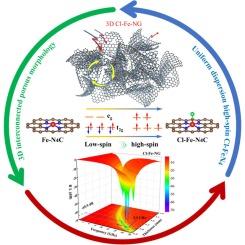
Introducing atomic magnetic factors to regulate the electromagnetic parameters of graphene is essential to achieving new-generation electromagnetic wave (EMW) absorbing materials. Herein, a new strategy of endowing graphene with atomic magnetic moments was developed by implanting high-spin FeN4 moieties with axial Cl ligands into 3D N-doped graphene (Cl-Fe-NG). The design facilitates the multi-reflection loss, dielectric loss and magnetic loss of EMW at ultra-low filling. Its minimum reflective loss (RL) is up to −65.9 dB with the biggest effective absorption bandwidth (EAB) of up to 5.5 GHz in the thin thickness of 1.9 mm and a low filler loading of 5 wt%. Meanwhile, a waterborne polyurethane wave-absorbing coating filled with 5 wt% Cl-Fe-NG demonstrates its high absorption performance with a dominant absorption loss of 90 %. Additionally, theory calculations reveal that introducing axial Cl-ligand FeN4 moiety with high-spin Fe into graphene not only generates additional electric dipoles but also induces an atomic magnetic moment, effectively enhancing the dielectric and magnetic loss of graphene for EMW absorption. This work provides a new approach to designing graphene with atomic magnetic moments for developing EMW absorbing materials with “thin, wide, light, and strong” characteristics instead of the conventional route of graphene with magnetic nanoparticles.
期刊介绍:
The Journal of Colloid and Interface Science publishes original research findings on the fundamental principles of colloid and interface science, as well as innovative applications in various fields. The criteria for publication include impact, quality, novelty, and originality.
Emphasis:
The journal emphasizes fundamental scientific innovation within the following categories:
A.Colloidal Materials and Nanomaterials
B.Soft Colloidal and Self-Assembly Systems
C.Adsorption, Catalysis, and Electrochemistry
D.Interfacial Processes, Capillarity, and Wetting
E.Biomaterials and Nanomedicine
F.Energy Conversion and Storage, and Environmental Technologies



 京公网安备 11010802042870号
京ICP备2023020795号-1
京公网安备 11010802042870号
京ICP备2023020795号-1

 分享
分享
 求助内容:
求助内容: 应助结果提醒方式:
 扫码关注我们
