Yu Zhang , Rong Li , Qi Guo , Fangxiang Song , Kang Kai , Qianlin Chen
{"title":"High-rate LiFe0.75Mn0.25PO4/C cathode material for lithium-ion battery was prepared by oriented growth of precursor crystal plane","authors":"Yu Zhang , Rong Li , Qi Guo , Fangxiang Song , Kang Kai , Qianlin Chen","doi":"10.1016/j.jcis.2025.137436","DOIUrl":null,"url":null,"abstract":"<div><div>The emergence of the lithium-ion battery as a subject of intense research interest has propelled of high-energy–density LiFe<sub>x</sub>Mn<sub>1-x</sub>PO<sub>4</sub>(LFMP) becoming a prominent area of investigation. However, the material suffers from inherently low electronic conductivity due to its olivine structure, which imposes severe constraints on electron transport kinetics, thus adversely impacting both charge–discharge rates and overall electrochemical performance. We propose an innovative protocol for high-precision reaction mechanism modulation. By employing Fe<sub>3</sub>(PO<sub>4</sub>)<sub>2</sub>·8H<sub>2</sub>O with strategically enhanced (020) crystal plane exposure as a pivotal precursor, we synthesized LiFe<sub>0.75</sub>Mn<sub>0.25</sub>PO<sub>4</sub>/C cathode material featuring a shorter ion diffusion path. Comprehensive characterization coupled with electrochemical validation revealed that the resultant cathode material exhibits a smaller particle size and more uniform morphology, along with a superior rate performance and cycle stability. The discharge specific capacity is 144.1 mAh g<sup>−1</sup> and the capacity retention reaches 96.1 % over 1000 cycles at a 1C rate. The findings demonstrate that the regulation of the growth trajectory of the precursor Fe<sub>3</sub>(PO<sub>4</sub>)<sub>2</sub>·8H<sub>2</sub>O crystal plane can markedly enhance the electronic conductivity and Li<sup>+</sup> mobility of the cathode material, thereby optimising the electrochemical performance.</div></div>","PeriodicalId":351,"journal":{"name":"Journal of Colloid and Interface Science","volume":"691 ","pages":"Article 137436"},"PeriodicalIF":9.7000,"publicationDate":"2025-08-01","publicationTypes":"Journal Article","fieldsOfStudy":null,"isOpenAccess":false,"openAccessPdf":"","citationCount":"0","resultStr":null,"platform":"Semanticscholar","paperid":null,"PeriodicalName":"Journal of Colloid and Interface Science","FirstCategoryId":"92","ListUrlMain":"https://www.sciencedirect.com/science/article/pii/S0021979725008276","RegionNum":1,"RegionCategory":"化学","ArticlePicture":[],"TitleCN":null,"AbstractTextCN":null,"PMCID":null,"EPubDate":"2025/3/28 0:00:00","PubModel":"Epub","JCR":"Q1","JCRName":"CHEMISTRY, PHYSICAL","Score":null,"Total":0}
引用次数: 0
Abstract
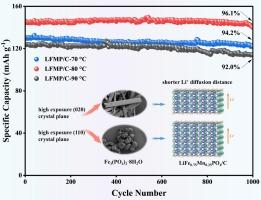
The emergence of the lithium-ion battery as a subject of intense research interest has propelled of high-energy–density LiFexMn1-xPO4(LFMP) becoming a prominent area of investigation. However, the material suffers from inherently low electronic conductivity due to its olivine structure, which imposes severe constraints on electron transport kinetics, thus adversely impacting both charge–discharge rates and overall electrochemical performance. We propose an innovative protocol for high-precision reaction mechanism modulation. By employing Fe3(PO4)2·8H2O with strategically enhanced (020) crystal plane exposure as a pivotal precursor, we synthesized LiFe0.75Mn0.25PO4/C cathode material featuring a shorter ion diffusion path. Comprehensive characterization coupled with electrochemical validation revealed that the resultant cathode material exhibits a smaller particle size and more uniform morphology, along with a superior rate performance and cycle stability. The discharge specific capacity is 144.1 mAh g−1 and the capacity retention reaches 96.1 % over 1000 cycles at a 1C rate. The findings demonstrate that the regulation of the growth trajectory of the precursor Fe3(PO4)2·8H2O crystal plane can markedly enhance the electronic conductivity and Li+ mobility of the cathode material, thereby optimising the electrochemical performance.
随着锂离子电池的兴起,高能量密度LiFexMn1-xPO4(LFMP)成为研究的热点。然而,由于其橄榄石结构,该材料具有固有的低电子导电性,这对电子传递动力学施加了严重的限制,从而对充放电速率和整体电化学性能产生不利影响。我们提出了一种创新的高精度反应机理调制方案。以Fe3(PO4)2·8H2O策略性增强(020)晶面曝光为关键前驱体,合成了离子扩散路径更短的LiFe0.75Mn0.25PO4/C正极材料。综合表征和电化学验证表明,合成的正极材料具有更小的粒径和更均匀的形貌,以及优越的倍率性能和循环稳定性。放电比容量为144.1 mAh g−1,在1C倍率下,1000次循环的容量保持率达到96.1%。研究结果表明,调节前驱体Fe3(PO4)2·8H2O晶面的生长轨迹可以显著提高正极材料的电子导电性和Li+迁移率,从而优化正极材料的电化学性能。
期刊介绍:
The Journal of Colloid and Interface Science publishes original research findings on the fundamental principles of colloid and interface science, as well as innovative applications in various fields. The criteria for publication include impact, quality, novelty, and originality.
Emphasis:
The journal emphasizes fundamental scientific innovation within the following categories:
A.Colloidal Materials and Nanomaterials
B.Soft Colloidal and Self-Assembly Systems
C.Adsorption, Catalysis, and Electrochemistry
D.Interfacial Processes, Capillarity, and Wetting
E.Biomaterials and Nanomedicine
F.Energy Conversion and Storage, and Environmental Technologies




 京公网安备 11010802042870号
京ICP备2023020795号-1
京公网安备 11010802042870号
京ICP备2023020795号-1

 分享
分享
 求助内容:
求助内容: 应助结果提醒方式:
 扫码关注我们
