{"title":"Investigation of dynamic fractures under varying stress states","authors":"Yi Shen, Tianbao Ma, Jianqiao Li","doi":"10.1016/j.ijmecsci.2025.110177","DOIUrl":null,"url":null,"abstract":"<div><div>The dynamic fracture behaviours of metallic materials vary significantly under different stress states, and the study on them is of great significance in guiding the design of engineering structures and improving their fracture resistance. To investigate the effect of the stress state on dynamic fractures, five newly designed specimens were proposed to produce different loading states, and the investigation was conducted using the traditional Split Hopkinson Pressure Bar (SHPB) device. In this study, the macroscopic fracture behaviour and microscopic void morphology were analysed under different loading rates and stress states. Subsequently, dynamic fractures under different stress states were investigated via numerical simulations using different damage models. Finally, the effects of specimen factors on the reliability of studying dynamic fractures using the newly proposed method were analysed using both experimental and numerical methods. All the results confirmed that the proposed experimental method is effective and simple for studying dynamic fractures under shear-to tensile-dominated states. The stress states are stable and controllable by changing the specimen shape. Moreover, both the microscopic void coalescence orientation and macroscopic fracture features are determined by the competition between the tensile and shear stresses. The proposed experimental method provides a new and reliable method for testing dynamic fracture behaviour of typical metallic materials under shear- to tensile-dominated states using the traditional SHPB device.</div></div>","PeriodicalId":56287,"journal":{"name":"International Journal of Mechanical Sciences","volume":"293 ","pages":"Article 110177"},"PeriodicalIF":9.4000,"publicationDate":"2025-05-01","publicationTypes":"Journal Article","fieldsOfStudy":null,"isOpenAccess":false,"openAccessPdf":"","citationCount":"0","resultStr":null,"platform":"Semanticscholar","paperid":null,"PeriodicalName":"International Journal of Mechanical Sciences","FirstCategoryId":"5","ListUrlMain":"https://www.sciencedirect.com/science/article/pii/S0020740325002632","RegionNum":1,"RegionCategory":"工程技术","ArticlePicture":[],"TitleCN":null,"AbstractTextCN":null,"PMCID":null,"EPubDate":"2025/4/1 0:00:00","PubModel":"Epub","JCR":"Q1","JCRName":"ENGINEERING, MECHANICAL","Score":null,"Total":0}
引用次数: 0
Abstract
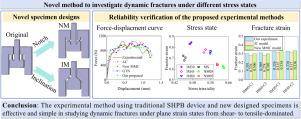
The dynamic fracture behaviours of metallic materials vary significantly under different stress states, and the study on them is of great significance in guiding the design of engineering structures and improving their fracture resistance. To investigate the effect of the stress state on dynamic fractures, five newly designed specimens were proposed to produce different loading states, and the investigation was conducted using the traditional Split Hopkinson Pressure Bar (SHPB) device. In this study, the macroscopic fracture behaviour and microscopic void morphology were analysed under different loading rates and stress states. Subsequently, dynamic fractures under different stress states were investigated via numerical simulations using different damage models. Finally, the effects of specimen factors on the reliability of studying dynamic fractures using the newly proposed method were analysed using both experimental and numerical methods. All the results confirmed that the proposed experimental method is effective and simple for studying dynamic fractures under shear-to tensile-dominated states. The stress states are stable and controllable by changing the specimen shape. Moreover, both the microscopic void coalescence orientation and macroscopic fracture features are determined by the competition between the tensile and shear stresses. The proposed experimental method provides a new and reliable method for testing dynamic fracture behaviour of typical metallic materials under shear- to tensile-dominated states using the traditional SHPB device.
期刊介绍:
The International Journal of Mechanical Sciences (IJMS) serves as a global platform for the publication and dissemination of original research that contributes to a deeper scientific understanding of the fundamental disciplines within mechanical, civil, and material engineering.
The primary focus of IJMS is to showcase innovative and ground-breaking work that utilizes analytical and computational modeling techniques, such as Finite Element Method (FEM), Boundary Element Method (BEM), and mesh-free methods, among others. These modeling methods are applied to diverse fields including rigid-body mechanics (e.g., dynamics, vibration, stability), structural mechanics, metal forming, advanced materials (e.g., metals, composites, cellular, smart) behavior and applications, impact mechanics, strain localization, and other nonlinear effects (e.g., large deflections, plasticity, fracture).
Additionally, IJMS covers the realms of fluid mechanics (both external and internal flows), tribology, thermodynamics, and materials processing. These subjects collectively form the core of the journal's content.
In summary, IJMS provides a prestigious platform for researchers to present their original contributions, shedding light on analytical and computational modeling methods in various areas of mechanical engineering, as well as exploring the behavior and application of advanced materials, fluid mechanics, thermodynamics, and materials processing.




 京公网安备 11010802042870号
京ICP备2023020795号-1
京公网安备 11010802042870号
京ICP备2023020795号-1

 分享
分享
 求助内容:
求助内容: 应助结果提醒方式:
 扫码关注我们
