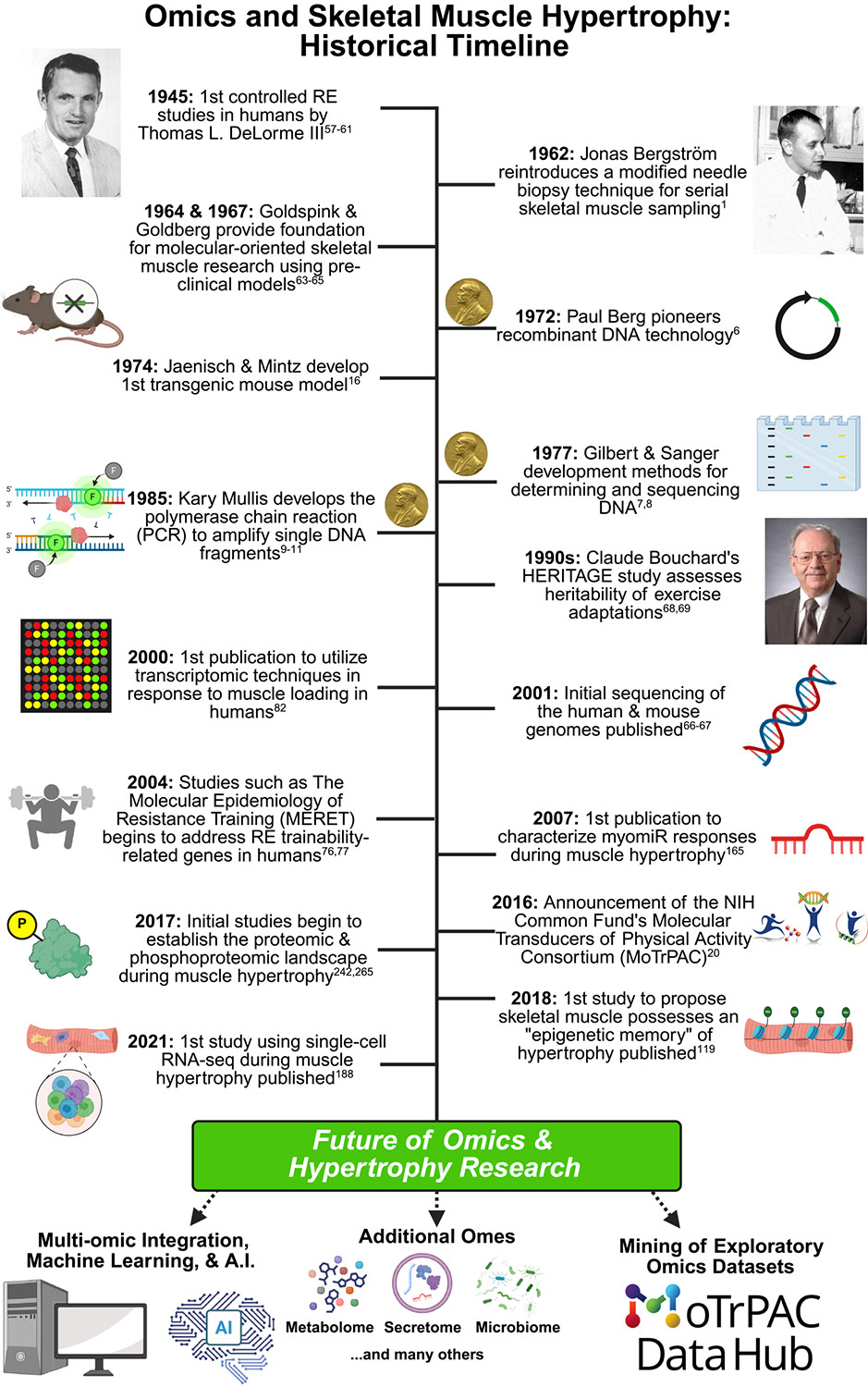
A history of omics discoveries reveals the correlates and mechanisms of loading-induced hypertrophy in adult skeletal muscle. 2024 CaMPS young investigator award invited review.
{"title":"A history of omics discoveries reveals the correlates and mechanisms of loading-induced hypertrophy in adult skeletal muscle. 2024 CaMPS young investigator award invited review.","authors":"Toby L Chambers, Kevin A Murach","doi":"10.1152/ajpcell.00968.2024","DOIUrl":null,"url":null,"abstract":"<p><p>Since the early 2000s, omics approaches to study skeletal muscle hypertrophy consequent to loading (e.g., resistance exercise) have expanded dramatically. Beginning with genomics and transcriptomics, there are now omics datasets from hypertrophying skeletal muscle spanning methylomics, proteomics, and phosphoproteomics, with further integration of single cell/nucleus-specific omics, among others. The purpose of this review is to explore the history of leveraging omics to enable understanding and discovery with respect to loading-induced hypertrophy in adult skeletal muscle. We elaborate on key historical and contemporary studies and findings, highlight specific examples where omics discoveries led to a mechanistic understanding of skeletal muscle growth, and provide background on established and emerging omic technologies. We focus on findings from human skeletal muscle tissue but also provide context and support from the rodent literature, including insights from gain- and loss-of-function experiments. Moving forward, the computational integration of omics datasets will provide unprecedented information and exciting new directions for studying how resistance exercise mediates skeletal muscle health. This information will help inform how to target key factors influencing muscle mass with a deep, comprehensive, and integrated multilayered understanding of their molecular regulation.</p>","PeriodicalId":7585,"journal":{"name":"American journal of physiology. Cell physiology","volume":" ","pages":"C1535-C1557"},"PeriodicalIF":4.7000,"publicationDate":"2025-05-01","publicationTypes":"Journal Article","fieldsOfStudy":null,"isOpenAccess":false,"openAccessPdf":"https://www.ncbi.nlm.nih.gov/pmc/articles/PMC12966886/pdf/","citationCount":"0","resultStr":null,"platform":"Semanticscholar","paperid":null,"PeriodicalName":"American journal of physiology. Cell physiology","FirstCategoryId":"99","ListUrlMain":"https://doi.org/10.1152/ajpcell.00968.2024","RegionNum":2,"RegionCategory":"生物学","ArticlePicture":[],"TitleCN":null,"AbstractTextCN":null,"PMCID":null,"EPubDate":"2025/4/2 0:00:00","PubModel":"Epub","JCR":"Q2","JCRName":"CELL BIOLOGY","Score":null,"Total":0}
引用次数: 0
Abstract
Since the early 2000s, omics approaches to study skeletal muscle hypertrophy consequent to loading (e.g., resistance exercise) have expanded dramatically. Beginning with genomics and transcriptomics, there are now omics datasets from hypertrophying skeletal muscle spanning methylomics, proteomics, and phosphoproteomics, with further integration of single cell/nucleus-specific omics, among others. The purpose of this review is to explore the history of leveraging omics to enable understanding and discovery with respect to loading-induced hypertrophy in adult skeletal muscle. We elaborate on key historical and contemporary studies and findings, highlight specific examples where omics discoveries led to a mechanistic understanding of skeletal muscle growth, and provide background on established and emerging omic technologies. We focus on findings from human skeletal muscle tissue but also provide context and support from the rodent literature, including insights from gain- and loss-of-function experiments. Moving forward, the computational integration of omics datasets will provide unprecedented information and exciting new directions for studying how resistance exercise mediates skeletal muscle health. This information will help inform how to target key factors influencing muscle mass with a deep, comprehensive, and integrated multilayered understanding of their molecular regulation.
期刊介绍:
The American Journal of Physiology-Cell Physiology is dedicated to innovative approaches to the study of cell and molecular physiology. Contributions that use cellular and molecular approaches to shed light on mechanisms of physiological control at higher levels of organization also appear regularly. Manuscripts dealing with the structure and function of cell membranes, contractile systems, cellular organelles, and membrane channels, transporters, and pumps are encouraged. Studies dealing with integrated regulation of cellular function, including mechanisms of signal transduction, development, gene expression, cell-to-cell interactions, and the cell physiology of pathophysiological states, are also eagerly sought. Interdisciplinary studies that apply the approaches of biochemistry, biophysics, molecular biology, morphology, and immunology to the determination of new principles in cell physiology are especially welcome.




 京公网安备 11010802042870号
京ICP备2023020795号-1
京公网安备 11010802042870号
京ICP备2023020795号-1

 分享
分享
 求助内容:
求助内容: 应助结果提醒方式:
 扫码关注我们
