Raziyeh Bounik, Alex E. Landolt, Jihyun Lee, Vijay Viswam, Fernando Cardes, Mario M. Modena and Andreas Hierlemann
{"title":"Seamless integration of CMOS microsensors into open microfluidic systems†","authors":"Raziyeh Bounik, Alex E. Landolt, Jihyun Lee, Vijay Viswam, Fernando Cardes, Mario M. Modena and Andreas Hierlemann","doi":"10.1039/D4LC01000K","DOIUrl":null,"url":null,"abstract":"<p >As traditional two-dimensional (2D) cell cultures offer limited predictive capabilities for drug development, three-dimensional (3D) tissue models, such as spherical microtissues, have been introduced to better reproduce physiological conditions. The hanging-drop method, used to cultivate microtissues at an air–liquid interface, proves to be effective for microtissue formation and maintenance. Using that technology, it is possible to fluidically interconnect several hanging drops hosting different models of human organs to recapitulate relevant tissue interactions. Here, we combine microfluidics with microelectronics (<em>i.e.</em>, complementary metal-oxide-semiconductor (CMOS) technology) and present a novel multifunctional CMOS microelectrode array (MEA) integrated into an open microfluidic system. The device can be used in hanging-drop mode for <em>in situ</em> microtissue readouts and in standing-drop mode like a conventional MEA. The CMOS-MEA chip features two reconfigurable electrode arrays with 1024 electrodes each, and enables electrophysiology, impedance spectroscopy, and electrochemical sensing to acquire a broad spectrum of biologically relevant information. We fabricated the chip using a 0.18 μm CMOS process and developed a strategy to integrate the CMOS-MEA chip into the open microfluidic system within a larger overall effort to incorporate discrete CMOS sensors into microfluidic devices. Proof-of-concept experiments demonstrate the capability to perform electrophysiology and impedance spectroscopy of human induced pluripotent stem cell (hiPSC)-derived cardiac microtissues, as well as electrochemical sensing of different analytes including hydrogen peroxide and epinephrine.</p>","PeriodicalId":85,"journal":{"name":"Lab on a Chip","volume":" 9","pages":" 2205-2221"},"PeriodicalIF":5.4000,"publicationDate":"2025-03-27","publicationTypes":"Journal Article","fieldsOfStudy":null,"isOpenAccess":false,"openAccessPdf":"https://www.ncbi.nlm.nih.gov/pmc/articles/PMC11962860/pdf/","citationCount":"0","resultStr":null,"platform":"Semanticscholar","paperid":null,"PeriodicalName":"Lab on a Chip","FirstCategoryId":"5","ListUrlMain":"https://pubs.rsc.org/en/content/articlelanding/2025/lc/d4lc01000k","RegionNum":2,"RegionCategory":"工程技术","ArticlePicture":[],"TitleCN":null,"AbstractTextCN":null,"PMCID":null,"EPubDate":"","PubModel":"","JCR":"Q1","JCRName":"BIOCHEMICAL RESEARCH METHODS","Score":null,"Total":0}
引用次数: 0
Abstract
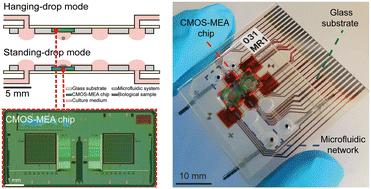
As traditional two-dimensional (2D) cell cultures offer limited predictive capabilities for drug development, three-dimensional (3D) tissue models, such as spherical microtissues, have been introduced to better reproduce physiological conditions. The hanging-drop method, used to cultivate microtissues at an air–liquid interface, proves to be effective for microtissue formation and maintenance. Using that technology, it is possible to fluidically interconnect several hanging drops hosting different models of human organs to recapitulate relevant tissue interactions. Here, we combine microfluidics with microelectronics (i.e., complementary metal-oxide-semiconductor (CMOS) technology) and present a novel multifunctional CMOS microelectrode array (MEA) integrated into an open microfluidic system. The device can be used in hanging-drop mode for in situ microtissue readouts and in standing-drop mode like a conventional MEA. The CMOS-MEA chip features two reconfigurable electrode arrays with 1024 electrodes each, and enables electrophysiology, impedance spectroscopy, and electrochemical sensing to acquire a broad spectrum of biologically relevant information. We fabricated the chip using a 0.18 μm CMOS process and developed a strategy to integrate the CMOS-MEA chip into the open microfluidic system within a larger overall effort to incorporate discrete CMOS sensors into microfluidic devices. Proof-of-concept experiments demonstrate the capability to perform electrophysiology and impedance spectroscopy of human induced pluripotent stem cell (hiPSC)-derived cardiac microtissues, as well as electrochemical sensing of different analytes including hydrogen peroxide and epinephrine.
期刊介绍:
Lab on a Chip is the premiere journal that publishes cutting-edge research in the field of miniaturization. By their very nature, microfluidic/nanofluidic/miniaturized systems are at the intersection of disciplines, spanning fundamental research to high-end application, which is reflected by the broad readership of the journal. Lab on a Chip publishes two types of papers on original research: full-length research papers and communications. Papers should demonstrate innovations, which can come from technical advancements or applications addressing pressing needs in globally important areas. The journal also publishes Comments, Reviews, and Perspectives.




 京公网安备 11010802042870号
京ICP备2023020795号-1
京公网安备 11010802042870号
京ICP备2023020795号-1

 分享
分享
 求助内容:
求助内容: 应助结果提醒方式:
 扫码关注我们
