Zhujun Lian, Ke Xu, Jie Jin, Xingliang Zhang, Junfang Xu
{"title":"Methods used to find clients and risky sexual behavior among female sex workers in China: a cross-sectional study.","authors":"Zhujun Lian, Ke Xu, Jie Jin, Xingliang Zhang, Junfang Xu","doi":"10.1186/s12889-025-22395-y","DOIUrl":null,"url":null,"abstract":"<p><strong>Background: </strong>Female sex workers (FSWs) are high-incidence population of sexually transmitted infections (STIs), including human immunodeficiency virus (HIV). The methods used to find clients for commercial sex have diversified in recent years. As a result, it is crucial to analyze the correlation between methods used to find clients and risky sexual behavior and explore changes in risky sexual behavior among FSWs over time.</p><p><strong>Methods: </strong>HIV sentinel surveillance data were collected from Zhejiang Province, China, between 2016 and 2021. In total, 4,798 FSWs were included in our analysis. We collected information related to socio-demographic variables, HIV knowledge, methods used to find clients, and condom use. Descriptive statistics were used to analyze the socio-demographic characteristics of FSWs. Univariate and sequential logistic regression models were employed to determine the influence of methods used to find clients on risky sexual behavior after controlling for other factors.</p><p><strong>Results: </strong>The average age of the 4,798 FSWs was 33.0 ± 7.4 years. The majority (70.6%) who find clients online reported always using condoms over the past month. The proportion of FSWs engaging in risky sexual behavior, defined as not using condoms at the last sexual encounter or not using them consistently over the past month, was lowest among those who find clients online, whereas the risk was highest among those who worked at a fixed site (p < 0.001). Sequential logistic regression demonstrated that compared to FSWs who find clients at a fixed site, those finding clients online (OR = 0.6, p < 0.001) were significantly associated with risky sexual behavior.</p><p><strong>Conclusion: </strong>FSWs had a high knowledge regarding acquired immunodeficiency syndrome (AIDS), but with greater likelihood of risky sexual behavior, particularly among FSWs who find customers at a fixed site. The risk of engaging in condomless sex among FSWs who find client at fixed sites was higher than those online. Therefore, it is essential to explore health interventions that improve condom use among FSWs.</p>","PeriodicalId":9039,"journal":{"name":"BMC Public Health","volume":"25 1","pages":"1232"},"PeriodicalIF":3.6000,"publicationDate":"2025-04-01","publicationTypes":"Journal Article","fieldsOfStudy":null,"isOpenAccess":false,"openAccessPdf":"https://www.ncbi.nlm.nih.gov/pmc/articles/PMC11963295/pdf/","citationCount":"0","resultStr":null,"platform":"Semanticscholar","paperid":null,"PeriodicalName":"BMC Public Health","FirstCategoryId":"3","ListUrlMain":"https://doi.org/10.1186/s12889-025-22395-y","RegionNum":2,"RegionCategory":"医学","ArticlePicture":[],"TitleCN":null,"AbstractTextCN":null,"PMCID":null,"EPubDate":"","PubModel":"","JCR":"Q1","JCRName":"PUBLIC, ENVIRONMENTAL & OCCUPATIONAL HEALTH","Score":null,"Total":0}
引用次数: 0
Abstract
Background: Female sex workers (FSWs) are high-incidence population of sexually transmitted infections (STIs), including human immunodeficiency virus (HIV). The methods used to find clients for commercial sex have diversified in recent years. As a result, it is crucial to analyze the correlation between methods used to find clients and risky sexual behavior and explore changes in risky sexual behavior among FSWs over time.
Methods: HIV sentinel surveillance data were collected from Zhejiang Province, China, between 2016 and 2021. In total, 4,798 FSWs were included in our analysis. We collected information related to socio-demographic variables, HIV knowledge, methods used to find clients, and condom use. Descriptive statistics were used to analyze the socio-demographic characteristics of FSWs. Univariate and sequential logistic regression models were employed to determine the influence of methods used to find clients on risky sexual behavior after controlling for other factors.
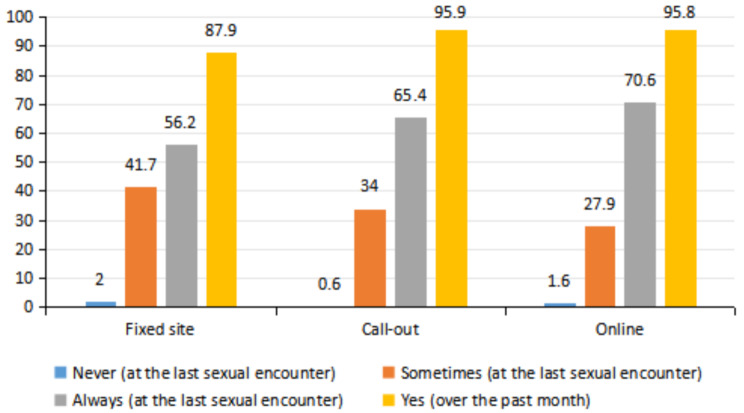
Results: The average age of the 4,798 FSWs was 33.0 ± 7.4 years. The majority (70.6%) who find clients online reported always using condoms over the past month. The proportion of FSWs engaging in risky sexual behavior, defined as not using condoms at the last sexual encounter or not using them consistently over the past month, was lowest among those who find clients online, whereas the risk was highest among those who worked at a fixed site (p < 0.001). Sequential logistic regression demonstrated that compared to FSWs who find clients at a fixed site, those finding clients online (OR = 0.6, p < 0.001) were significantly associated with risky sexual behavior.
Conclusion: FSWs had a high knowledge regarding acquired immunodeficiency syndrome (AIDS), but with greater likelihood of risky sexual behavior, particularly among FSWs who find customers at a fixed site. The risk of engaging in condomless sex among FSWs who find client at fixed sites was higher than those online. Therefore, it is essential to explore health interventions that improve condom use among FSWs.
期刊介绍:
BMC Public Health is an open access, peer-reviewed journal that considers articles on the epidemiology of disease and the understanding of all aspects of public health. The journal has a special focus on the social determinants of health, the environmental, behavioral, and occupational correlates of health and disease, and the impact of health policies, practices and interventions on the community.




 京公网安备 11010802042870号
京ICP备2023020795号-1
京公网安备 11010802042870号
京ICP备2023020795号-1

 分享
分享
 求助内容:
求助内容: 应助结果提醒方式:
 扫码关注我们
