BUN-to-ALB ratio as an effective predictor of 30 day mortality in ADHF patients in eastern China

IF 3.7 2区 医学 Q2 CARDIAC & CARDIOVASCULAR SYSTEMS ESC Heart Failure Pub Date : 2025-04-01 DOI:10.1002/ehf2.15289
Xin Huang, Chao Wang, Shiming He, Guoan Jian, Kun Jiang, Zihao Lu, Guotai Sheng, Yang Zou, Guobo Xie
{"title":"BUN-to-ALB ratio as an effective predictor of 30 day mortality in ADHF patients in eastern China","authors":"Xin Huang,&nbsp;Chao Wang,&nbsp;Shiming He,&nbsp;Guoan Jian,&nbsp;Kun Jiang,&nbsp;Zihao Lu,&nbsp;Guotai Sheng,&nbsp;Yang Zou,&nbsp;Guobo Xie","doi":"10.1002/ehf2.15289","DOIUrl":null,"url":null,"abstract":"<div>\n \n \n <section>\n \n <h3> Aims</h3>\n \n <p>The blood urea nitrogen-to-albumin ratio (BAR) is considered a potential indicator for assessing the poor prognosis of heart failure (HF). However, its prognostic value for Chinese patients with acute decompensated HF (ADHF) remains unclear.</p>\n </section>\n \n <section>\n \n <h3> Methods</h3>\n \n <p>This study included ADHF patients who met the study criteria and were admitted to Jiangxi Provincial People's Hospital from 2019 to 2022. We first employed univariate and multivariate Cox regression models to determine the role of BAR in evaluating the short-term prognosis of ADHF patients. Subsequently, we used restricted cubic spline regression to explore the nonlinear relationship and potential threshold between BAR and prognosis. Receiver operating characteristic (ROC) curve analysis was performed to calculate the predictive accuracy of BAR for 30 day mortality and identify relevant threshold points.</p>\n </section>\n \n <section>\n \n <h3> Results</h3>\n \n <p>A total of 1421 patients were included in the analysis, and the population was divided into two groups based on the optimal threshold for BAR (0.33) determined by ROC curve analysis. During the median 30 day follow-up period, the mortality rates in the high-BAR and low-BAR groups were 12.46% and 1.26%, respectively. Multivariable Cox regression analysis indicated that a high BAR was associated with an increased 30 day mortality risk in ADHF patients [hazard ratio (HR): 3.25, 95% confidence interval (CI): 1.28–8.30], particularly among those with concomitant cerebral infarction (HR: 19.12, 95% CI: 2.67–136.67). The five sensitivity analyses completed were consistent with the results of the main analysis. Furthermore, restricted cubic spline analysis revealed a nonlinear association between BAR and short-term mortality in ADHF patients (<i>P</i> for nonlinearity: &lt;0.001), with a potential threshold effect observed when BAR was between 0.3 and 0.5. ROC curve analysis determined that the predictive efficiency of BAR for short-term mortality in ADHF patients was ~84%, with an area under the ROC curve (AUC) of 0.84.</p>\n </section>\n \n <section>\n \n <h3> Conclusions</h3>\n \n <p>This study found that BAR can serve as an effective predictor of short-term prognosis in ADHF patients based on clinical data from the Jiangxi population, with an optimal predictive threshold calculated at 0.33.</p>\n </section>\n </div>","PeriodicalId":11864,"journal":{"name":"ESC Heart Failure","volume":"12 4","pages":"2540-2551"},"PeriodicalIF":3.7000,"publicationDate":"2025-04-01","publicationTypes":"Journal Article","fieldsOfStudy":null,"isOpenAccess":false,"openAccessPdf":"https://onlinelibrary.wiley.com/doi/epdf/10.1002/ehf2.15289","citationCount":"0","resultStr":null,"platform":"Semanticscholar","paperid":null,"PeriodicalName":"ESC Heart Failure","FirstCategoryId":"3","ListUrlMain":"https://onlinelibrary.wiley.com/doi/10.1002/ehf2.15289","RegionNum":2,"RegionCategory":"医学","ArticlePicture":[],"TitleCN":null,"AbstractTextCN":null,"PMCID":null,"EPubDate":"","PubModel":"","JCR":"Q2","JCRName":"CARDIAC & CARDIOVASCULAR SYSTEMS","Score":null,"Total":0}
引用次数: 0

Abstract

Aims

The blood urea nitrogen-to-albumin ratio (BAR) is considered a potential indicator for assessing the poor prognosis of heart failure (HF). However, its prognostic value for Chinese patients with acute decompensated HF (ADHF) remains unclear.

Methods

This study included ADHF patients who met the study criteria and were admitted to Jiangxi Provincial People's Hospital from 2019 to 2022. We first employed univariate and multivariate Cox regression models to determine the role of BAR in evaluating the short-term prognosis of ADHF patients. Subsequently, we used restricted cubic spline regression to explore the nonlinear relationship and potential threshold between BAR and prognosis. Receiver operating characteristic (ROC) curve analysis was performed to calculate the predictive accuracy of BAR for 30 day mortality and identify relevant threshold points.

Results

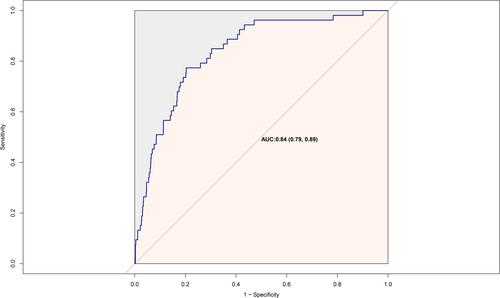
A total of 1421 patients were included in the analysis, and the population was divided into two groups based on the optimal threshold for BAR (0.33) determined by ROC curve analysis. During the median 30 day follow-up period, the mortality rates in the high-BAR and low-BAR groups were 12.46% and 1.26%, respectively. Multivariable Cox regression analysis indicated that a high BAR was associated with an increased 30 day mortality risk in ADHF patients [hazard ratio (HR): 3.25, 95% confidence interval (CI): 1.28–8.30], particularly among those with concomitant cerebral infarction (HR: 19.12, 95% CI: 2.67–136.67). The five sensitivity analyses completed were consistent with the results of the main analysis. Furthermore, restricted cubic spline analysis revealed a nonlinear association between BAR and short-term mortality in ADHF patients (P for nonlinearity: <0.001), with a potential threshold effect observed when BAR was between 0.3 and 0.5. ROC curve analysis determined that the predictive efficiency of BAR for short-term mortality in ADHF patients was ~84%, with an area under the ROC curve (AUC) of 0.84.

Conclusions

This study found that BAR can serve as an effective predictor of short-term prognosis in ADHF patients based on clinical data from the Jiangxi population, with an optimal predictive threshold calculated at 0.33.
Abstract Image

查看原文
分享 分享
微信好友 朋友圈 QQ好友 复制链接
本刊更多论文
bun / alb比值作为中国东部ADHF患者30天死亡率的有效预测因子
目的:血尿素氮白蛋白比(BAR)被认为是评估心力衰竭(HF)预后不良的潜在指标。然而,其对中国急性失代偿性心衰(ADHF)患者的预后价值尚不清楚。方法:本研究纳入2019 - 2022年江西省人民医院收治的符合研究标准的ADHF患者。我们首先采用单因素和多因素Cox回归模型来确定BAR在评估ADHF患者短期预后中的作用。随后,我们使用限制三次样条回归来探讨BAR与预后之间的非线性关系和潜在阈值。采用受试者工作特征(ROC)曲线分析,计算BAR对30天死亡率的预测精度,并确定相关阈值点。结果:共纳入1421例患者,根据ROC曲线分析确定的BAR最佳阈值(0.33)将人群分为两组。在中位30天随访期间,高bar组和低bar组的死亡率分别为12.46%和1.26%。多变量Cox回归分析显示,高BAR与ADHF患者30天死亡风险增加相关[危险比(HR): 3.25, 95%可信区间(CI): 1.28-8.30],尤其是伴有脑梗死的患者(HR: 19.12, 95% CI: 2.67-136.67)。完成的5项敏感性分析与主分析结果一致。此外,限制性三次样条分析显示,BAR与ADHF患者短期死亡率之间存在非线性关联(P为非线性)。结论:本研究发现,基于江西人群的临床数据,BAR可作为ADHF患者短期预后的有效预测指标,其最佳预测阈值为0.33。
本文章由计算机程序翻译,如有差异,请以英文原文为准。
求助全文
约1分钟内获得全文 去求助
来源期刊
ESC Heart Failure
ESC Heart Failure Medicine-Cardiology and Cardiovascular Medicine
CiteScore
7.00
自引率
7.90%
发文量
461
审稿时长
12 weeks
期刊介绍: ESC Heart Failure is the open access journal of the Heart Failure Association of the European Society of Cardiology dedicated to the advancement of knowledge in the field of heart failure. The journal aims to improve the understanding, prevention, investigation and treatment of heart failure. Molecular and cellular biology, pathology, physiology, electrophysiology, pharmacology, as well as the clinical, social and population sciences all form part of the discipline that is heart failure. Accordingly, submission of manuscripts on basic, translational, clinical and population sciences is invited. Original contributions on nursing, care of the elderly, primary care, health economics and other specialist fields related to heart failure are also welcome, as are case reports that highlight interesting aspects of heart failure care and treatment.
期刊最新文献
Issue Information Real-world effectiveness of targeted therapies in ATTR cardiomyopathy: A meta-analysis integrating population-based data Inflammation and genetics in myo-pericardial diseases: Insights from the Italian Study Group on Cardiomyopathies and Pericardial Diseases Economic burden of heart failure in Europe: A systematic review of costs and cost-effectiveness Indirect mitral annuloplasty in patients with reduced or preserved ejection fraction: A real-world, single-centre experience
×
引用
GB/T 7714-2015
复制
MLA
复制
APA
复制
导出至
BibTeX EndNote RefMan NoteFirst NoteExpress
×
×
提示
您的信息不完整,为了账户安全,请先补充。
现在去补充
×
提示
您因"违规操作"
具体请查看互助需知
我知道了
×
提示
现在去查看 取消
×
提示
确定
0
微信
客服QQ
Book学术公众号 扫码关注我们
反馈
×
意见反馈
请填写您的意见或建议
请填写您的手机或邮箱
已复制链接
已复制链接
快去分享给好友吧!
我知道了
×
扫码分享
扫码分享
Book学术官方微信
Book学术文献互助
Book学术文献互助群
群 号:604180095
Book学术
文献互助 智能选刊 最新文献 互助须知 联系我们:info@booksci.cn
Book学术提供免费学术资源搜索服务,方便国内外学者检索中英文文献。致力于提供最便捷和优质的服务体验。
Copyright © 2023 Book学术 All rights reserved.
ghs 京公网安备 11010802042870号 京ICP备2023020795号-1





