Chaosheng Luo, Ting Li, You Huang, Taiqin Liu, Yan Dong
{"title":"Exogenous nano-silicon enhances the ability of intercropped faba bean to alleviate cadmium toxicity and resist Fusarium wilt.","authors":"Chaosheng Luo, Ting Li, You Huang, Taiqin Liu, Yan Dong","doi":"10.1186/s12951-025-03330-0","DOIUrl":null,"url":null,"abstract":"<p><p>Excessive soil cadmium (Cd) and the accumulation of pathogens pose serious threats to legume growth. However, it remains unclear whether intercropping (IFcd) and its combined treatment with silicon nanoparticles (Si-NPs) (IFcd + Si) can alleviate these challenges under Cd stress, as well as the underlying mechanisms involved. This study systematically elucidated the mechanism of faba bean-wheat intercropping and Si-NPs regulating faba bean growth under Cd stress using rhizosphere metabolomics and 16 S rRNA microbiome analysis. The results showed that IFcd and IFcd + Si treatments significantly reduced Cd accumulation by 17.3% and 56.2%, and Fusarium wilt incidence by 11.1% and 33.3%, respectively, compared with monoculture faba bean (MFcd) while promoting root and plant growth. These treatments reduced oxidative stress markers, including H<sub>2</sub>O<sub>2</sub>, MDA, and O<sub>2</sub><sup>-</sup>, and increased the activity of defense enzymes, such as SOD, APX, and POD in plants. Furthermore, they increased NH<sub>4</sub><sup>+</sup>-N and available potassium levels in rhizosphere soils. Interestingly, the NH<sub>4</sub><sup>+</sup>-N content increased and was significantly positively correlated with urease (URE) activity and negatively correlated with Cd. Beneficial bacteria and functional metabolites were enriched in the rhizosphere of faba bean. Joint analysis revealed increased relative abundances of Sphingomonas, Intrasporangium, and Streptomyces, which were positively correlated with antibacterial metabolites, such as sordarin, lactucin, and 15-methylpalmate. This explains the reduced Cd accumulation and Fusarium wilt in plants. These findings provide mechanistic insights into how intercropping with Si-NPs mitigates Cd stress and controls soil-borne diseases by regulating rhizosphere metabolites, bacterial communities, and plant resistance.</p>","PeriodicalId":16383,"journal":{"name":"Journal of Nanobiotechnology","volume":"23 1","pages":"262"},"PeriodicalIF":12.6000,"publicationDate":"2025-04-01","publicationTypes":"Journal Article","fieldsOfStudy":null,"isOpenAccess":false,"openAccessPdf":"https://www.ncbi.nlm.nih.gov/pmc/articles/PMC11959883/pdf/","citationCount":"0","resultStr":null,"platform":"Semanticscholar","paperid":null,"PeriodicalName":"Journal of Nanobiotechnology","FirstCategoryId":"5","ListUrlMain":"https://doi.org/10.1186/s12951-025-03330-0","RegionNum":1,"RegionCategory":"生物学","ArticlePicture":[],"TitleCN":null,"AbstractTextCN":null,"PMCID":null,"EPubDate":"","PubModel":"","JCR":"Q1","JCRName":"BIOTECHNOLOGY & APPLIED MICROBIOLOGY","Score":null,"Total":0}
引用次数: 0
Abstract
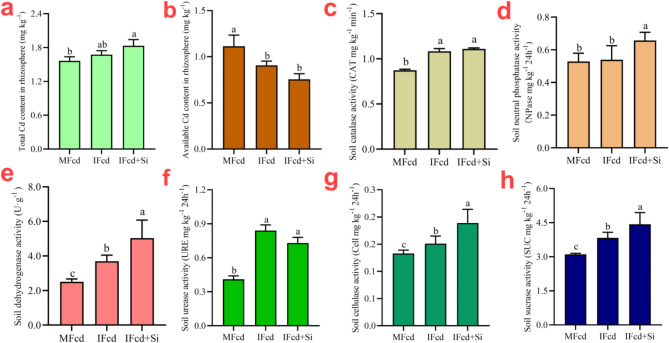
Excessive soil cadmium (Cd) and the accumulation of pathogens pose serious threats to legume growth. However, it remains unclear whether intercropping (IFcd) and its combined treatment with silicon nanoparticles (Si-NPs) (IFcd + Si) can alleviate these challenges under Cd stress, as well as the underlying mechanisms involved. This study systematically elucidated the mechanism of faba bean-wheat intercropping and Si-NPs regulating faba bean growth under Cd stress using rhizosphere metabolomics and 16 S rRNA microbiome analysis. The results showed that IFcd and IFcd + Si treatments significantly reduced Cd accumulation by 17.3% and 56.2%, and Fusarium wilt incidence by 11.1% and 33.3%, respectively, compared with monoculture faba bean (MFcd) while promoting root and plant growth. These treatments reduced oxidative stress markers, including H2O2, MDA, and O2-, and increased the activity of defense enzymes, such as SOD, APX, and POD in plants. Furthermore, they increased NH4+-N and available potassium levels in rhizosphere soils. Interestingly, the NH4+-N content increased and was significantly positively correlated with urease (URE) activity and negatively correlated with Cd. Beneficial bacteria and functional metabolites were enriched in the rhizosphere of faba bean. Joint analysis revealed increased relative abundances of Sphingomonas, Intrasporangium, and Streptomyces, which were positively correlated with antibacterial metabolites, such as sordarin, lactucin, and 15-methylpalmate. This explains the reduced Cd accumulation and Fusarium wilt in plants. These findings provide mechanistic insights into how intercropping with Si-NPs mitigates Cd stress and controls soil-borne diseases by regulating rhizosphere metabolites, bacterial communities, and plant resistance.
期刊介绍:
Journal of Nanobiotechnology is an open access peer-reviewed journal communicating scientific and technological advances in the fields of medicine and biology, with an emphasis in their interface with nanoscale sciences. The journal provides biomedical scientists and the international biotechnology business community with the latest developments in the growing field of Nanobiotechnology.





 京公网安备 11010802042870号
京ICP备2023020795号-1
京公网安备 11010802042870号
京ICP备2023020795号-1

 分享
分享
 求助内容:
求助内容: 应助结果提醒方式:
 扫码关注我们
