{"title":"The Effects of Denosumab Treatment on Pain and Function Beyond Bone Density in Patients With Postmenopausal Osteoporosis: A Prospective Study.","authors":"Miao Zheng, Xiong-Yi Wang, Ke-Yu Zhu, Si-Min Yun, Yi-Ke Wang, Cheng-Wei Weng, Dong-Zhang, Qi Wei, You-Jia Xu","doi":"10.1111/os.70032","DOIUrl":null,"url":null,"abstract":"<p><strong>Objective: </strong>Postmenopausal osteoporosis (PMOP) leads to bone loss, fragility, and fractures, causing pain and reduced function. Effective treatment should improve bone mineral density (BMD), prevent fractures, and enhance quality of life. Denosumab is FDA-approved for osteoporosis, but its effects on pain and function in Chinese patients with PMOP remain underexplored. This study investigates the impact and influencing factors of denosumab treatment on pain and function to support a broader evaluation of osteoporosis treatment.</p><p><strong>Methods: </strong>This prospective study included 200 patients with PMOP, treated at the hospital, between September 2022 and September 2023. Subjects received 60 mg of denosumab subcutaneously, and calcium and vitamin D supplements. Pain (Numerical Rating Scale, NRS), function (Oswestry Disability Index, ODI), bone metabolic markers, and BMD were assessed at baseline, 6, and 12 months posttreatment. Correlations between NRS, ODI, and BMD, and the influencing factors of efficacy differences were analyzed.</p><p><strong>Results: </strong>(1) Posttreatment, NRS scores and ODI significantly decreased. (2) Posttreatment, bone metabolic markers were significantly lower; BMD of the hip, femoral neck, and lumbar spine significantly increased from baseline but was most significant in the lumbar spine. (3) Changes in NRS and ODI positively correlated with the increase in lumbar spine BMD but not with changes in femoral neck or total hip BMD. ODI reduction was positively correlated with increases in all three sites' BMD. (4) Factors influencing NRS, ODI, and BMD of treatment include the following: patients with prior fragility fractures (mainly vertebral fractures) had greater improvements in NRS, ODI, and lumbar spine BMD than those without a history of fragility fractures; those without previous antiosteoporosis medication had a more significant increase in lumbar spine BMD than those with a history of antiosteoporosis medication use (mainly antiresorptive drugs).</p><p><strong>Conclusion: </strong>Following 12 months of denosumab treatment in patients with PMOP and increasing BMD, there was a significant improvement in pain and functional disability. The improvement in pain was closely related to the increase in lumbar spine BMD, while functional enhancement was strongly associated with BMD gains in the total hip, femoral neck, and lumbar spine. Age, weight, and osteoporosis severity do not affect treatment response. Patients with prior fragility fractures (mainly vertebral fractures) experienced more significant improvements in pain symptoms and functional outcomes. Denosumab resulted in a more significant increase in BMD in patients with a history of fragility fractures (mainly vertebral fractures) and those without a history of antiosteoporosis medication use.</p>","PeriodicalId":19566,"journal":{"name":"Orthopaedic Surgery","volume":" ","pages":"1644-1655"},"PeriodicalIF":2.1000,"publicationDate":"2025-06-01","publicationTypes":"Journal Article","fieldsOfStudy":null,"isOpenAccess":false,"openAccessPdf":"https://www.ncbi.nlm.nih.gov/pmc/articles/PMC12146127/pdf/","citationCount":"0","resultStr":null,"platform":"Semanticscholar","paperid":null,"PeriodicalName":"Orthopaedic Surgery","FirstCategoryId":"3","ListUrlMain":"https://doi.org/10.1111/os.70032","RegionNum":2,"RegionCategory":"医学","ArticlePicture":[],"TitleCN":null,"AbstractTextCN":null,"PMCID":null,"EPubDate":"2025/4/2 0:00:00","PubModel":"Epub","JCR":"Q2","JCRName":"ORTHOPEDICS","Score":null,"Total":0}
引用次数: 0
Abstract
Objective: Postmenopausal osteoporosis (PMOP) leads to bone loss, fragility, and fractures, causing pain and reduced function. Effective treatment should improve bone mineral density (BMD), prevent fractures, and enhance quality of life. Denosumab is FDA-approved for osteoporosis, but its effects on pain and function in Chinese patients with PMOP remain underexplored. This study investigates the impact and influencing factors of denosumab treatment on pain and function to support a broader evaluation of osteoporosis treatment.
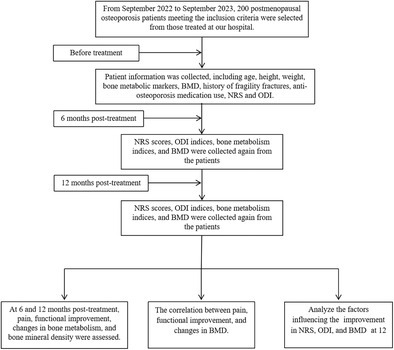
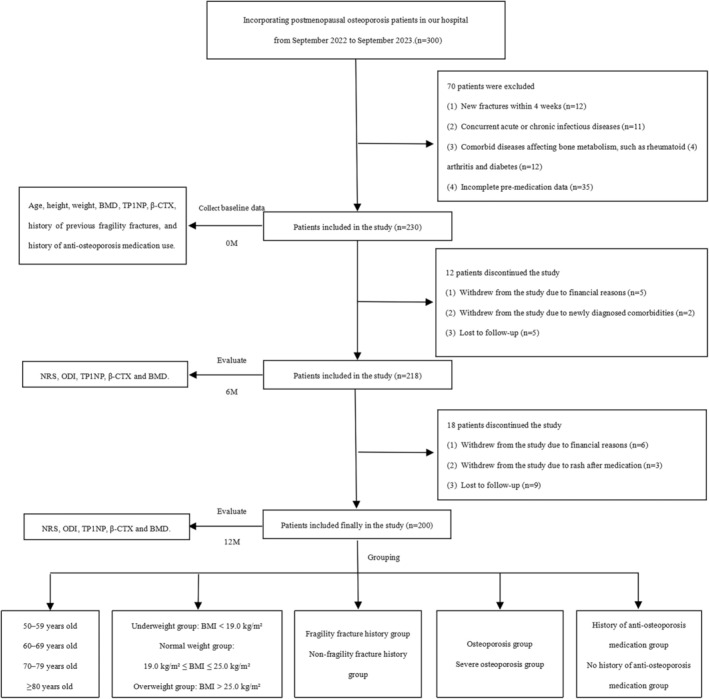
Methods: This prospective study included 200 patients with PMOP, treated at the hospital, between September 2022 and September 2023. Subjects received 60 mg of denosumab subcutaneously, and calcium and vitamin D supplements. Pain (Numerical Rating Scale, NRS), function (Oswestry Disability Index, ODI), bone metabolic markers, and BMD were assessed at baseline, 6, and 12 months posttreatment. Correlations between NRS, ODI, and BMD, and the influencing factors of efficacy differences were analyzed.
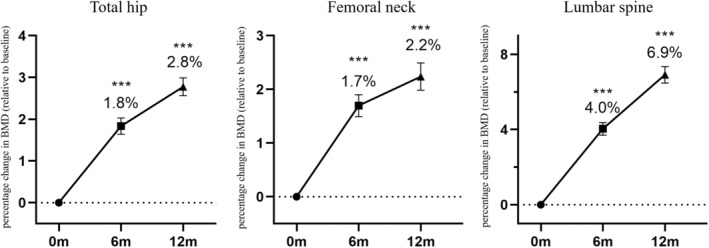
Results: (1) Posttreatment, NRS scores and ODI significantly decreased. (2) Posttreatment, bone metabolic markers were significantly lower; BMD of the hip, femoral neck, and lumbar spine significantly increased from baseline but was most significant in the lumbar spine. (3) Changes in NRS and ODI positively correlated with the increase in lumbar spine BMD but not with changes in femoral neck or total hip BMD. ODI reduction was positively correlated with increases in all three sites' BMD. (4) Factors influencing NRS, ODI, and BMD of treatment include the following: patients with prior fragility fractures (mainly vertebral fractures) had greater improvements in NRS, ODI, and lumbar spine BMD than those without a history of fragility fractures; those without previous antiosteoporosis medication had a more significant increase in lumbar spine BMD than those with a history of antiosteoporosis medication use (mainly antiresorptive drugs).
Conclusion: Following 12 months of denosumab treatment in patients with PMOP and increasing BMD, there was a significant improvement in pain and functional disability. The improvement in pain was closely related to the increase in lumbar spine BMD, while functional enhancement was strongly associated with BMD gains in the total hip, femoral neck, and lumbar spine. Age, weight, and osteoporosis severity do not affect treatment response. Patients with prior fragility fractures (mainly vertebral fractures) experienced more significant improvements in pain symptoms and functional outcomes. Denosumab resulted in a more significant increase in BMD in patients with a history of fragility fractures (mainly vertebral fractures) and those without a history of antiosteoporosis medication use.
期刊介绍:
Orthopaedic Surgery (OS) is the official journal of the Chinese Orthopaedic Association, focusing on all aspects of orthopaedic technique and surgery.
The journal publishes peer-reviewed articles in the following categories: Original Articles, Clinical Articles, Review Articles, Guidelines, Editorials, Commentaries, Surgical Techniques, Case Reports and Meeting Reports.



 京公网安备 11010802042870号
京ICP备2023020795号-1
京公网安备 11010802042870号
京ICP备2023020795号-1

 分享
分享
 求助内容:
求助内容: 应助结果提醒方式:
 扫码关注我们
