{"title":"Time Wasters Facing Nurses During Work in Hospital Departments.","authors":"Mohammad Qtait","doi":"10.1177/23779608251328278","DOIUrl":null,"url":null,"abstract":"<p><strong>Introduction: </strong>The authorities of healthcare and treatment worldwide are seeking to use available resources in a way that prevents any waste of money or time, as time is, of course, convertible to money.</p><p><strong>Objective: </strong>The objective of the study is to assess the time wasters facing nurses in the work department.</p><p><strong>Method: </strong>A cross-sectional study was conducted involving surgical and medical ward nurses from hospitals in the West Bank. A structured questionnaire was administered to 200 nurses.</p><p><strong>Results: </strong>The participants' sociodemographic characteristics indicated that nurses were almost equal in terms of gender (females: 51%). Seventy-four percent were young, with ages ranging from 25 to 34 years and work experience ranging from 6 to 10 years. Most of the participants (71.6%) held a bachelor's degree. More time was wasted by nurses during work, with an overall mean of 3.4 (medium). The activity thought to waste the most time in hospital care was moving around between patients' rooms, the nursing station, and the restroom, which may delay required tasks. Other time-wasting activities included using phones and social media, waiting for physicians to provide medication orders, post-round information, discharge orders, and other necessary details, communicating with patient relatives, and searching for supplies or equipment and returning them.</p><p><strong>Conclusion: </strong>The hospital working environment is complex, and opportunities for improving the efficiency of nurses' workloads should be analyzed case by case in each hospital and workgroup. Modifications to reduce the time wasted waiting in wards, straightforward creative solutions to minimize the time spent searching for necessary equipment, the use of Hospital Information System technology for communication and documentation, and better ward design to decrease time wasted moving between the ward and the restroom could all be beneficial for increasing productivity and providing safer, more acceptable care.</p>","PeriodicalId":43312,"journal":{"name":"SAGE Open Nursing","volume":"11 ","pages":"23779608251328278"},"PeriodicalIF":2.5000,"publicationDate":"2025-03-31","publicationTypes":"Journal Article","fieldsOfStudy":null,"isOpenAccess":false,"openAccessPdf":"https://www.ncbi.nlm.nih.gov/pmc/articles/PMC11960182/pdf/","citationCount":"0","resultStr":null,"platform":"Semanticscholar","paperid":null,"PeriodicalName":"SAGE Open Nursing","FirstCategoryId":"1085","ListUrlMain":"https://doi.org/10.1177/23779608251328278","RegionNum":0,"RegionCategory":null,"ArticlePicture":[],"TitleCN":null,"AbstractTextCN":null,"PMCID":null,"EPubDate":"2025/1/1 0:00:00","PubModel":"eCollection","JCR":"Q2","JCRName":"NURSING","Score":null,"Total":0}
引用次数: 0
Abstract
Introduction: The authorities of healthcare and treatment worldwide are seeking to use available resources in a way that prevents any waste of money or time, as time is, of course, convertible to money.
Objective: The objective of the study is to assess the time wasters facing nurses in the work department.
Method: A cross-sectional study was conducted involving surgical and medical ward nurses from hospitals in the West Bank. A structured questionnaire was administered to 200 nurses.
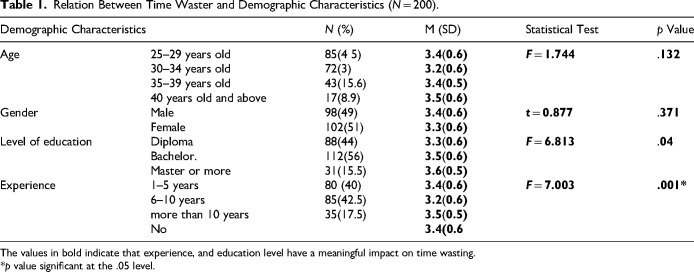
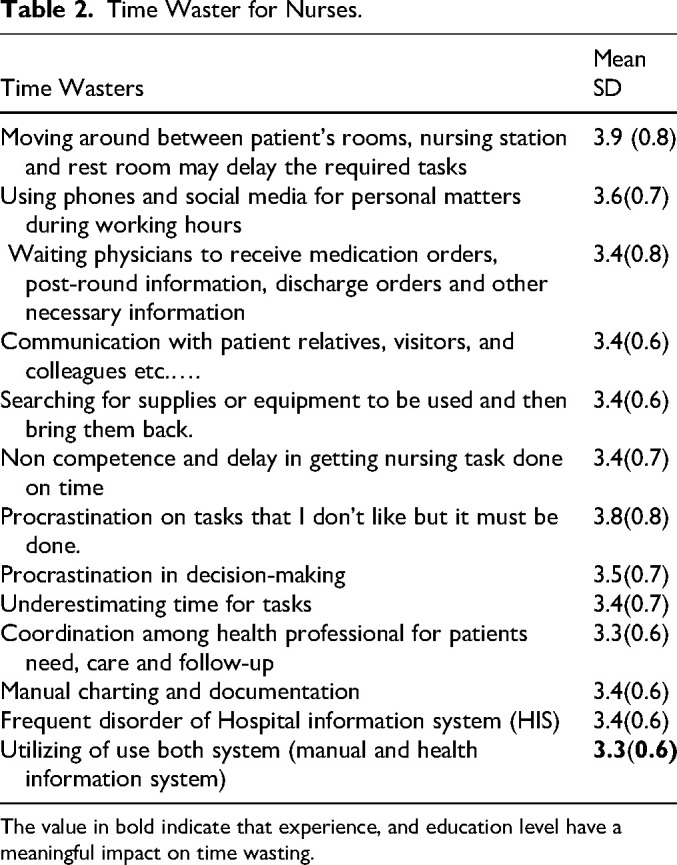
Results: The participants' sociodemographic characteristics indicated that nurses were almost equal in terms of gender (females: 51%). Seventy-four percent were young, with ages ranging from 25 to 34 years and work experience ranging from 6 to 10 years. Most of the participants (71.6%) held a bachelor's degree. More time was wasted by nurses during work, with an overall mean of 3.4 (medium). The activity thought to waste the most time in hospital care was moving around between patients' rooms, the nursing station, and the restroom, which may delay required tasks. Other time-wasting activities included using phones and social media, waiting for physicians to provide medication orders, post-round information, discharge orders, and other necessary details, communicating with patient relatives, and searching for supplies or equipment and returning them.
Conclusion: The hospital working environment is complex, and opportunities for improving the efficiency of nurses' workloads should be analyzed case by case in each hospital and workgroup. Modifications to reduce the time wasted waiting in wards, straightforward creative solutions to minimize the time spent searching for necessary equipment, the use of Hospital Information System technology for communication and documentation, and better ward design to decrease time wasted moving between the ward and the restroom could all be beneficial for increasing productivity and providing safer, more acceptable care.




 京公网安备 11010802042870号
京ICP备2023020795号-1
京公网安备 11010802042870号
京ICP备2023020795号-1

 分享
分享
 求助内容:
求助内容: 应助结果提醒方式:
 扫码关注我们
