Spyridon Sioutis, Stylianos Kolovos, Maria-Eleni Papakonstantinou, Pavlos Altsitzioglou, Maria Polyzou, Konstantinos Chlapoutakis, Vasileios Karampikas, Panayiotis Gavriil, Evanthia Mitsiokapa, Dimitrios Koulalis, Panayiotis J Papagelopoulos, Andreas F Mavrogenis
{"title":"Impact of probe tilt on Graf ultrasonography accuracy for neonatal hip dysplasia screening.","authors":"Spyridon Sioutis, Stylianos Kolovos, Maria-Eleni Papakonstantinou, Pavlos Altsitzioglou, Maria Polyzou, Konstantinos Chlapoutakis, Vasileios Karampikas, Panayiotis Gavriil, Evanthia Mitsiokapa, Dimitrios Koulalis, Panayiotis J Papagelopoulos, Andreas F Mavrogenis","doi":"10.1051/sicotj/2025016","DOIUrl":null,"url":null,"abstract":"<p><strong>Background/objective: </strong>Developmental Dysplasia of the Hip (DDH) is the most common congenital musculoskeletal disease of the infantile age. The gold standard for early diagnosis of the disease is the Graf ultrasound method. In our study, we examined the correlation between age of the examined infant and diagnostic errors due to the ultrasound probe tilt effect during examination.</p><p><strong>Methods: </strong>Forty-two newborns who underwent ultrasound examination with the Graf method, were included. We categorized the neonates into three age groups (Group#1: 0-1 weeks, Group#2: 3-4 weeks, Group#3: 5-6weeks). Two ultrasound examinations were performed in every group. In the first examination, images were obtained with the probe in vertical position. In the second examination, images were taken with a 10° caudocranial tilt of the probe. Our aim was to measure the α angle in both examination and to mention the possible Type changes according to the Graf classification. The α angle defines the osseous coverage of the femoral head from the acetabulum in the neonatal hip joint.</p><p><strong>Results: </strong>In many cases, the classification changed from type I to type IIa or D and from type IIa to D, when instead of the vertical acquisition, the ultrasound probe was placed in a 10° caudocranial tilt at the hip joint of the examined infant. At Group#1 of the study we observed 60 Graf classification Type changes (90.91%), while in Group#2 and Group#3 we had 18 (33.33%) and 3 (7.96%) Type changes respectively.</p><p><strong>Conclusion: </strong>As the age of the examined newborns increases, measurement and classification errors due to the tilt effect are significantly reduced. Clinically, the examination will be even more accurate and the use of an incorrect therapeutic approach due to incorrect classification will be avoided. Finally, the optimal time for conducting an ultrasonographic examination is between the 5th and 6th week of life.</p>","PeriodicalId":46378,"journal":{"name":"SICOT-J","volume":"11 ","pages":"22"},"PeriodicalIF":2.3000,"publicationDate":"2025-01-01","publicationTypes":"Journal Article","fieldsOfStudy":null,"isOpenAccess":false,"openAccessPdf":"https://www.ncbi.nlm.nih.gov/pmc/articles/PMC11961070/pdf/","citationCount":"0","resultStr":null,"platform":"Semanticscholar","paperid":null,"PeriodicalName":"SICOT-J","FirstCategoryId":"1085","ListUrlMain":"https://doi.org/10.1051/sicotj/2025016","RegionNum":0,"RegionCategory":null,"ArticlePicture":[],"TitleCN":null,"AbstractTextCN":null,"PMCID":null,"EPubDate":"2025/4/1 0:00:00","PubModel":"Epub","JCR":"Q2","JCRName":"ORTHOPEDICS","Score":null,"Total":0}
引用次数: 0
Abstract
Background/objective: Developmental Dysplasia of the Hip (DDH) is the most common congenital musculoskeletal disease of the infantile age. The gold standard for early diagnosis of the disease is the Graf ultrasound method. In our study, we examined the correlation between age of the examined infant and diagnostic errors due to the ultrasound probe tilt effect during examination.
Methods: Forty-two newborns who underwent ultrasound examination with the Graf method, were included. We categorized the neonates into three age groups (Group#1: 0-1 weeks, Group#2: 3-4 weeks, Group#3: 5-6weeks). Two ultrasound examinations were performed in every group. In the first examination, images were obtained with the probe in vertical position. In the second examination, images were taken with a 10° caudocranial tilt of the probe. Our aim was to measure the α angle in both examination and to mention the possible Type changes according to the Graf classification. The α angle defines the osseous coverage of the femoral head from the acetabulum in the neonatal hip joint.
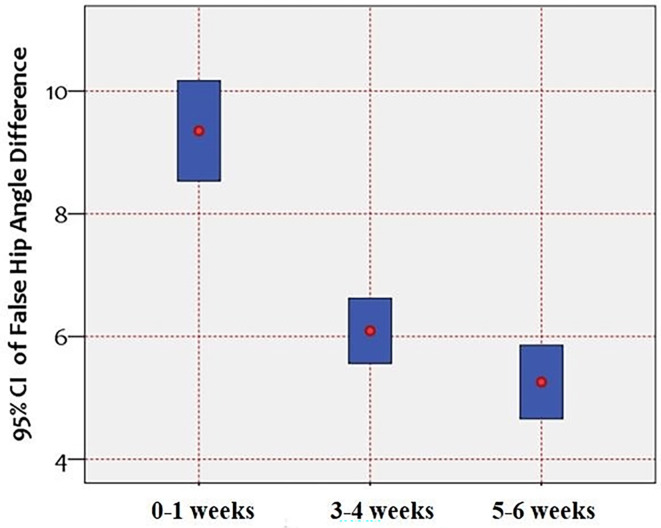
Results: In many cases, the classification changed from type I to type IIa or D and from type IIa to D, when instead of the vertical acquisition, the ultrasound probe was placed in a 10° caudocranial tilt at the hip joint of the examined infant. At Group#1 of the study we observed 60 Graf classification Type changes (90.91%), while in Group#2 and Group#3 we had 18 (33.33%) and 3 (7.96%) Type changes respectively.
Conclusion: As the age of the examined newborns increases, measurement and classification errors due to the tilt effect are significantly reduced. Clinically, the examination will be even more accurate and the use of an incorrect therapeutic approach due to incorrect classification will be avoided. Finally, the optimal time for conducting an ultrasonographic examination is between the 5th and 6th week of life.






 京公网安备 11010802042870号
京ICP备2023020795号-1
京公网安备 11010802042870号
京ICP备2023020795号-1

 分享
分享
 求助内容:
求助内容: 应助结果提醒方式:
 扫码关注我们
